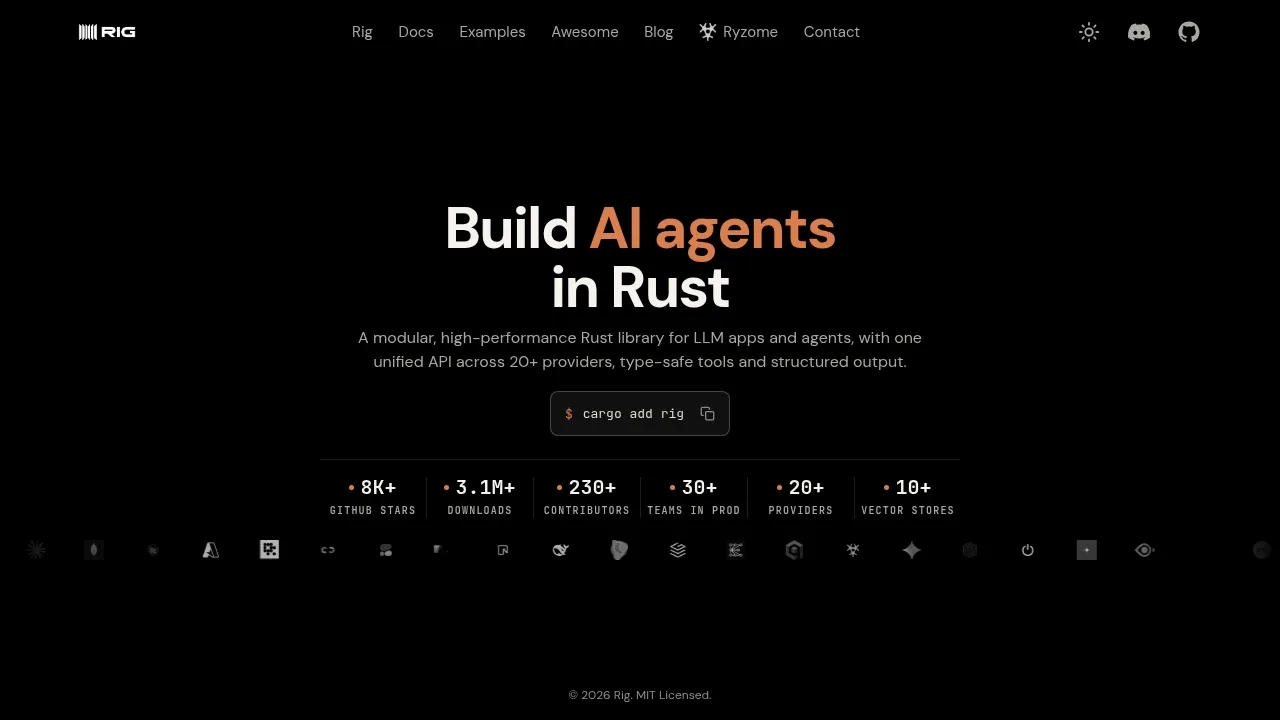
Rig is a Rust library for developers building AI agents and LLM applications with local or cloud models. Its unified API covers model providers and vector stores, so applications can share the same abstractions across backends. It's open source under MIT.
For local AI, its Candle integration supports Llama, SmolLM2 and Qwen3. FastEmbed provides another embedding integration. Cloud connections include AWS Bedrock, Google Vertex AI and Google Gemini gRPC; those model calls go to external services, while Candle runs models locally. Rig is a library you incorporate into your own application, rather than a standalone chat app.
Agents can call type-safe tools, return structured output and handle multi-turn conversations with streaming responses. Completion and embedding workflows sit alongside support for transcription, audio generation and image generation, depending on the model backend. Conversation memory and history policies help manage context across turns.
For applications that search their own documents, Rig includes an in-memory vector store and integrations with Qdrant, LanceDB, PostgreSQL, Milvus and other databases. Recording and replay support lets developers capture agent execution and check replay compatibility, with checkpoints for execution state.
The portable core and classic agent runtime also support browser WebAssembly. MCP support runs only in native applications, and WASI isn't supported.
Claim this page with an email at rig.rs. Rig gets the verified badge, and you can upgrade the listing to be featured on localhosted. Proud to be listed? Put our badge on your site.
Want more people to find Rig?Promote it
Something wrong or outdated on this page?
6.5KUpdated 17 hours agoApache-2.0
Web#LLM tracing#Multimodal input#Ollama integration
Genkit is Google's open-source framework for developers building AI applications and agents with local or cloud models. Its shared API connects to Ollama as well as hosted providers such as Gemini, OpenAI and Anthropic. You can host the application logic yourself. The framework uses the Apache 2.0 license.
711Updated 1 month agoMIT
Web#Agent Skills#Code execution#Git integration
9.4KUpdated 2 hours agoApache-2.0
macOS · Windows · Linux · iOS · Android · Web#Batch processing#LLM tracing#Structured output
3.2KUpdated 16 hours agoApache-2.0
macOS · Linux · Web#Agent Client Protocol#Agent Skills#MCP
3.9KUpdated 1 week agoApache-2.0
Docker · Web#Distributed execution#LoRA#MCP
1.7KUpdated 3 weeks agoApache-2.0
#Agent Skills#Code execution#Guardrails
GitAgent is an MIT-licensed, open-source AI agent framework for developers who want to keep an agent's behavior and memory under version control. It runs locally, with its configuration, personality, rules and saved memory stored as files in a Git repository. That makes changes reviewable through diffs and history, and lets teams fork an agent or maintain different behaviors on separate branches.
BAML is a programming language for developers building AI agents, with typed model calls and local tracing built into the language. It runs standalone on macOS, Linux and Windows, or alongside an existing application. The language is open source under Apache 2.0, and works offline.
fx is an open source coding assistant that runs as a small native program in your terminal and connects to local or cloud models. It's aimed at developers who prefer a shell-style interface, and researchers building agents into larger systems. Written in Zig and licensed under Apache 2.0, it runs without a background service.
LazyLLM is a Python framework for developers building multi-agent applications with locally deployed models or cloud services. It combines application assembly with data preparation, evaluation and model fine-tuning, so developers can test a prototype and improve the parts that perform poorly. It's open source under Apache 2.0.
Agently is an open-source Python framework for engineering teams building AI service backends on their own infrastructure. It focuses on turning model responses into validated data and controlled actions that business applications can use. The framework runs in your application; requests go to the model provider you connect, including external services.