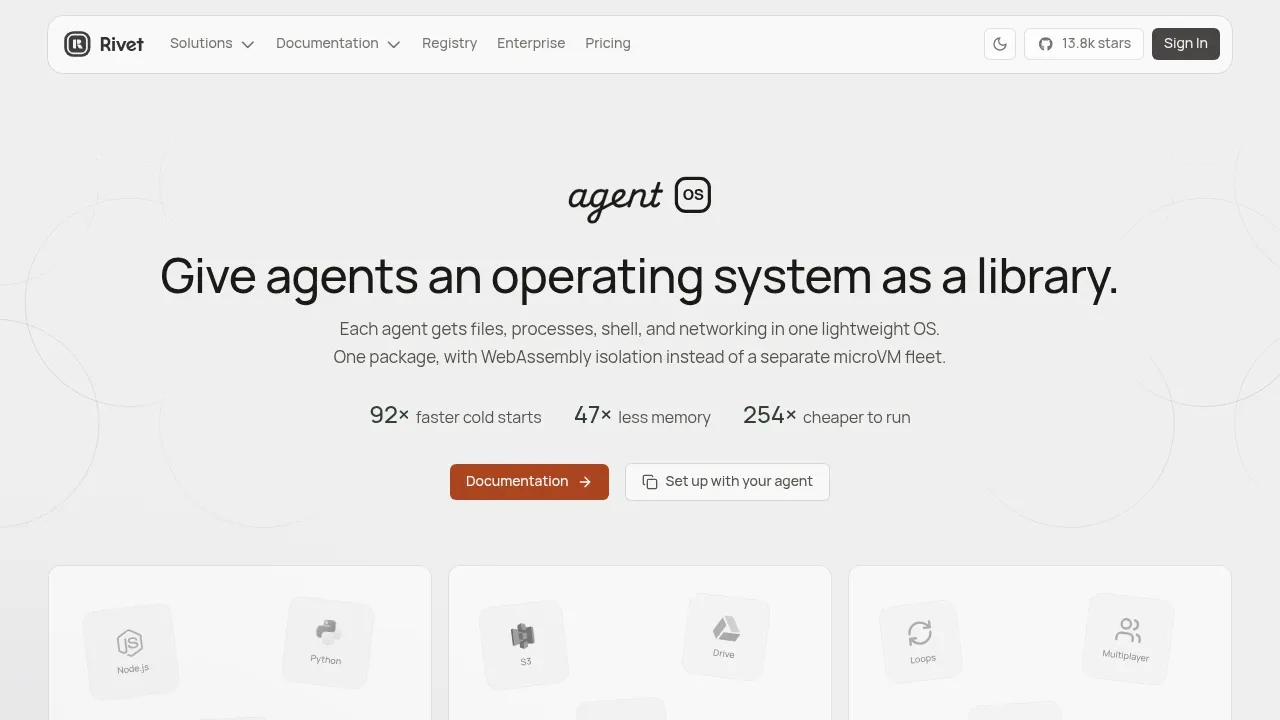
Rivet AgentOS gives AI agents an isolated working environment inside an existing backend process. It's for developers building agent applications who want to run workloads on their own hardware or servers without managing a separate virtual machine for every agent. The runtime uses WebAssembly and V8 isolates and runs on standard Linux infrastructure without nested virtualization.
Each agent has a persistent filesystem, processes, a shell and permission-controlled networking. Agents can execute Bash, Python and Node.js, with Node.js running directly on V8. Storage mounts let them work with host directories, S3 and Google Drive through ordinary file paths. Typed host functions connect agents to backend capabilities while credentials stay on the host. A full Linux sandbox can be attached for workloads that need native binaries or heavy compilation.
AgentOS works with Pi, Claude Code, Codex and OpenCode, or agents you build yourself. Rivet Actors provide durable identity and state, while Workflows record completed operations so multi-step tasks can wait, retry and resume. Human review can pause permission requests for approval in your application's UI. Idle environments sleep and wake when work arrives; resource limits bound memory, processes and execution time.
The project is open source under Apache 2.0. You can run it locally and self-host the control plane as a Rust binary or container. Rivet Cloud provides managed hosting and persisted Actor data. Rivet also offers managed deployment inside your own VPC, where data stays within your cloud.
Claim this page with an email at agentos-sdk.dev. Rivet AgentOS gets the verified badge, and you can upgrade the listing to be featured on localhosted. Proud to be listed? Put our badge on your site.
Want more people to find Rivet AgentOS?Promote it
Something wrong or outdated on this page?
3.2KUpdated 16 hours agoApache-2.0
macOS · Linux · Web#Agent Client Protocol#Agent Skills#MCP
fx is an open source coding assistant that runs as a small native program in your terminal and connects to local or cloud models. It's aimed at developers who prefer a shell-style interface, and researchers building agents into larger systems. Written in Zig and licensed under Apache 2.0, it runs without a background service.
29.8KUpdated 20 hours agoMIT
macOS · Windows · Linux#Code execution#Guardrails#Human approval
201Updated 3 months agoMIT
macOS · Linux#Distributed execution#Guardrails#Human approval
27.6KUpdated 1 day agoMIT
macOS · Windows · Linux#Code execution#MCP#Tool calling
13.7KUpdated 8 hours agoApache-2.0
macOS · Windows · Linux · Docker#Agent Skills#Code execution#Guardrails
OpenShell is a self-hosted runtime for teams running autonomous AI agents that need access to files, APIs and credentials. It runs agents in sandboxes with kernel-level isolation and explicit access policies. It's open source under Apache 2.0 and supports Linux and macOS on Apple Silicon, with Docker, Podman or host virtualization.
28.6KUpdated 1 day agoMIT
macOS · Windows · Linux#LM Studio integration#MCP#Multi-agent workflows
OpenAI Agents SDK is an open-source Python framework for developers building AI apps that need to use tools, delegate tasks, or work across multiple steps. Its runtime manages agent turns and conversation state while letting developers express workflows in ordinary Python. It uses the MIT license.
claudectl is a local dashboard and supervisor for developers running several Claude Code agents on macOS or Linux. It brings session activity, approvals and spending into one terminal view, with an optional local LLM that makes decisions based on your preferences. It's open source under the MIT license.
Cua gives AI agents access to computers they can inspect and operate, with tools for desktop automation, local virtual machines, and hosted fleets. It's for developers building agents that work across native apps and browsers, or evaluating how well those agents complete computer tasks. You bring the agent and model.
Semantic Kernel is an MIT-licensed SDK for developers adding AI agents to their applications. It supports local models through Ollama, LMStudio and ONNX, alongside cloud services such as OpenAI and Azure OpenAI. You choose the model backend. The SDK runs on Windows, macOS and Linux and supports C#, Python and Java.