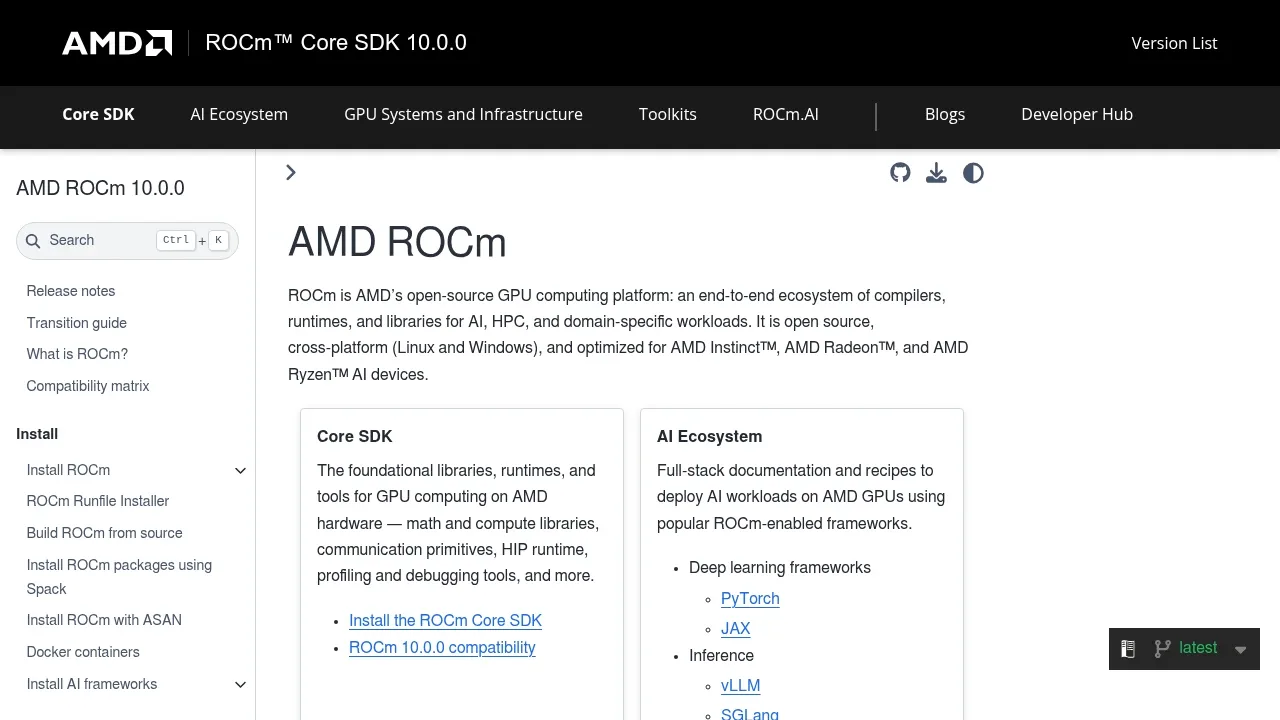
ROCm is AMD's open-source GPU computing platform for developers running AI training, inference and scientific workloads on their own hardware or servers. It supports selected Linux and Windows configurations on AMD Instinct, Radeon and Ryzen AI devices. Check the version-specific GPU, operating-system, driver and firmware compatibility matrix before installing. It's the software foundation for applications that need AMD GPU acceleration, including local LLM workloads.
Its AI ecosystem supports PyTorch and JAX, with vLLM and SGLang for inference. Developers can use these frameworks alongside GPU math libraries and communication libraries for workloads that span multiple GPUs. ROCm also supports TensorFlow.
For developers writing GPU code, HIP provides a C++ programming interface similar to NVIDIA CUDA and supports portable GPU code. ROCm also supports OpenMP and OpenCL. The Core SDK brings together compilers, runtimes and compute libraries, plus profiling and debugging tools for finding performance bottlenecks and diagnosing failures.
ROCm covers deployments beyond a single workstation. Its infrastructure tools support GPU monitoring, partitioning, virtualization and containers, with Kubernetes integration through the Network Operator. The platform also supports cloud deployments, so where a workload runs depends on the infrastructure you choose.
Domain-specific toolkits include ROCm Data Science, Finance, Life Science, LLMExt and Simulation. Components have their own licenses. The MIT-licensed legacy-rocm-build repository directs new build work to ROCm/TheRock.
Claim this page with an email at rocm.docs.amd.com. ROCm gets the verified badge, and you can upgrade the listing to be featured on localhosted. Proud to be listed? Put our badge on your site.
Want more people to find ROCm?Promote it
Something wrong or outdated on this page?
2.3KUpdated 1 day agoMPL-2.0
macOS · Windows · Linux · Docker#Agent Skills#Batch processing#Multi-user access
dstack is a self-hosted orchestration tool for AI teams managing compute across GPU clouds and their own servers. It puts cluster management, training jobs and model inference behind one interface, so teams can use different providers and accelerators without maintaining a separate workflow for each environment. It's open source under the Mozilla Public License 2.0.
223Updated 16 hours agoApache-2.0
macOS · Linux#GGUF#Git integration#Guardrails
49.3KUpdated 2 hours agoMIT
macOS · Linux · Docker · Web#Code execution#Human approval#llama.cpp backend
798Updated 1 month agoApache-2.0
Linux
NVIDIA DCGM monitors and manages NVIDIA data-center GPUs on your own Linux servers. It's for infrastructure teams running GPU clusters, including those hosting AI workloads, who need to track hardware health, investigate slow jobs and control power use. It supports x86_64 and aarch64 (SBSA) systems.
5.1KUpdated 20 hours agoApache-2.0
#Batch processing#Distributed execution#LoRA
6.9KUpdated 2 days agoApache-2.0
Docker · Web#Code execution#Git integration#Multi-user access
LLMKube is a free, open-source Kubernetes operator for teams and homelab owners running local LLM inference across their own hardware. It manages Linux GPU servers and Apple Silicon Macs together, so a mixed fleet can serve models through the same platform. It uses the Apache 2.0 license.
LocalAI runs language models, speech, vision and image generation on hardware you control. It's for developers and teams that want a self-hosted AI server for their apps without sending model requests to a cloud service. Its OpenAI-compatible API works with existing clients, and it also accepts Anthropic, Ollama and ElevenLabs API calls.
AIBrix is open-source infrastructure for teams serving large language models on their own Kubernetes clusters. It focuses on the work around inference: directing requests, scaling capacity and managing models across servers. Enterprise infrastructure teams can use its components to build a self-hosted model service. It's licensed under Apache 2.0.
ClearML is an MLOps suite for recording experiments, managing datasets and running ML workloads. Its Apache 2.0 Python SDK connects to a ClearML Server, available as a hosted service or open-source software you deploy yourself. ClearML Agent handles job orchestration and reproducibility.