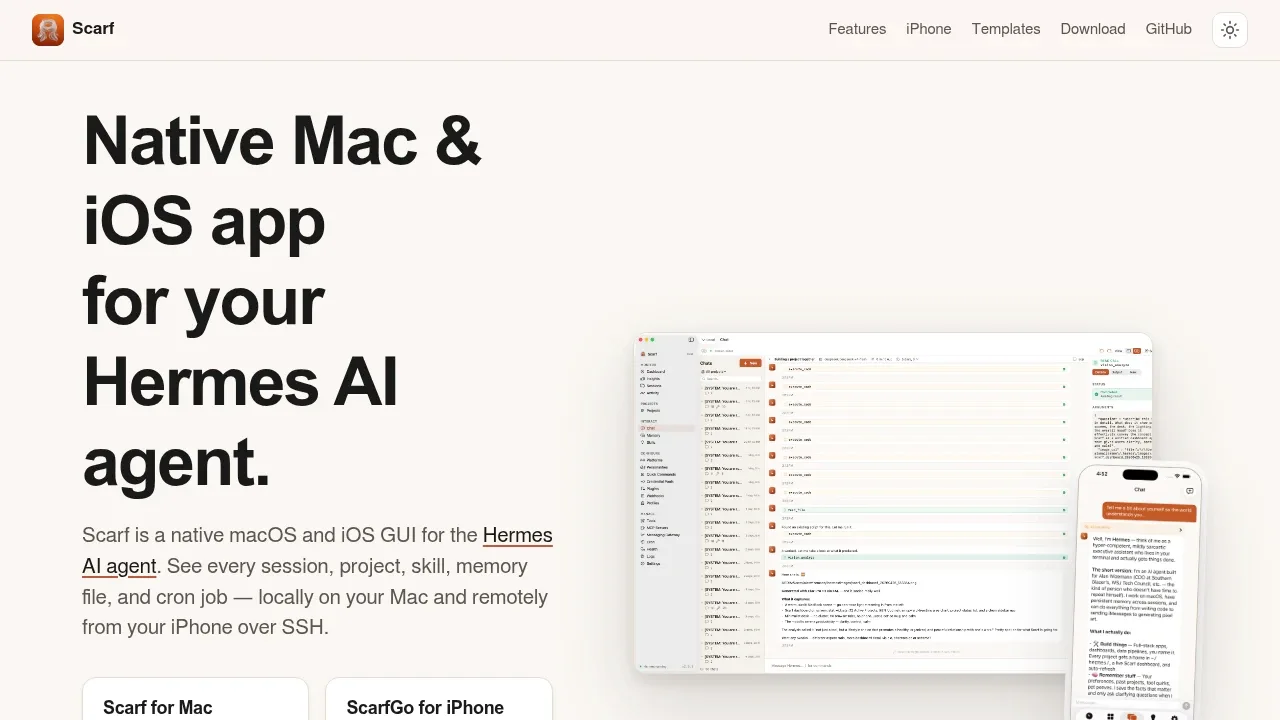
Scarf gives people running the Hermes AI agent a native Mac interface for chat, project work, and server management. Its iPhone companion, ScarfGo, connects directly to Hermes hosts over SSH without a separate relay service. Both apps are free and open source under the MIT license. Hermes must already be installed.
Chat streams replies as they arrive, shows tool calls and reasoning, and lets you approve or deny tool requests. You can resume earlier conversations and search session history. Project workspaces keep chats tied to a working directory, with custom dashboards and shareable templates for project context, skills, and scheduled jobs.
The management interface covers memory editing, Skills Hub browsing, MCP servers, cron jobs, and messaging gateways such as Telegram, Discord, and Slack. Usage views break down tokens and costs by model and platform. Local-model discovery works with Ollama, LM Studio, vLLM, and llama.cpp on local or remote hosts.
Scarf runs on macOS 14.6 or later with Apple Silicon or Intel; ScarfGo requires iOS 18 or later. Both use Swift and SwiftUI rather than Electron. The Mac app can read local Hermes data offline, though model providers, remote hosts, and MCP services may need a network connection. Neither app requires an account.
Conversation history stays on the Hermes host. Scarf opens the session database read-only, and ScarfGo reads it over SSH without caching transcripts on the phone. Optional GPT-Live voice conversations send audio and recent chat context directly to OpenAI, with consent before the first session.
The Mac app collects anonymous usage statistics by default. You can disable them in Settings → Advanced → Usage Analytics. ScarfGo on iOS collects no usage statistics.
Claim this page and we'll verify you by hand. Scarf gets the verified badge, and you can upgrade the listing to be featured on localhosted. Proud to be listed? Put our badge on your site.
Want more people to find Scarf?Promote it
Something wrong or outdated on this page?
141Updated 22 hours ago
macOS · Windows · Linux · iOS · Web#Agent Skills#Code execution#Human approval
Bloks is a desktop workspace for people who want personal AI agents on their own computer, with conversations arranged like a messaging app. Agents appear as contacts, and shared rooms let them work together. It runs on macOS, Windows and Linux. The desktop app needs no Bloks account and is source-available under FSL-1.1-MIT.
1.3KUpdated 2 days agoApache-2.0
macOS · Windows · Linux · iOS · Android · Web#Code execution#LM Studio integration#MCP
4.1KUpdated 4 days agoAGPL-3.0
macOS · Windows · Linux · iOS · Android#Agent Skills#Code execution#Human approval
3.2KUpdated 5 days agoMIT
macOS · Windows · Linux · iOS · Android#GGUF#Human approval#LM Studio integration
noemaai.comChat With Your Documents
macOS · iOS#GGUF#MCP#MLX
391.1KUpdated 11 hours ago
macOS · Windows · Linux · iOS · Android · Docker#Multi-user access#Persistent memory#Tool calling
Kai 9000 is an open-source personal AI assistant that can turn responses into interactive screens, including quizzes, recipe cards and dashboards. It's for people who want an assistant that remembers their preferences and can act through tools, with apps for Android, iOS, Windows, macOS, Linux and the web.
Kelivo is a free, open-source LLM chat client for people who want to use local and cloud models in the same app while keeping their conversation history on their own device. It connects to Ollama, self-hosted OpenAI-compatible endpoints, and providers such as OpenAI, Gemini, Claude, DeepSeek and OpenRouter. The app runs on Android, iOS, HarmonyOS, Windows, macOS and Linux, including Apple Silicon and Intel Macs.
Off Grid AI runs language models on iOS, Android, macOS, Windows and Linux. You can chat, analyze documents and generate images on your own hardware. The mobile app uses the MIT license, while the desktop app uses AGPL.
Noema is a private local AI assistant for iPhone, iPad, Mac, and Vision Pro. It's for people who want to chat with models and work with their own files on Apple hardware without depending on a cloud service. Local chats can stay on your device, and file retrieval runs there too.
OpenClaw is a self-hosted AI assistant that connects your own computer to the messaging services you already use. It's for people who want a personal assistant on their laptop, or teams that want to run a shared assistant on their own hardware. The project is open source under the MIT license.