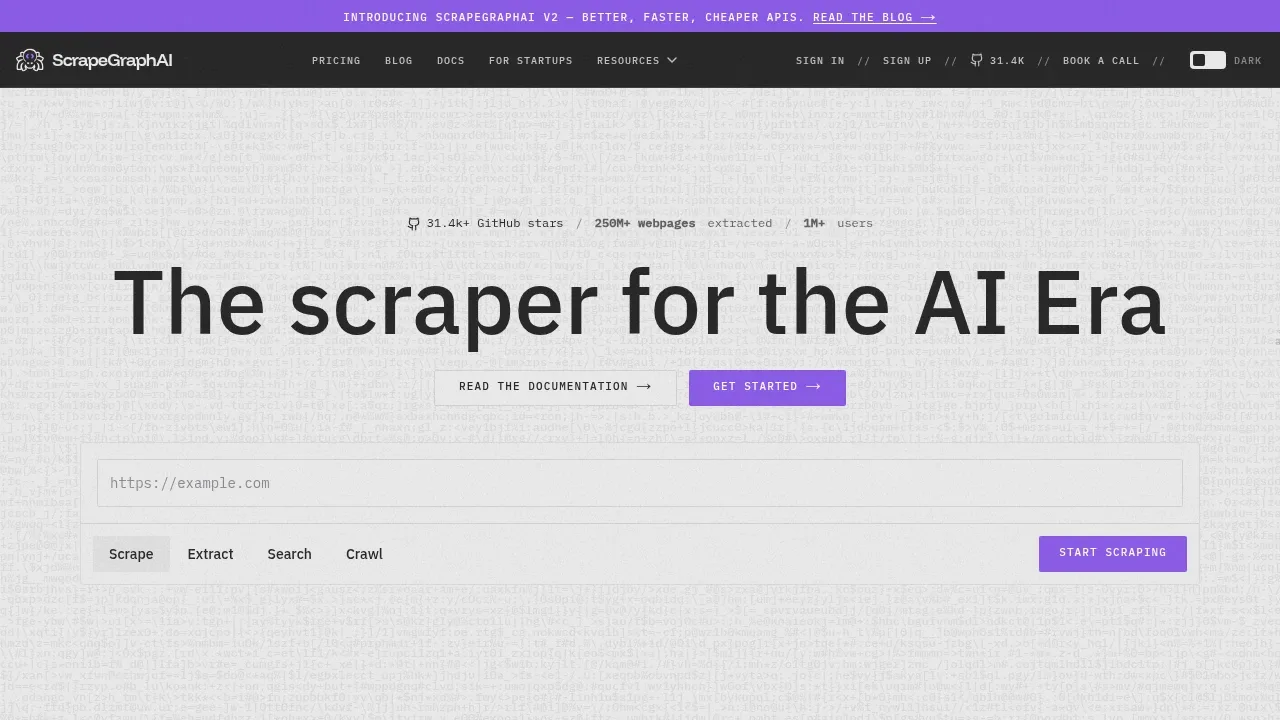
ScrapeGraphAI is an AI web scraping tool for developers who want to describe the data they need in plain language. Its open-source Python library runs on your own infrastructure under the MIT license. A separate managed API runs in ScrapeGraphAI's cloud.
The library extracts information from websites and local documents, including XML, HTML, JSON and Markdown. It uses LLMs and graph-based pipelines to turn a request into data extraction, with a standard pipeline for pulling information from a single page. This approach suits projects where writing page-specific selectors would add work.
You choose the model backend. The self-hosted library supports local LLMs through Ollama, alongside OpenAI, Groq, Gemini and Azure. With Ollama, model inference runs locally; choosing a cloud provider sends model requests to that service. The package collects anonymous usage metrics, which you can disable. Website scraping still involves accessing the target site.
The two offerings divide responsibility differently. With the library, you manage Playwright browser rendering, proxies, anti-bot handling and infrastructure. The hosted API manages those parts and the LLM, with Python and Node.js SDKs for calling the service.
Integrations include LangChain, LlamaIndex and Crew.ai for LLM applications, plus n8n, Dify and Zapier for workflow automation. ScrapeGraphAI also provides an MCP server.
Claim this page with an email at scrapegraphai.com. ScrapeGraphAI gets the verified badge, and you can upgrade the listing to be featured on localhosted. Proud to be listed? Put our badge on your site.
Want more people to find ScrapeGraphAI?Promote it
Something wrong or outdated on this page?
8.5KUpdated 23 hours agoApache-2.0
Web#LLM tracing#MCP#Multimodal input
Bifrost is a self-hosted AI gateway for developers and teams whose applications use multiple model providers. It puts Ollama, custom model deployments, and cloud services behind one OpenAI-compatible API, so applications can switch models without maintaining a separate integration for each provider.
31.3KUpdated 1 day agoApache-2.0
Docker#Hybrid search#Knowledge graphs#llama.cpp backend
9.4KUpdated 2 days agoMIT
macOS · Windows · Linux · Android · Docker · Web#Batch processing#LM Studio integration#MCP
30.4KUpdated 17 hours agoMIT
#MCP#Tool calling
Composio connects AI assistants and custom agents to apps such as Gmail, Slack, GitHub, and Linear. It's for people who want their assistant to act on requests across apps, and developers who don't want to maintain each integration themselves. Its CLI gives coding agents a local interface; the standard setup uses Composio's hosted authentication and execution service. It requires an account and internet access.
62.5KUpdated 1 day agoMIT
#MCP#RAG#Tool calling
27.3KUpdated 20 hours agoMIT
macOS · Windows · Linux#Code execution#MCP#Tool calling
Graphiti is a self-hosted Python framework for developers building AI agents that need to remember changing facts. It builds knowledge graphs from conversations, structured records and unstructured text, so an agent can query current information or recover what was true earlier. It's open source under Apache 2.0.
xberg, formerly Kreuzberg, is a local document extraction engine for developers building AI search, document processing, and retrieval-augmented generation applications. It reads PDFs, Office files, scanned images, email, and nested archives, extracting text, tables, images, and metadata through one shared engine. It's open source under MIT.
Context7 brings current library documentation and code examples into an AI coding assistant's context. It's for developers who want answers grounded in the libraries and versions they're actually using, rather than an assistant's older training data. It works with Claude Code, Codex, Cursor, Devin Desktop and Antigravity.
Cua gives AI agents access to computers they can inspect and operate, with tools for desktop automation, local virtual machines, and hosted fleets. It's for developers building agents that work across native apps and browsers, or evaluating how well those agents complete computer tasks. You bring the agent and model.