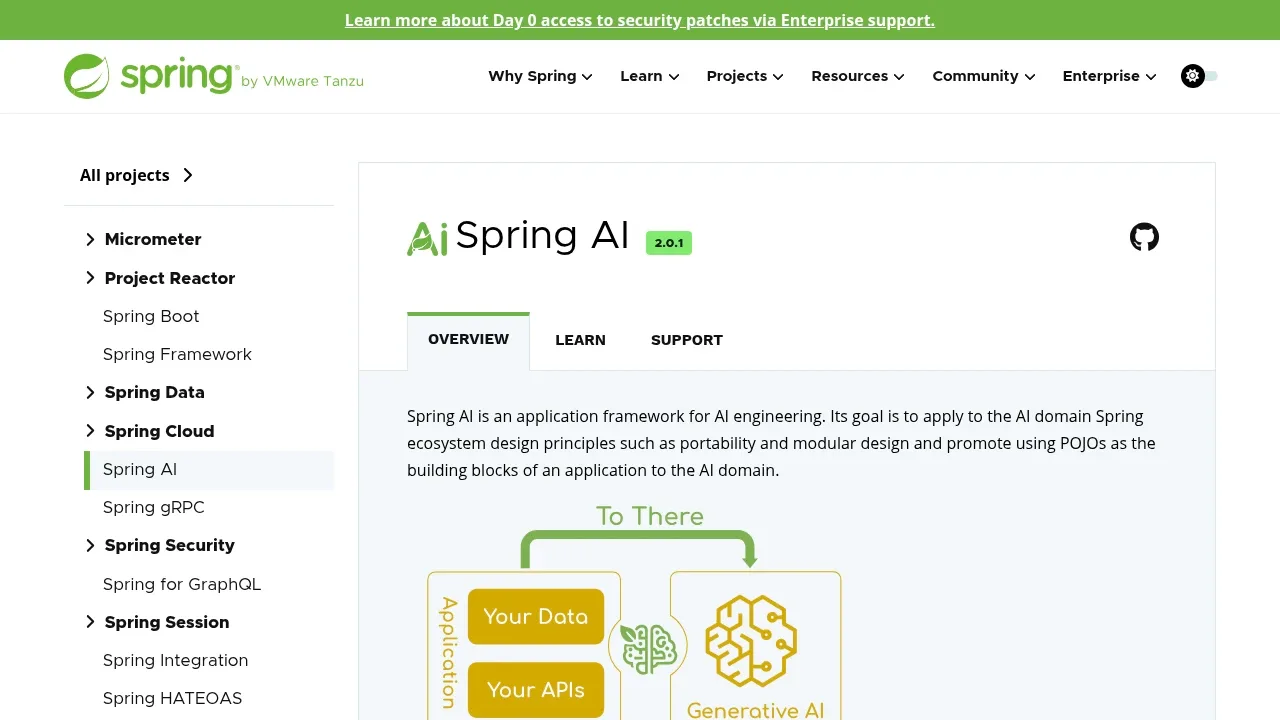
Spring AI is an open-source Java framework for developers adding AI to Spring applications. It connects application data and APIs to models through a common interface, with Ollama support for local LLM use and integrations with cloud providers such as OpenAI, Anthropic and Amazon Bedrock. The framework runs within your application; your choice of model provider determines whether model requests stay local or go to a cloud service.
Its shared APIs let developers change providers while retaining access to provider-specific features. It supports streaming responses, embeddings, image generation, speech transcription and speech synthesis, as well as moderation. Structured output maps model responses into typed Java objects that application code can use.
For applications that answer questions about documents, Spring AI includes document ingestion and retrieval augmented generation (RAG). It connects to vector stores including PostgreSQL/PGVector, Chroma and Qdrant, with a shared interface for filtering metadata. Conversation memory can persist in databases such as JDBC-backed stores, MongoDB or Redis.
Tool calling lets models request functions in your application. MCP support lets Spring applications consume MCP servers or expose their own services to AI clients. Spring Boot integration handles model and vector-store setup, while observability and evaluation utilities help developers inspect AI operations and assess generated content. The project uses the Apache 2.0 license.
Claim this page with an email at spring.io. Spring AI gets the verified badge, and you can upgrade the listing to be featured on localhosted. Proud to be listed? Put our badge on your site.
Want more people to find Spring AI?Promote it
Something wrong or outdated on this page?
38.4KUpdated 4 days agoMIT
#Code execution#MCP#Multimodal input
DSPy is a Python framework for developers building AI applications whose tasks need clear inputs, predictable output types, and measurable results. You define what a language model should produce, then compose those tasks into a larger program. It's open source under the MIT license.
26.6KUpdated 1 day agoApache-2.0
Docker#Guardrails#Hugging Face integration#Hybrid search
Haystack is a Python framework for developers building self-hosted AI agents, document search, and apps that answer questions using their own data. Its modular pipelines let teams control which information reaches a model and inspect how retrieval, memory, tools, and generation contribute to an answer. It's open source under Apache 2.0.
147.3KUpdated 1 day agoMIT
#Human approval#RAG#Streaming inference
LangChain is an MIT-licensed open-source framework for developers building AI agents and applications powered by LLMs. It provides a shared interface for models, tools and data connections, so developers can change providers or test workflows without rebuilding the whole application.
13.2KUpdated 1 day agoApache-2.0
#MCP#Ollama integration#RAG
LangChain4j is an Apache 2.0 open-source Java library for developers building chatbots, assistants and AI agents in JVM applications. It connects application code to local LLM backends such as Ollama as well as cloud providers such as OpenAI and Google Vertex AI. Where model requests go depends on the backend you choose.
9.7KUpdated 9 months agoMIT
#Ollama integration#RAG#Semantic search
LangChainGo is a Go implementation of LangChain for developers building LLM applications in their own software. It connects Go programs to model backends, including Ollama for local LLM use and cloud services such as OpenAI and Gemini. It's a library, so its audience is developers who want to build an application rather than use a ready-made chat interface.
39.6KUpdated 1 year ago
#Ollama integration#RAG#Reranking
Quivr Core is a Python framework for developers adding document-based AI answers to their own applications. It combines file ingestion with retrieval-augmented generation (RAG), so a model can answer questions using material from your documents. It supports local models through Ollama as well as cloud APIs from OpenAI, Anthropic, and Mistral.