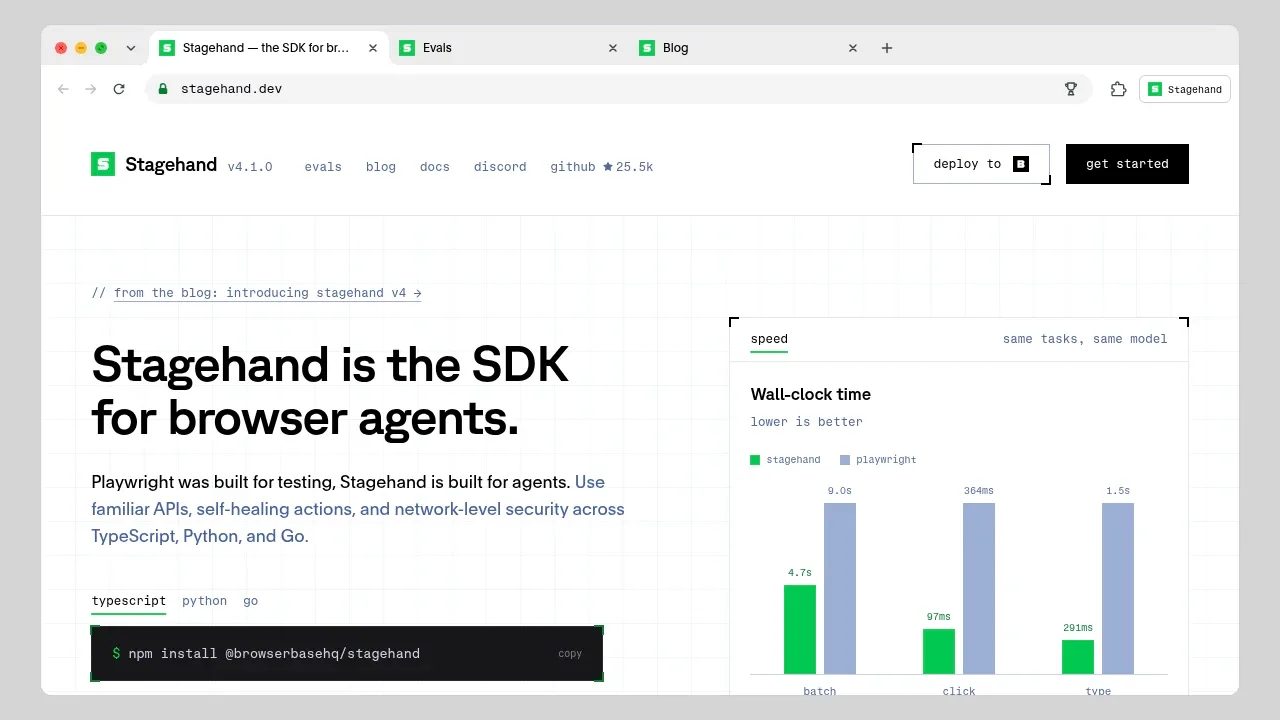
Stagehand is an open-source browser automation SDK for developers building AI agents that interact with websites and extract structured data. It can run with Chrome on your own machine or use Browserbase's cloud browsers. Local runs require Chrome. The project uses the MIT license and supports TypeScript, Python, and Go.
Its natural-language methods let agents act on a page, identify available actions, and extract data into a defined schema. Self-healing actions refresh how they find and interact with page elements when a website changes. Developers can combine these methods with familiar Playwright-style browser controls for clicks, screenshots, and element selection.
Stagehand runs its browser driver as an extension alongside the page to reduce delays between commands and browser actions. It trims the page's accessibility tree to reduce the context an agent sends to its model. Support for nested iframes and closed Shadow DOMs lets agents reach elements inside complex page structures. Batched commands, clipboard access, and WebMCP support cover further browser tasks, while domain allowlists and blocklists control which sites agents can access. OpenTelemetry tracing records their activity.
Browserbase is the hosted route, with persistent browser contexts, session recordings, and server-side caching for repeated actions. Its hosted MCP server also gives Cursor, Codex, and other MCP clients browser actions without a local browser. Separate Fetch and Search capabilities retrieve URL content as Markdown and return web search results without opening a browser session.
Claim this page with an email at stagehand.dev. Stagehand gets the verified badge, and you can upgrade the listing to be featured on localhosted. Proud to be listed? Put our badge on your site.
Want more people to find Stagehand?Promote it
Something wrong or outdated on this page?
27.3KUpdated 20 hours agoMIT
macOS · Windows · Linux#Code execution#MCP#Tool calling
Cua gives AI agents access to computers they can inspect and operate, with tools for desktop automation, local virtual machines, and hosted fleets. It's for developers building agents that work across native apps and browsers, or evaluating how well those agents complete computer tasks. You bring the agent and model.
31.4KUpdated 5 days agoMIT
#MCP#Ollama integration
ScrapeGraphAI is an AI web scraping tool for developers who want to describe the data they need in plain language. Its open-source Python library runs on your own infrastructure under the MIT license. A separate managed API runs in ScrapeGraphAI's cloud.
7.7KUpdated 2 days agoApache-2.0
macOS · Docker · Web
Steel is a browser API for developers building AI agents that interact with websites. It runs Chrome sessions locally or on a self-hosted server through Docker, so you can keep browser infrastructure on hardware you control. The code uses the Apache 2.0 license. Steel also offers a hosted service where browser sessions run in its cloud.
9.4KUpdated 1 day agoApache-2.0
macOS · Windows · Linux · iOS · Android · Web#Batch processing#LLM tracing#Structured output
20.3KUpdated 1 hour agoMIT
#Human approval#LLM tracing#MCP
4.8KUpdated 1 day ago
Docker · Web#Git integration#Human approval#LLM tracing
Agenta is an MIT-licensed, open source workspace for teams that want AI agents to handle tasks in chat and continue recurring work in the background. You can self-host it with Docker Compose or Helm to keep agents and workspace data on your infrastructure, or use Agenta Cloud as a hosted service.
BAML is a programming language for developers building AI agents, with typed model calls and local tracing built into the language. It runs standalone on macOS, Linux and Windows, or alongside an existing application. The language is open source under Apache 2.0, and works offline.
Pydantic AI is a Python SDK for developers building AI agents into their own applications. Its main draw is Pydantic validation across agent tools and results, so an agent can return structured data that application code can check and use. The SDK is MIT licensed.