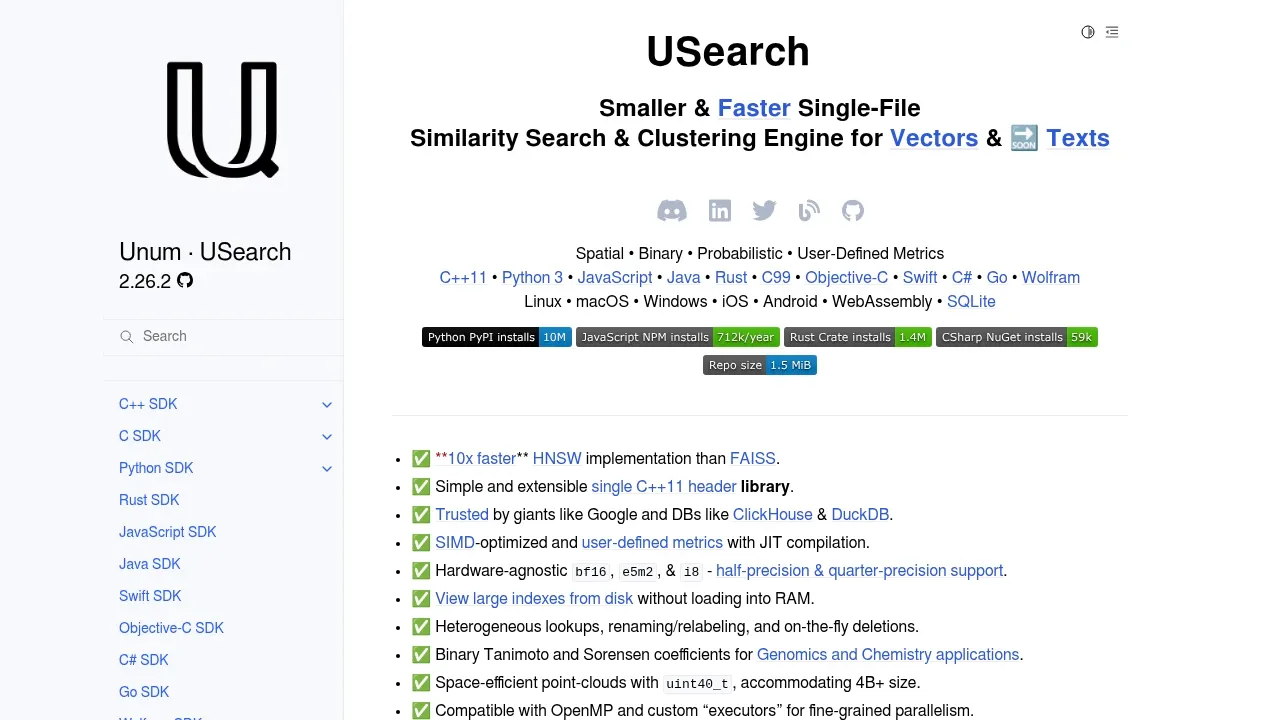
USearch is an open-source similarity search library for developers building semantic search, recommendation systems, and other applications that compare vectors. It runs within your application on your own hardware or server. Its compact C++ core supports custom definitions of similarity, including comparisons between combined image and text embeddings or geospatial data.
It provides HNSW approximate nearest-neighbor search for large collections and exact search for smaller datasets. Compared with FAISS, its design puts more emphasis on custom metrics, few dependencies, and native language bindings. Filters can consult an external database while a search runs, and indexes support deletions and changes to record labels.
Large indexes can stay on disk without loading entirely into RAM. Lower-precision vector storage, including bf16, Float8, and integer formats, reduces memory use; quantized storage doesn't retain the original full-precision vectors. CPU optimizations use Arm and x86 SIMD instructions. Developers can also search across several indexes together and reuse saved indexes across programming languages.
USearch runs on Linux, macOS, Windows, iOS, and Android, with WebAssembly and SQLite support. Bindings include Python, Rust, JavaScript, Swift, Java, C#, and Go alongside C and C++. It uses the Apache 2.0 license. Integrations include LangChain, Microsoft Semantic Kernel, GPTCache, and Sentence-Transformers, while databases including ClickHouse and DuckDB use its search engine.
Claim this page and we'll verify you by hand. USearch gets the verified badge, and you can upgrade the listing to be featured on localhosted. Proud to be listed? Put our badge on your site.
Want more people to find USearch?Promote it
Something wrong or outdated on this page?
38.7KUpdated 11 months agoApache-2.0
macOS · Windows · Linux · Docker · Web#Multimodal input#Ollama integration#OpenAI-compatible API
Langchain-Chatchat is a self-hosted application for asking questions about your own documents and using AI agents. It focuses on Chinese-language use and open models, with a fully offline setup that can keep documents and model processing on your hardware. Its code is open source under Apache 2.0.
22.2KUpdated 1 month agoMIT
macOS · Windows · Linux · Docker · Web#Hugging Face integration#Hybrid search#Ollama integration
14.2KUpdated 1 week agoAGPL-3.0
macOS · Windows · Linux · Docker · Web#Multilingual#Ollama integration#OpenAI-compatible API
322Updated 2 weeks agoMIT
iOS · Android · Docker · Web#Batch processing#Code execution#Guardrails
2.8KUpdated 1 month agoMIT
macOS#Batch processing#Hugging Face integration#LoRA
30.1KUpdated 3 weeks agoMIT
macOS#GGUF#Hugging Face integration#Hybrid search
localGPT is a self-hosted AI document chat app for people who want to question and summarise files on their own hardware. Its local Ollama setup keeps documents and conversations on your machine. Answers include source passages, so you can check what the model used.
QAnything is a self-hosted knowledge base for people and teams who want to ask questions about their own documents, including collections that mix Chinese and English. It can answer in either language regardless of the document's language, and runs locally through Docker on Windows, macOS and Linux.
Tiledesk is a self-hosted platform for building AI agents and connecting them to human support teams. It's aimed at businesses automating customer conversations, internal information searches and workflows through a visual builder. You can run it on your own server with Docker or Kubernetes, or use its hosted cloud service.
ColPali is a local AI document retrieval library for developers and researchers building document search or retrieval-augmented generation systems. It searches pages as images, using their text, charts and layout together rather than relying on a separate OCR pipeline. The colpali-engine package is deprecated; its maintainers recommend Sentence Transformers for new projects and production use.
QMD is a local search engine for people with Markdown notes, meeting transcripts, or documentation they want to search themselves or make available to an AI agent. It accepts exact keywords and natural-language queries, with indexing and model inference running on your own machine. It's open source under MIT.