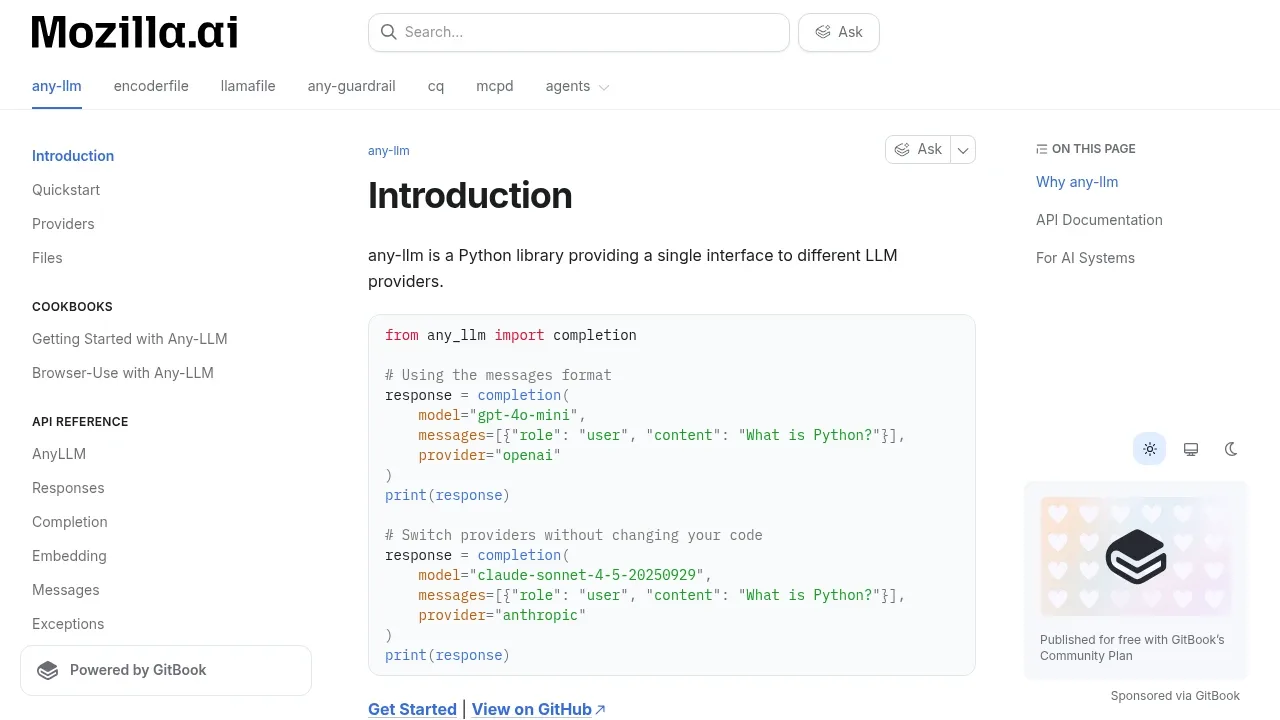
any-llm is a Python library for developers who want the same application to work with local LLM servers and cloud providers. It connects to Ollama and custom OpenAI-compatible endpoints, alongside OpenAI, Anthropic, Mistral and Azure / Microsoft Foundry. A shared interface reduces the provider-specific code needed to try another model or change where inference runs.
The library runs in your Python application; the selected backend handles inference. Local endpoints let you use models on your own hardware or server, while cloud providers receive requests through their APIs and require provider credentials. any-llm is open source under the Apache 2.0 license.
Its capabilities include chat completions, streaming responses, tool calling, text embeddings, reasoning and content moderation. It also exposes the OpenResponses API for agentic applications, with availability depending on the provider. Consistent exception handling gives applications a common way to handle errors across backends.
any-llm uses official provider SDKs and doesn't depend on a particular agent framework. Full Python type hints support editor assistance. Direct functions suit scripts and notebooks, while the AnyLLM class supports reusable provider clients and access to provider metadata. Developers moving from LiteLLM can retain their existing API keys and environment variables.
Claim this page and we'll verify you by hand. any-llm gets the verified badge, and you can upgrade the listing to be featured on localhosted. Proud to be listed? Put our badge on your site.
Want more people to find any-llm?Promote it
Something wrong or outdated on this page?
8.5KUpdated 23 hours agoApache-2.0
Web#LLM tracing#MCP#Multimodal input
Bifrost is a self-hosted AI gateway for developers and teams whose applications use multiple model providers. It puts Ollama, custom model deployments, and cloud services behind one OpenAI-compatible API, so applications can switch models without maintaining a separate integration for each provider.
59.9KUpdated 55 minutes ago
#Guardrails#MCP#Multi-user access
4.4KUpdated 1 day agoMIT
#Human approval#Multi-agent workflows#Multimodal input
1.7KUpdated 2 days agoApache-2.0
#Batch processing#Code execution#Multimodal input
31.3KUpdated 1 day agoApache-2.0
Docker#Hybrid search#Knowledge graphs#llama.cpp backend
26.6KUpdated 1 day agoApache-2.0
Docker#Guardrails#Hugging Face integration#Hybrid search
LiteLLM gives platform teams one place to manage access to LLMs across providers. Its self-hosted AI gateway puts cloud services and internal or locally hosted models behind an OpenAI-compatible API, so applications can change models without changing their integration. Developers can also use its Python SDK directly.
RubyLLM is an MIT-licensed AI framework for developers building Ruby and Rails applications with local or hosted models. Its shared API lets an application switch between Ollama, cloud providers such as Anthropic and OpenAI, and OpenAI-compatible endpoints without rewriting its model integration. The framework runs in your application; model processing happens at the local or hosted backend you choose.
Curator is a Python library for developers preparing LLM training datasets or extracting structured records from existing data. It supports local inference through Ollama and vLLM alongside cloud model APIs, so the same data pipeline can use models on your hardware or a hosted provider. It's open source under Apache 2.0.
Graphiti is a self-hosted Python framework for developers building AI agents that need to remember changing facts. It builds knowledge graphs from conversations, structured records and unstructured text, so an agent can query current information or recover what was true earlier. It's open source under Apache 2.0.
Haystack is a Python framework for developers building self-hosted AI agents, document search, and apps that answer questions using their own data. Its modular pipelines let teams control which information reaches a model and inspect how retrieval, memory, tools, and generation contribute to an answer. It's open source under Apache 2.0.