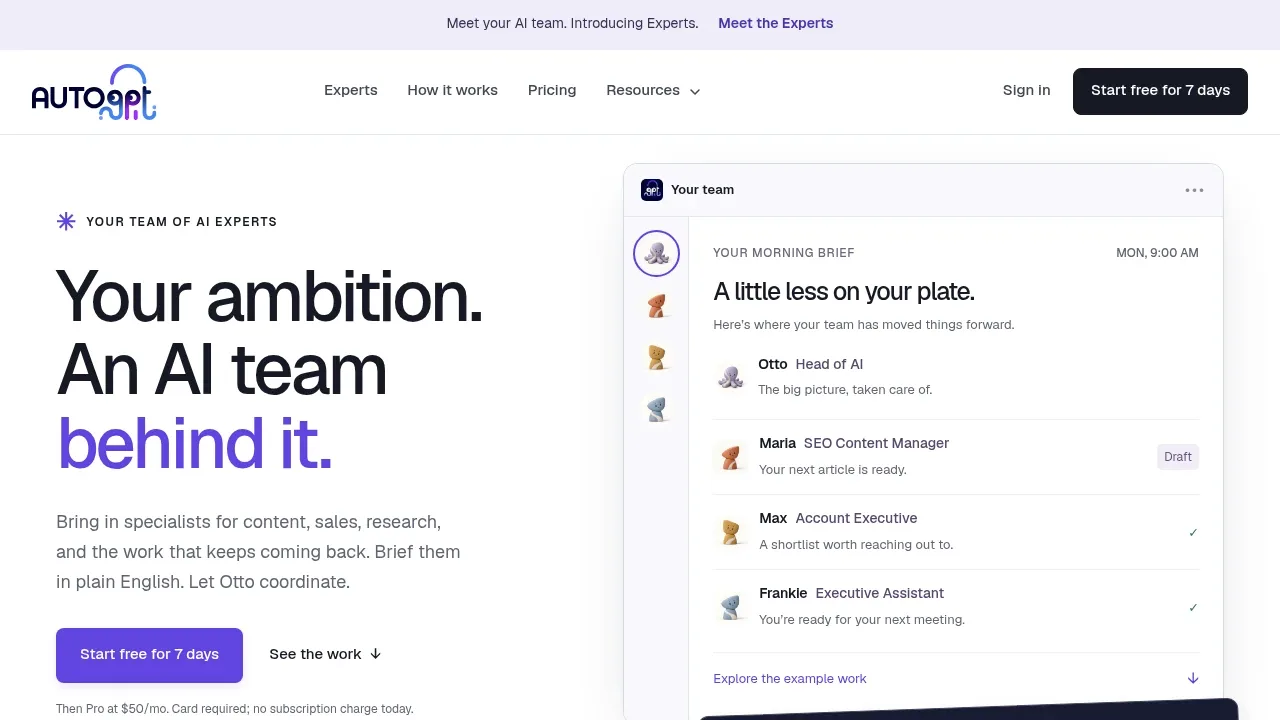
AutoGPT is an AI agent platform for teams handling recurring business work, with a hosted service and a self-hosted option. Its coordinator, Otto, assigns work to specialists for content, sales, research and operations. You can describe an outcome in plain English or talk directly to the specialist responsible for it.
Ready-made Experts cover jobs such as drafting articles, researching prospects and preparing meeting briefs. You can also create your own specialists with instructions, skills and workflows suited to your work. The visual builder lets you define and inspect individual workflow steps when you need closer control than a conversation provides.
Agents can run on demand, on a schedule or in response to a trigger. Connected services include Google Drive and WordPress. Each Expert has its own account access and spending controls, and you can review activity, results and approval requests. Recurring work can be adjusted or paused.
The hosted service runs on AutoGPT's infrastructure and manages model access, credentials and updates. Self-hosting uses Docker and includes the core builder and agent runtime. You manage the deployment and supply model API keys, so running the platform on your server doesn't mean model processing also happens locally. The platform code uses Polyform Shield, whose noncompete terms restrict competing products and services.
The original standalone AutoGPT Classic is available separately under the MIT License, alongside Forge for building agents and agbenchmark for evaluating them.
Claim this page with an email at agpt.co. AutoGPT gets the verified badge, and you can upgrade the listing to be featured on localhosted. Proud to be listed? Put our badge on your site.
Want more people to find AutoGPT?Promote it
Something wrong or outdated on this page?
12KUpdated 1 week agoApache-2.0
Docker · Web#Batch processing#Human approval#Multi-agent workflows
Bisheng is an open source, self-hosted platform for teams building AI applications around business documents and processes. Its visual workflow editor combines automated tasks with human feedback, including intervention during multi-turn conversations. It's suited to document review, support ticket assistance and report generation that need more control than a single chatbot exchange.
34.4KUpdated 2 months agoApache-2.0
macOS · Windows · Linux · Docker · Web#Batch processing#Human approval#MCP
18.3KUpdated 24 hours agoMIT
macOS · Windows · Linux · Docker · Web#Human approval#Hybrid search#llama.cpp backend
55.5KUpdated 2 months ago
Docker · Web#Human approval#LLM tracing#Multi-agent workflows
24.8KUpdated 1 day ago
Docker · Web#Code execution#Human approval#MCP
155.4KUpdated 1 day agoMIT
macOS · Windows · Docker · Web#LLM tracing#MCP#Multi-agent workflows
ChatDev is a self-hosted platform for building teams of AI agents through a visual workflow editor. It's for people who want agents to collaborate on research, data analysis or software projects without writing the orchestration code themselves. You define each agent's role and how information passes between them.
DocsGPT is an MIT-licensed, open-source platform for teams that want AI search, assistants and agents over their own documents. It can run on your servers with local models, including fully air-gapped deployments where documents and questions stay inside your network. Answers include the source title and page number so readers can check the evidence.
Flowise is a visual builder for AI agents and chatbots that can run locally or on your own server, including through Docker. It's for developers and teams building LLM applications with connected workflow blocks. The project is archived and no longer maintained.
Activepieces brings AI agents and workflow automation into one workspace for teams that need to connect their apps and internal data. It runs on your own servers with Docker or Kubernetes, or as a managed cloud service. An isolated deployment can keep platform data on its own infrastructure; connected apps and model providers may still require external access. Its core and app integration pieces are MIT-licensed.
Langflow is a visual builder for developers creating AI agents and retrieval-augmented generation (RAG) applications. You can run it locally or on your own server, with Docker support and desktop apps for Windows and macOS. The open-source software uses the MIT license. A hosted cloud offering provides a separate deployment option.