
Dagu
A self-hosted workflow engine runs scripts and local AI steps with retries, human approvals, and a Web UI, without an external database.
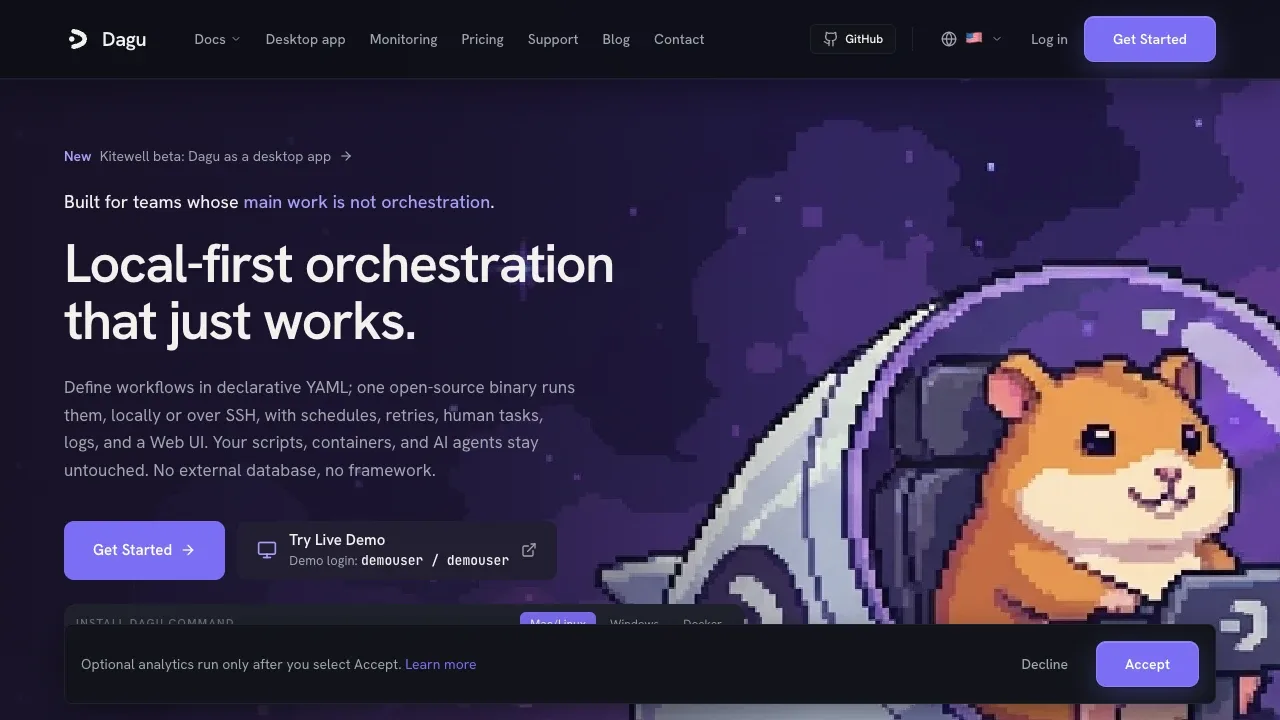
Dagu turns existing scripts and runbooks into scheduled workflows for operations, data pipelines, and AI automation. You define dependencies and actions in YAML, then inspect runs and retry failures from its built-in Web UI.
- Scripts and services: Run shell commands, Docker containers, Kubernetes Jobs, and remote commands over SSH.
- AI workflow steps: Use native
chat.completionactions with local or hosted models, or run coding-agent CLIs as workflow steps. Local inference can use Ollama, llama.cpp, vLLM, or LM Studio through an OpenAI-compatible endpoint. - Scheduling and reliability: Connect reusable workflows, run steps in parallel, and manage recurring jobs with timezone support, concurrency controls, and retries.
- Human tasks: Pause a workflow for acknowledgement or operator input, then pass the response to later steps.
- Run visibility: Inspect dependency graphs, follow logs, review execution history, and view workflow definitions.
- MCP access: Let an AI client create and run workflows, inspect results, retry failures, or stop execution through scoped tools.
Dagu runs on Linux, macOS, and Windows, with Docker and Kubernetes deployment options. A single binary includes the Web UI and scheduler. It stores state in local files and needs no external database or message broker; distributed workers can execute jobs on additional machines.
Local workflow execution can run in air-gapped deployments. Steps that call online services or hosted AI providers still need those connections. Dagu is open source under GPL-3.0.
 Logotyper


