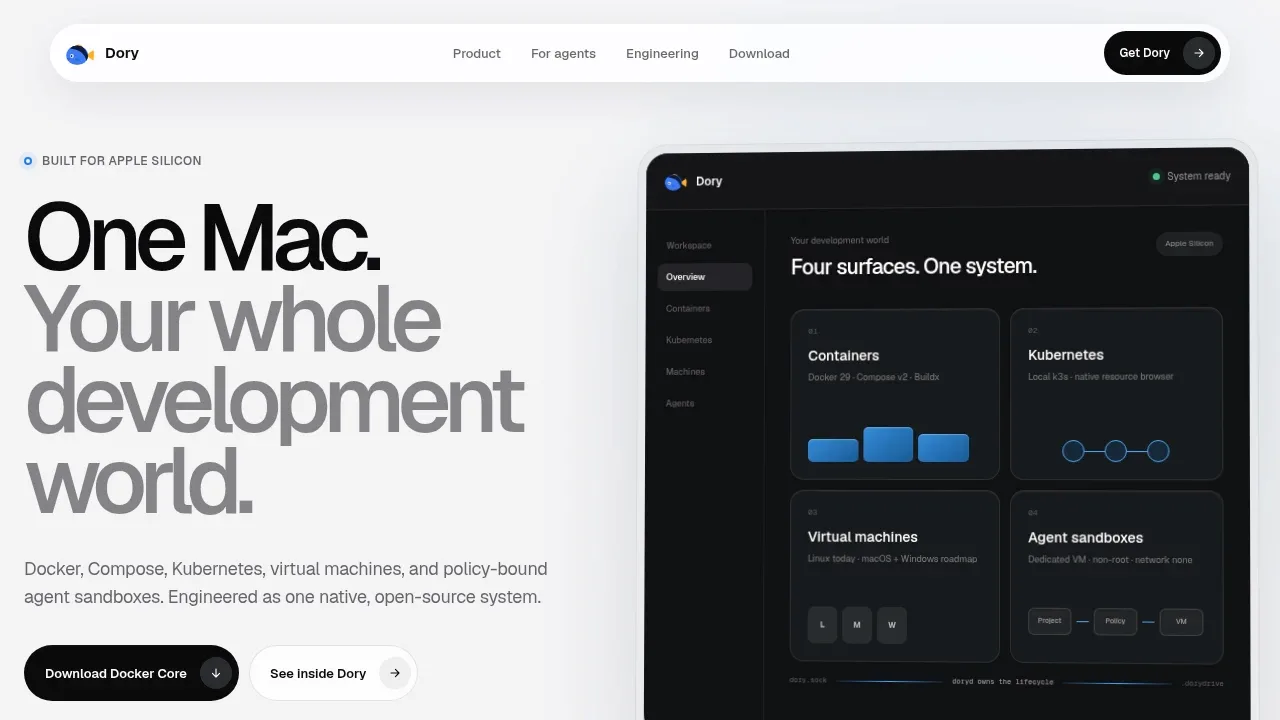
Dory brings Docker, Kubernetes and Linux virtual machines into a native macOS app, with dedicated sandboxes for coding agents. It's for developers who want container workflows and separate Linux environments on an Apple Silicon Mac. It runs on macOS Sonoma or later and is open source under GPL-3.0.
The runtime includes Docker, Compose, BuildKit and Buildx, so existing Docker tools can use its engine. Optional components add local k3s with a graphical resource browser, persistent headless Linux machines, and Ubuntu, Debian or Kali desktops. Machines have their own disks, resource limits and snapshots. The app and CLI manage these environments together, and optional components can be removed without deleting workload data.
Coding agents run in dedicated Linux VMs with non-root commands. File access, networking, credentials and lifetime follow explicit policies; networking is disabled by default, and additional mounts default to read-only. Dory can recognize Node.js, Python, Go and Rust projects and prepare matching environments. Its local MCP interface has a read-only mode for inspecting runtime state while blocking execution and sandbox changes.
Dory requires no account, telemetry or cloud control plane, and workload data stays on your Mac. An idle container engine can sleep, reclaimable guest memory can return to macOS, and sparse disks grow as data is written. Migration tools copy and verify workloads from Docker Desktop, OrbStack, Colima, Rancher Desktop or Podman while leaving the original data untouched.
Claim this page with an email at usedory.dev. Dory gets the verified badge, and you can upgrade the listing to be featured on localhosted. Proud to be listed? Put our badge on your site.
Want more people to find Dory?Promote it
Something wrong or outdated on this page?
27.6KUpdated 1 day agoMIT
macOS · Windows · Linux#Code execution#MCP#Tool calling
Cua gives AI agents access to computers they can inspect and operate, with tools for desktop automation, local virtual machines, and hosted fleets. It's for developers building agents that work across native apps and browsers, or evaluating how well those agents complete computer tasks. You bring the agent and model.
1.3KUpdated 3 weeks agoMIT
macOS · Windows · Linux#Code execution#Guardrails#MCP
1.8KUpdated 3 months agoApache-2.0
macOS · Windows · Linux · Docker#Agent Client Protocol#Code execution#Guardrails
201Updated 3 months agoMIT
macOS · Linux#Distributed execution#Guardrails#Human approval
42.5KUpdated 10 hours agoApache-2.0
Docker · Web#Guardrails#Human approval#LLM tracing
1.2KUpdated 2 days agoApache-2.0
Linux · Docker#Code execution#Git integration#Guardrails
Coding Tools MCP gives AI chat apps and agents access to a codebase on your own machine through the Model Context Protocol (MCP). It's for developers who want their existing client to read files, edit code and run tests, with access confined to a chosen workspace. The Python server is open source under Apache 2.0 and can also run in Docker.
Reverify is a local verification toolkit for developers and reverse engineers who use AI to analyze binaries or rewrite code. It checks a model's claims against the actual file or executed behavior, then returns a verdict with evidence. The Python project is open source under the MIT license and runs on Linux, Windows and macOS as a CLI or MCP server.
Stakpak is an open source AI agent for developers and DevOps teams who want to run production operations on their own machines or servers. It can work interactively in a terminal or run continuously in the background, investigating app health problems, taking corrective action and notifying a human when it needs help.
claudectl is a local dashboard and supervisor for developers running several Claude Code agents on macOS or Linux. It brings session activity, approvals and spending into one terminal view, with an optional local LLM that makes decisions based on your preferences. It's open source under the MIT license.
Agno is a Python framework and runtime for developers building customer-facing or internal AI agents. You can run its agent platform locally with Docker, on your own servers or in your cloud. The open-source framework uses the Apache 2.0 license, and the platform keeps sessions, memory, knowledge and traces in your database.