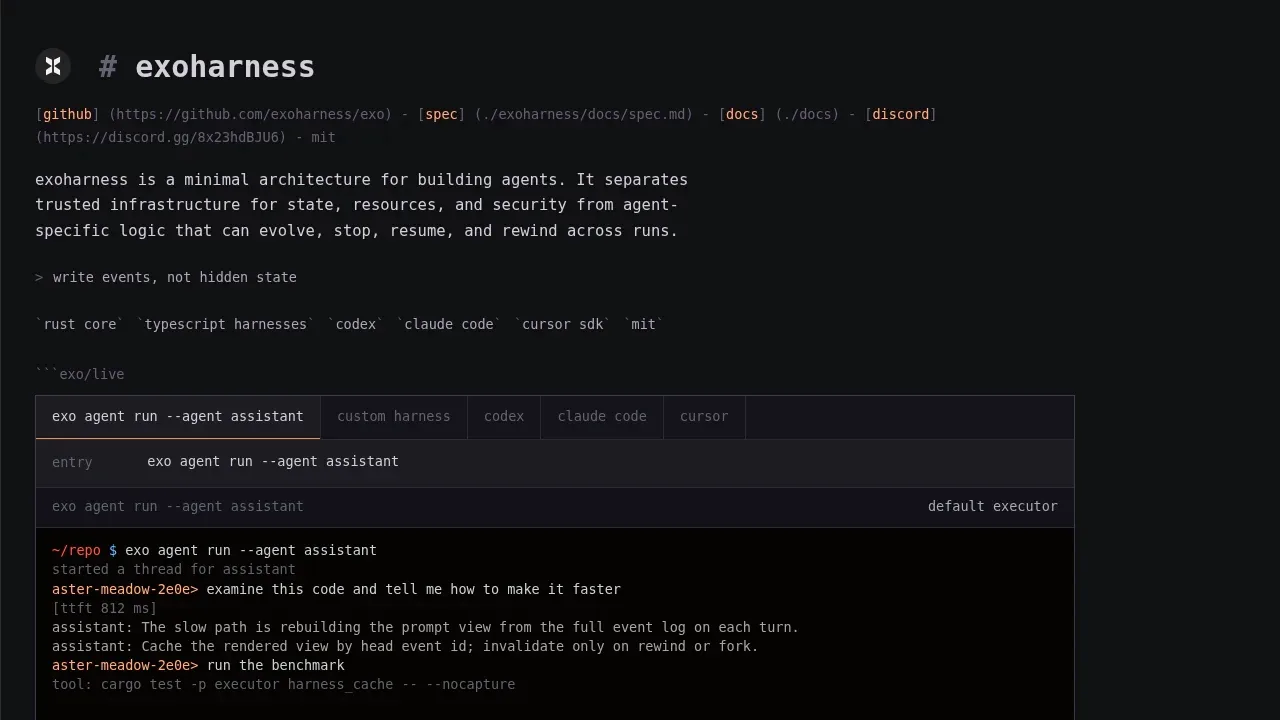
Exo Agent Framework is a self-hosted framework for developers building long-running AI agents that can revise their own code, tools and prompts. Its exoharness foundation keeps agent history and resources separate from the logic that decides what the agent does next. The project is open source under the MIT license.
That separation is its main distinction. An agent can change its implementation across runs while exoharness retains its identity, event history, secrets and artifacts. Developers can stop and resume a run, replace the executor with Codex, Claude Code, Cursor or their own implementation, and fork or rewind from an earlier event without losing resources. The recorded history remains the source of truth even when the agent's prompt or execution logic changes.
The framework has a Rust core and TypeScript support for custom agent harnesses. It works with local models as well as OpenAI, Claude and Gemini APIs. The harness runs on your own machine or server; choosing a cloud model sends model requests to that provider.
For agents that run commands and edit files, sandboxes provide workspace access, network controls and snapshots across turns. Exo also supports command-line chat and browser access through ExoChat, plus messaging connections such as Discord, Slack and Signal. Agents can use scheduling and human-authored extensions for task-specific work.
It's early software, with an unstable public API. Exo can inspect its own code and runtime logs, clone itself and manage a lineage of clones.
Claim this page with an email at exoharness.ai. Exo Agent Framework gets the verified badge, and you can upgrade the listing to be featured on localhosted. Proud to be listed? Put our badge on your site.
Want more people to find Exo Agent Framework?Promote it
Something wrong or outdated on this page?
25KUpdated 3 weeks agoApache-2.0
macOS · Windows · Linux#Persistent memory
Letta is an open-source platform for AI agents that retain memory across conversations and use experience to improve over time. Formerly called MemGPT, it's for people building or using assistants that need continuity beyond a single chat. Agents can run locally or on a self-hosted server.
48.7KUpdated 1 day agoMIT
macOS · Windows · Linux · Docker · Web#Agent Skills#Code execution#MCP
137Updated 14 hours ago
macOS · Windows · Linux · Docker · Web#Agent Skills#Human approval#Knowledge graphs
4.4KUpdated 1 week agoApache-2.0
Web#Agent Skills#Human approval#MCP
MS Agent is an open-source Python framework for developers building AI agents that carry out complex tasks over multiple sessions. Its browser workspace works with local projects, while terminal interfaces and a Python SDK share the same agent logic. It uses the Apache 2.0 license and supports OpenAI-compatible APIs, Anthropic and ModelScope.
162Updated 2 months ago
#Code execution#MCP#Multi-agent workflows
Forge Orchestrator coordinates Claude Code, Codex CLI, and Gemini CLI when they work on the same repository. It's for developers who use multiple AI coding assistants and need them to share decisions, respect file ownership, and follow the same specification.
15.9KUpdated 4 months agoMIT
macOS · Windows · Linux#Agent Skills#Code execution#Git integration
nanobot is a self-hosted personal AI agent for people who want an assistant that can work with files, carry tasks across conversations and handle recurring jobs. It runs on macOS, Windows or Linux, on your own server, or in Docker. Its Python core is open source under the MIT license and small enough for developers to inspect and extend.
Project Orchestrator is a self-hosted coordination tool for developers working with multiple AI coding agents. It keeps code knowledge, development plans, and architectural decisions in a shared store so agents can reuse context across tasks and projects. It runs on macOS, Windows, and Linux, with desktop apps and Docker deployment available.
OpenHarness is an MIT-licensed Python framework for developers and researchers building AI agents on their own machines. It runs on macOS, Linux and native Windows, and includes ohmo, a personal assistant that can work on coding tasks through Feishu, Slack, Telegram or Discord.