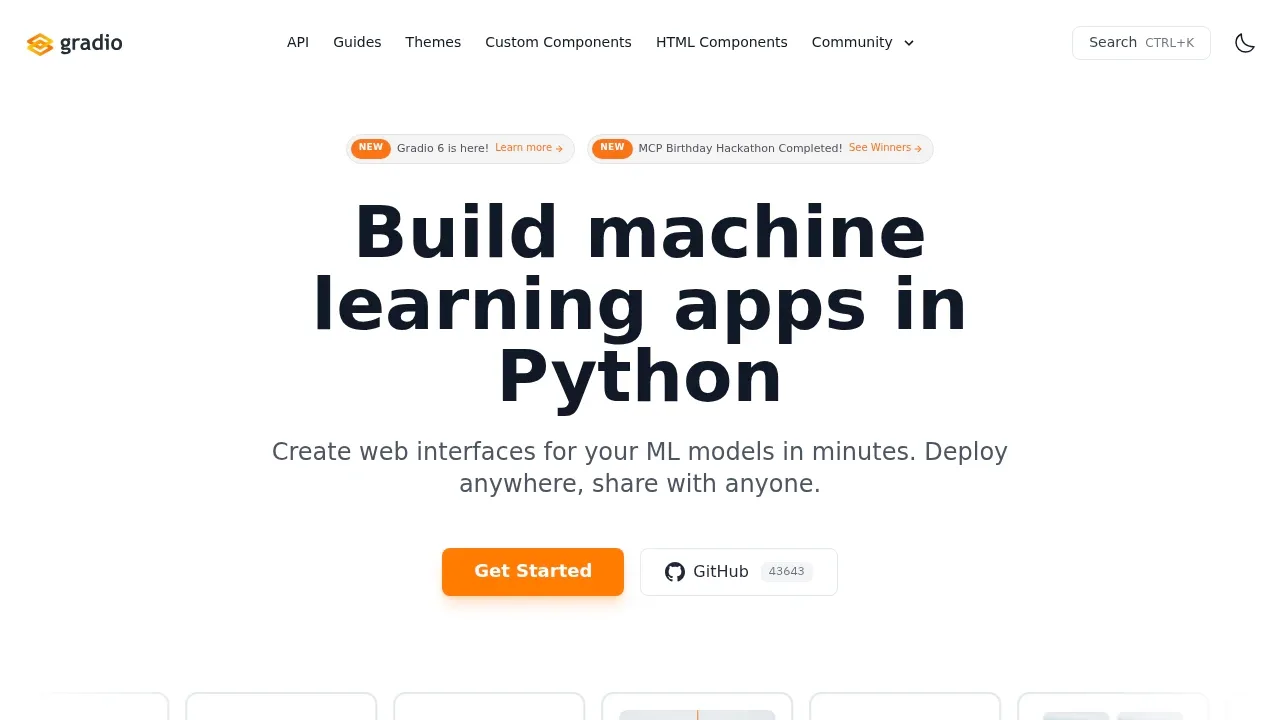
Gradio turns a Python function, model, or API into a web interface. It runs on your computer, making it useful for developers and researchers who want people to try an AI project through a browser. It's open source under the Apache 2.0 license.
You can make a focused demo with text fields, buttons, and outputs without building a frontend in JavaScript or CSS. Gradio also has components for images, audio, video, plots, data tables, and 3D content, so people can interact with a model using the kind of input it expects. For conversational projects, it provides a dedicated chatbot interface.
The scope can grow beyond a simple model demo. Gradio Blocks lets you arrange components and build interactions where one result feeds another part of the app, all from Python. That makes it a fit for testing an idea with colleagues as well as building a more involved tool around a Python workflow.
A local app can be shared through a public link while the demo keeps running on your computer. Hugging Face Spaces is a separate hosting option for keeping an app online. Gradio doesn't prescribe a particular local LLM or model format; its interface can sit in front of a model, an API, or another Python function.
Claim this page with an email at gradio.app. Gradio gets the verified badge, and you can upgrade the listing to be featured on localhosted. Proud to be listed? Put our badge on your site.
Want more people to find Gradio?Promote it
Something wrong or outdated on this page?
11.2KUpdated 5 months agoMIT
VS Code#Code execution#LLM tracing#Visual workflows
Prompt flow is an MIT-licensed, open-source toolkit for developers who build LLM applications and need to test their behavior before deployment. Its development tools run locally, while an optional cloud version in Azure AI supports team collaboration. Feature development has ended.
4.7KUpdated 1 month agoMIT
macOS · Windows · Linux#Visual workflows
Rivet is a desktop visual programming environment for developers building AI agents and applications with complex LLM workflows. Its editor runs on macOS, Windows and Linux, and its TypeScript library executes the resulting graphs inside your own application. The project uses the MIT license.
61.2KUpdated 6 months agoCC-BY-4.0
Web#Code execution#MCP#Multi-agent workflows
8.5KUpdated 23 hours agoApache-2.0
Web#LLM tracing#MCP#Multimodal input
37.6KUpdated 18 hours agoMIT
iOS · Android · Web#Human approval#MCP#Persistent memory
157.6KUpdated 3 hours ago
Docker · Web#Code execution#MCP#OpenAI-compatible API
AutoGen is a framework for developers building AI agents that work together or alongside people. Its agent runtime can run locally or across distributed systems, while model integrations such as OpenAI and Azure OpenAI send requests to external services. It's community-managed and in maintenance mode, with no further features or enhancements planned.
Bifrost is a self-hosted AI gateway for developers and teams whose applications use multiple model providers. It puts Ollama, custom model deployments, and cloud services behind one OpenAI-compatible API, so applications can switch models without maintaining a separate integration for each provider.
CopilotKit is a self-hostable SDK for developers building AI agents into web and mobile apps, Slack, or Microsoft Teams. Agents can display interactive charts and forms using an app's own components, read shared app state, and take actions through frontend tools, APIs, or MCP tools.
Dify is a source-available platform for teams building AI agents and apps on a visual canvas. Its Community Edition runs on your own server with Docker. Dify also offers a hosted cloud service, while Enterprise deployments can run in a VPC or on a self-hosted server. The Community Edition uses a custom Apache 2.0 derivative license.