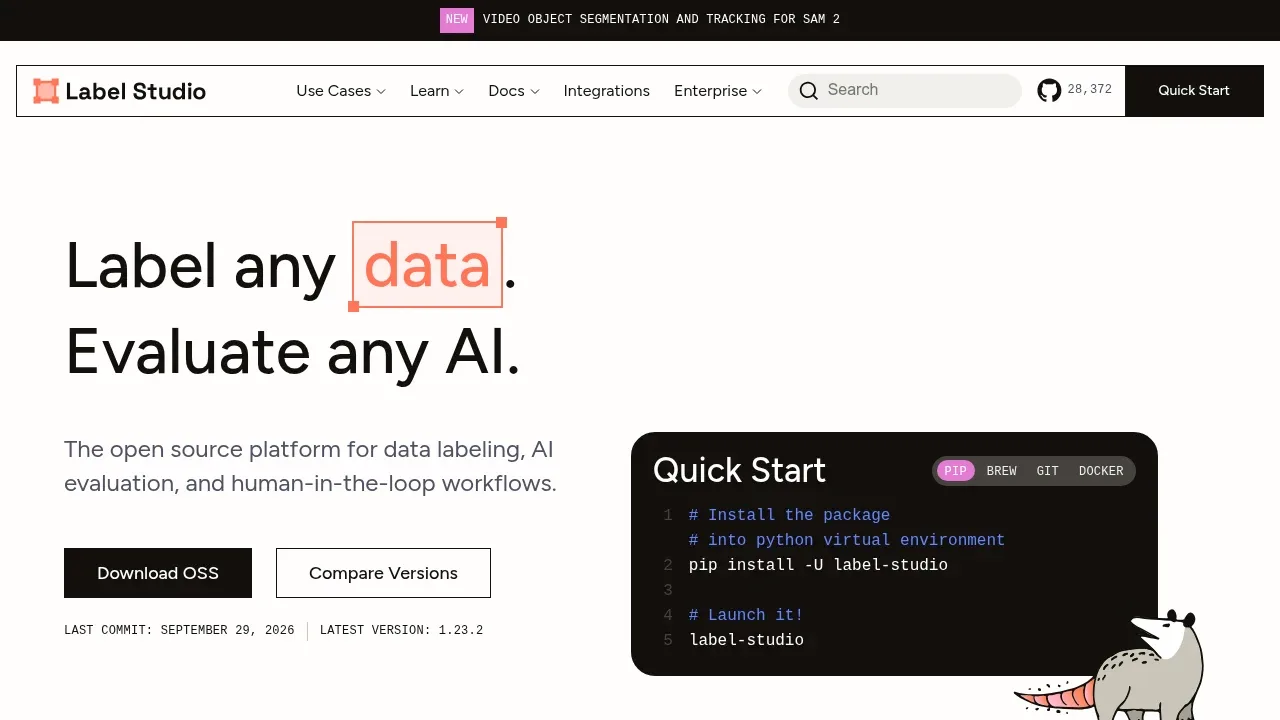
Label Studio is a self-hosted platform for teams preparing training data or evaluating AI outputs through human review. It handles text, images, audio, video and time series in the same application, including tasks that combine several data types. The open source edition uses the Apache 2.0 license and runs locally or on your own server, with Docker deployment and browser access. A separate hosted cloud edition runs on the provider's infrastructure.
For LLM and agent evaluation, reviewers can compare answers side by side, apply custom rubrics and benchmarks, and collect preferences, rankings or corrections for RLHF and fine-tuning. It also supports reviewing agent traces through connections to observability tools. RAG evaluation covers retrieval relevance and grading generated answers against their source material.
Its annotation tools cover object detection and segmentation, document OCR, named entity recognition, audio transcription and speaker diarization. Custom layouts and templates let teams adapt the review interface to their data and criteria. Connected machine learning models can supply preliminary labels and predictions for people to check or compare.
Teams can manage multiple datasets as separate projects and associate annotations with user accounts. Data can come from local files, Amazon S3 or Google Cloud Storage, with exports for model training. A REST API, Python SDK and webhooks connect labeling work to training, active learning and evaluation pipelines.
Claim this page with an email at labelstud.io. Label Studio gets the verified badge, and you can upgrade the listing to be featured on localhosted. Proud to be listed? Put our badge on your site.
Want more people to find Label Studio?Promote it
Something wrong or outdated on this page?
3.3KUpdated 2 weeks agoApache-2.0
Docker · Web#LLM tracing#MCP
Laminar is an open-source platform for developers who need to see why an AI agent failed and check whether a fix worked. You can self-host it with Docker or on Kubernetes, including AWS and GCP, or use its managed cloud service. It uses the Apache 2.0 license.
5.1KUpdated 1 year agoApache-2.0
Web#Multi-user access#Semantic search
Argilla is an open-source data annotation and feedback tool for AI engineers and domain experts who build training and evaluation datasets. You can run your own Argilla server or deploy it on Hugging Face Spaces. It's licensed under Apache 2.0.
3.4KUpdated 10 months agoApache-2.0
#Structured output
Distilabel is an open-source Python framework for engineers building datasets to train or evaluate AI models. It pairs synthetic data generation with LLM feedback, so a pipeline can create examples and judge their quality. It uses the Apache 2.0 license.
19.9KUpdated 2 years agoApache-2.0
Web#Hugging Face integration
10.8KUpdated 8 months agoMIT
Windows · Docker · Web#Multi-user access#Multilingual
9.4KUpdated 1 day agoApache-2.0
macOS · Windows · Linux · iOS · Android · Web#Batch processing#LLM tracing#Structured output
Segment Anything 2 (SAM 2) is Meta's open-source model for selecting objects in images and tracking them through video. It's for developers and researchers who need object masks for visual applications or dataset annotation. The model and its web demo can run on your own GPU machine; Meta also provides a hosted demo.
Doccano is a self-hosted text annotation tool for machine learning practitioners who need labeled training or evaluation data. It runs on your own machine or server, with a browser interface and Docker support. The software is open source under the MIT license.
BAML is a programming language for developers building AI agents, with typed model calls and local tracing built into the language. It runs standalone on macOS, Linux and Windows, or alongside an existing application. The language is open source under Apache 2.0, and works offline.