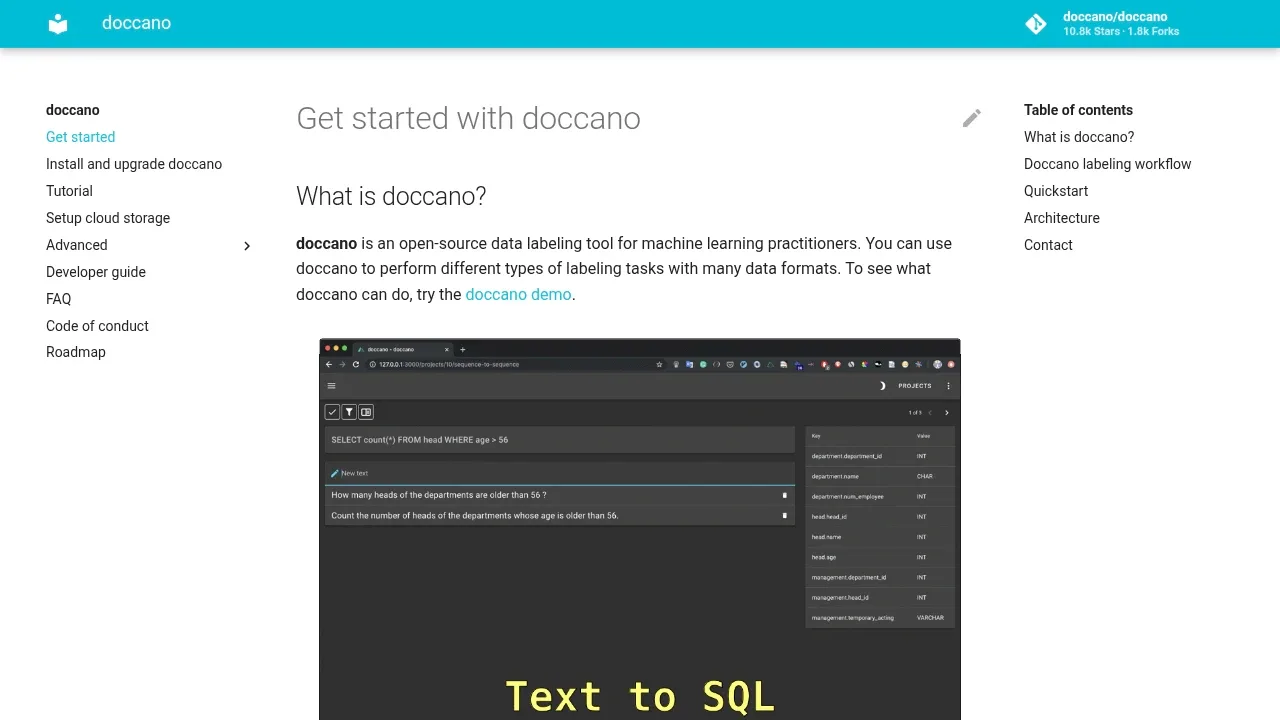
Doccano is a self-hosted text annotation tool for machine learning practitioners who need labeled training or evaluation data. It runs on your own machine or server, with a browser interface and Docker support. The software is open source under the MIT license.
Its annotation tasks cover text classification, sequence labeling, and sequence-to-sequence work. You can assign sentiment labels, mark named entities within text, or pair a document with a summary. These task types let teams prepare datasets for different language models within the same application.
Projects support collaborative annotation, with multiple users and shared annotation guidelines. Doccano can import existing labeled datasets as well as data awaiting annotation, then export the results for use elsewhere. It handles multiple data formats and supports multilingual text, emoji, and access from mobile devices. The interface also has a dark theme.
For teams that already have scripts or models involved in labeling, the REST API connects Doccano to that work. A machine learning model can label data through the API, alongside the annotation interface used by people. This makes it relevant to both manual labeling projects and workflows that incorporate model-generated labels.
The application has a Python backend built with Django and Django REST Framework, plus a Vue.js and Nuxt.js frontend. Teams can customize it to their needs. It uses SQLite by default and also supports PostgreSQL.
Claim this page and we'll verify you by hand. Doccano gets the verified badge, and you can upgrade the listing to be featured on localhosted. Proud to be listed? Put our badge on your site.
Want more people to find Doccano?Promote it
Something wrong or outdated on this page?
28.4KUpdated 1 day agoApache-2.0
macOS · Windows · Docker · Web#Human approval#Multi-user access#Multimodal input
Label Studio is a self-hosted platform for teams preparing training data or evaluating AI outputs through human review. It handles text, images, audio, video and time series in the same application, including tasks that combine several data types. The open source edition uses the Apache 2.0 license and runs locally or on your own server, with Docker deployment and browser access. A separate hosted cloud edition runs on the provider's infrastructure.
89Updated 22 hours agoGPL-3.0
macOS · Windows · Linux · Docker · Web#Batch processing#Hugging Face integration#ONNX
PixlStash is an open-source image manager for photographers, AI creators and people curating image datasets. It combines library search with tools for reviewing tags, ranking images and sending selected work through ComfyUI. You can use a desktop app or a self-hosted server with a browser interface.
16.8KUpdated 1 day agoMIT
Docker · Web#Hugging Face integration#Multi-user access#ONNX
1.3KUpdated 7 months agoApache-2.0
Windows · Docker#Hugging Face integration#Multimodal input#OpenAI-compatible API
3.3KUpdated 2 weeks agoApache-2.0
Docker · Web#LLM tracing#MCP
Laminar is an open-source platform for developers who need to see why an AI agent failed and check whether a fix worked. You can self-host it with Docker or on Kubernetes, including AWS and GCP, or use its managed cloud service. It uses the Apache 2.0 license.
5.1KUpdated 1 year agoApache-2.0
Web#Multi-user access#Semantic search
Argilla is an open-source data annotation and feedback tool for AI engineers and domain experts who build training and evaluation datasets. You can run your own Argilla server or deploy it on Hugging Face Spaces. It's licensed under Apache 2.0.
CVAT is a browser-based data annotation platform for teams building computer vision datasets. Its open-source Community edition runs on your own infrastructure with Docker and uses the MIT license. CVAT Online is hosted by CVAT, while the Enterprise offering runs in an organization's own cloud or internal environment.
JoyCaption is an open-weight image captioning model for people preparing datasets to train or fine-tune diffusion models. It runs on your own GPU and covers both SFW and NSFW images, including photography, anime, digital art and furry artwork. Automated captions reduce the need to write descriptions by hand or find images that already have usable text.