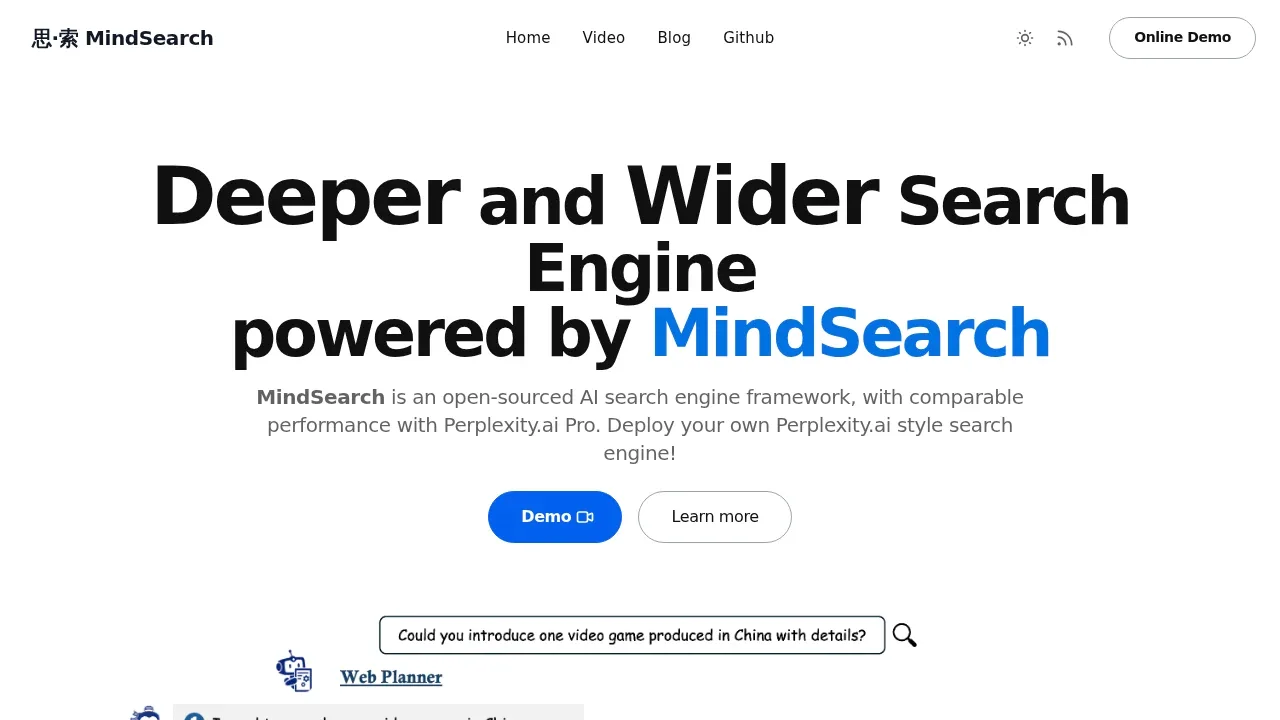
MindSearch is a self-hosted AI search framework for people who want to build their own Perplexity-style answer engine. Multiple LLM agents search and read web pages to produce answers with a visible research process. It's open source under Apache 2.0.
The focus is on questions that need broader research than a single search result can provide. MindSearch draws on multiple pages and exposes the path behind its answer, so readers can inspect how it reached a conclusion. That visibility matters when you're comparing information across sources or checking the basis for a response.
You can run the model locally through an InternLM server using InternLM2.5-7b-chat, or use GPT-4 through a cloud service. The local model has optimizations for Chinese, and the framework supports English and Chinese. Self-hosting doesn't make web research offline: searches still contact external services, and choosing GPT-4 sends model requests to a cloud provider.
MindSearch works with GoogleSearch, DuckDuckGoSearch, BraveSearch, BingSearch and TencentSearch. These connections let you choose the search service behind your answer engine rather than depend on one fixed provider.
Its FastAPI backend supports a choice of interfaces, including React, Gradio and Streamlit, as well as terminal access. Applications can also query the backend directly without using a frontend.
Claim this page and we'll verify you by hand. MindSearch gets the verified badge, and you can upgrade the listing to be featured on localhosted. Proud to be listed? Put our badge on your site.
Want more people to find MindSearch?Promote it
Something wrong or outdated on this page?
34.4KUpdated 2 months agoApache-2.0
macOS · Windows · Linux · Docker · Web#Batch processing#Human approval#MCP
ChatDev is a self-hosted platform for building teams of AI agents through a visual workflow editor. It's for people who want agents to collaborate on research, data analysis or software projects without writing the orchestration code themselves. You define each agent's role and how information passes between them.
18.3KUpdated 24 hours agoMIT
macOS · Windows · Linux · Docker · Web#Human approval#Hybrid search#llama.cpp backend
DocsGPT is an MIT-licensed, open-source platform for teams that want AI search, assistants and agents over their own documents. It can run on your servers with local models, including fully air-gapped deployments where documents and questions stay inside your network. Answers include the source title and page number so readers can check the evidence.
42.4KUpdated 1 day agoApache-2.0
Docker · Web#Guardrails#Human approval#LLM tracing
Agno is a Python framework and runtime for developers building customer-facing or internal AI agents. You can run its agent platform locally with Docker, on your own servers or in your cloud. The open-source framework uses the Apache 2.0 license, and the platform keeps sessions, memory, knowledge and traces in your database.
41.2KUpdated 1 day agoAGPL-3.0
macOS · Docker · Web#Code execution#Hybrid search#LM Studio integration
AstrBot brings AI assistants into messaging apps such as Telegram, Discord, Slack, QQ and WeCom. It's an open source platform under AGPL-3.0 for people building personal companions, customer support bots or team automation. You can run it on your own computer or server, including through Docker, or use its desktop app for browser-style chat.
3.1KUpdated 2 days agoApache-2.0
macOS · Windows · Linux · Web#Code execution#MCP#Multi-agent workflows
BotSharp is a self-hosted framework for .NET developers building AI agents into business applications. Written in C#, it runs on Windows, Linux and macOS and is open source software under Apache 2.0. Its plugin design lets teams choose their model provider, storage and interface while keeping agent coordination in the same framework.
3.1KUpdated 2 months agoGPL-3.0
Web#MCP#Multi-agent workflows#Ollama integration
Cheshire Cat is a self-hosted Python framework for people learning how AI agents work or building custom assistants for research and creative projects. It pairs a local web chat interface with an API, so you can test an agent in conversation and use it inside another application. It's open source under GPL-3.0.