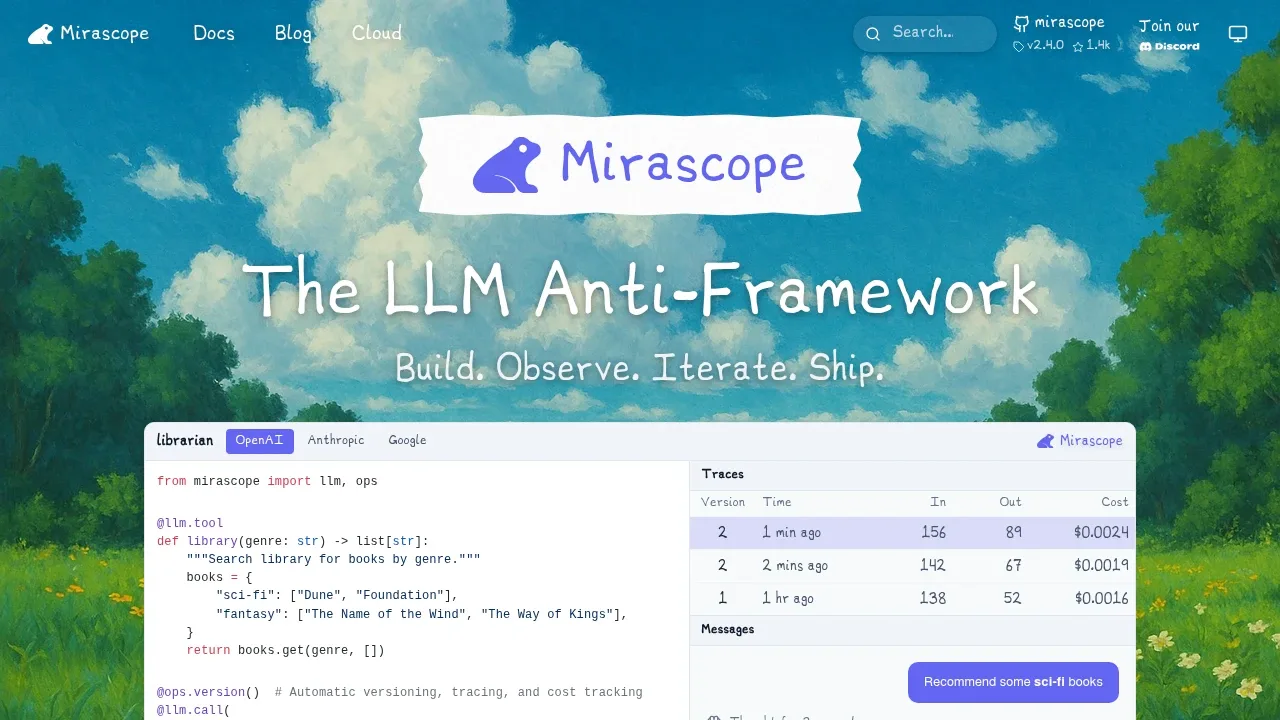
Mirascope is an open-source toolkit for developers building LLM applications and AI agents in Python or TypeScript. It gives applications a shared interface to model providers, including OpenAI, Anthropic and Google, so developers can work across providers within the same toolkit. It's MIT licensed.
Its approach centers on ordinary application functions. Developers can expose functions as tools that a model can call, then build agents that execute those tools and continue the conversation with the results. This suits applications where an LLM needs access to the application's own actions or data, such as a book recommendation agent querying a library.
The toolkit supports streaming responses, asynchronous calls and multi-turn conversations. Alongside model calls, it includes automatic versioning, tracing and cost tracking. Traces show messages and tool inputs and outputs, with timing, token usage and cost attached to calls. These records let developers inspect what an agent did and compare calls across versions.
Mirascope is a development library rather than a standalone chat app. The provider integrations shown use cloud models, so those calls send prompts to the selected service and need an internet connection. Python and TypeScript implementations share documentation, and the repository includes examples for both languages.
Claim this page with an email at mirascope.com. Mirascope gets the verified badge, and you can upgrade the listing to be featured on localhosted. Proud to be listed? Put our badge on your site.
Want more people to find Mirascope?Promote it
Something wrong or outdated on this page?
1.3KUpdated 2 weeks agoMIT
VS Code#Context compression#LLM tracing#MCP
Prompty is an MIT-licensed, open-source prompt format and developer toolkit for AI applications. It keeps a prompt's text, model settings, inputs, and tool definitions in one portable Markdown file. Developers can use the same file in VS Code and across Python, TypeScript, C#, and Rust runtimes.
9.4KUpdated 2 hours agoApache-2.0
macOS · Windows · Linux · iOS · Android · Web#Batch processing#LLM tracing#Structured output
1.7KUpdated 3 weeks agoApache-2.0
#Agent Skills#Code execution#Guardrails
20.3KUpdated 19 hours agoMIT
#Human approval#LLM tracing#MCP
8.8KUpdated 1 hour agoMIT
Web#LLM tracing#MCP#Resumable workflows
8.6KUpdated 23 hours agoApache-2.0
#Guardrails#LLM tracing#MCP
BAML is a programming language for developers building AI agents, with typed model calls and local tracing built into the language. It runs standalone on macOS, Linux and Windows, or alongside an existing application. The language is open source under Apache 2.0, and works offline.
Agently is an open-source Python framework for engineering teams building AI service backends on their own infrastructure. It focuses on turning model responses into validated data and controlled actions that business applications can use. The framework runs in your application; requests go to the model provider you connect, including external services.
Pydantic AI is a Python SDK for developers building AI agents into their own applications. Its main draw is Pydantic validation across agent tools and results, so an agent can return structured data that application code can check and use. The SDK is MIT licensed.
Rig is a Rust library for developers building AI agents and LLM applications with local or cloud models. Its unified API covers model providers and vector stores, so applications can share the same abstractions across backends. It's open source under MIT.
Strands Harness SDK is an open source toolkit for developers who want to build AI agents while controlling how they run. It executes inside your own application process, with no hosted control plane. The Apache 2.0 license covers the SDK, which supports Python and TypeScript.