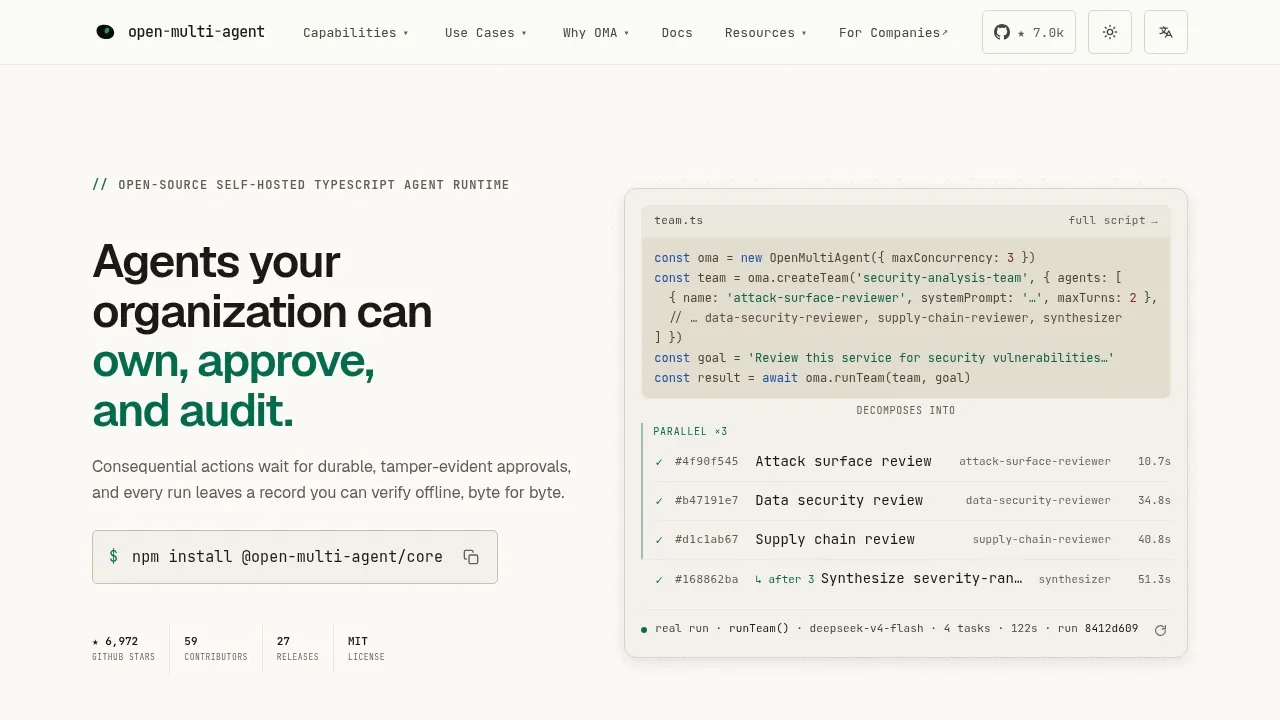
Open Multi Agent is a self-hosted TypeScript framework for developers building AI agent teams that need human approval and an inspectable record of their work. It runs on your own infrastructure and is free and open source under the MIT license. There's no OMA account, hosted control service, or telemetry.
Teams can use local LLM backends such as Ollama, vLLM, and llama-server, or connect to OpenAI-compatible endpoints and cloud providers including Anthropic, OpenAI, and Gemini. Agents in the same team can use different models. Local or air-gapped models let inference stay in your environment; cloud models send requests to the provider using your credentials.
Approvals can pause a proposed plan, a task, or a consequential tool call. Requests survive restarts and bind the decision to the content the reviewer saw. Tools start with access denied, and network policies can restrict connections made by built-in model adapters.
You can define task dependencies yourself or let a coordinator divide a goal among agents. Independent tasks run in parallel. Checkpoints let interrupted runs resume while reusing completed tool results, and Claude Code, Codex, and Gemini CLI can participate in the task graph.
The optional journal records model context, tool calls, results, and context changes for offline verification. Missing evidence produces an inconclusive result. Governance checks assess which required roles ran and in what order, separately from task success. The offline Run Viewer shows task assignments, tool activity, token usage, and cost estimates.
Claim this page with an email at open-multi-agent.com. Open Multi Agent gets the verified badge, and you can upgrade the listing to be featured on localhosted. Proud to be listed? Put our badge on your site.
Want more people to find Open Multi Agent?Promote it
Something wrong or outdated on this page?
2.6KUpdated 2 days agoApache-2.0
#Distributed execution#Guardrails#Human approval
AgentField is a self-hosted, open source platform for developers building AI agents that need to work together under shared access rules. It runs in your own infrastructure and combines agent execution with identity, policy enforcement and audit records. The project uses the Apache 2.0 license.
42.5KUpdated 13 hours agoApache-2.0
Docker · Web#Guardrails#Human approval#LLM tracing
201Updated 3 months agoMIT
macOS · Linux#Distributed execution#Guardrails#Human approval
536Updated 6 months agoMIT
Web#Code execution#Git integration#Guardrails
447Updated 4 weeks agoApache-2.0
#Agent Skills#Code execution#Guardrails
409Updated 1 day agoApache-2.0
#Code execution#Guardrails#Human approval
Agno is a Python framework and runtime for developers building customer-facing or internal AI agents. You can run its agent platform locally with Docker, on your own servers or in your cloud. The open-source framework uses the Apache 2.0 license, and the platform keeps sessions, memory, knowledge and traces in your database.
claudectl is a local dashboard and supervisor for developers running several Claude Code agents on macOS or Linux. It brings session activity, approvals and spending into one terminal view, with an optional local LLM that makes decisions based on your preferences. It's open source under the MIT license.
ClawLess runs Claw AI agents in a browser sandbox, giving developers a place to execute and inspect agent tasks without a backend server. WebContainers provide a Node.js environment with a virtual filesystem that agents can read, write and execute files in, without access to the host system. The runtime runs locally. Model requests go to cloud services from Anthropic, OpenAI or Google using API keys, so this isn't fully offline AI.
Hypha is a local-first TypeScript framework for developers building AI agents that need controlled tool use, recoverable workflows and an audit trail. It separates the agent's reasoning and planning from the execution layer that enforces policies, approvals and workflow boundaries. It's open source under Apache 2.0.
MartinLoop is a free, self-hosted runtime for developers and engineering teams delegating software work to AI coding agents. It wraps Claude Code, Codex CLI and Gemini CLI with limits and checks that sit outside the agent. The agent writes the code; MartinLoop decides when work can continue and when the result passes the configured checks.