
OpenAdapt
Local GUI automation compiles demonstrated tasks into repeatable programs. The MIT engine runs on your hardware and independently checks results.
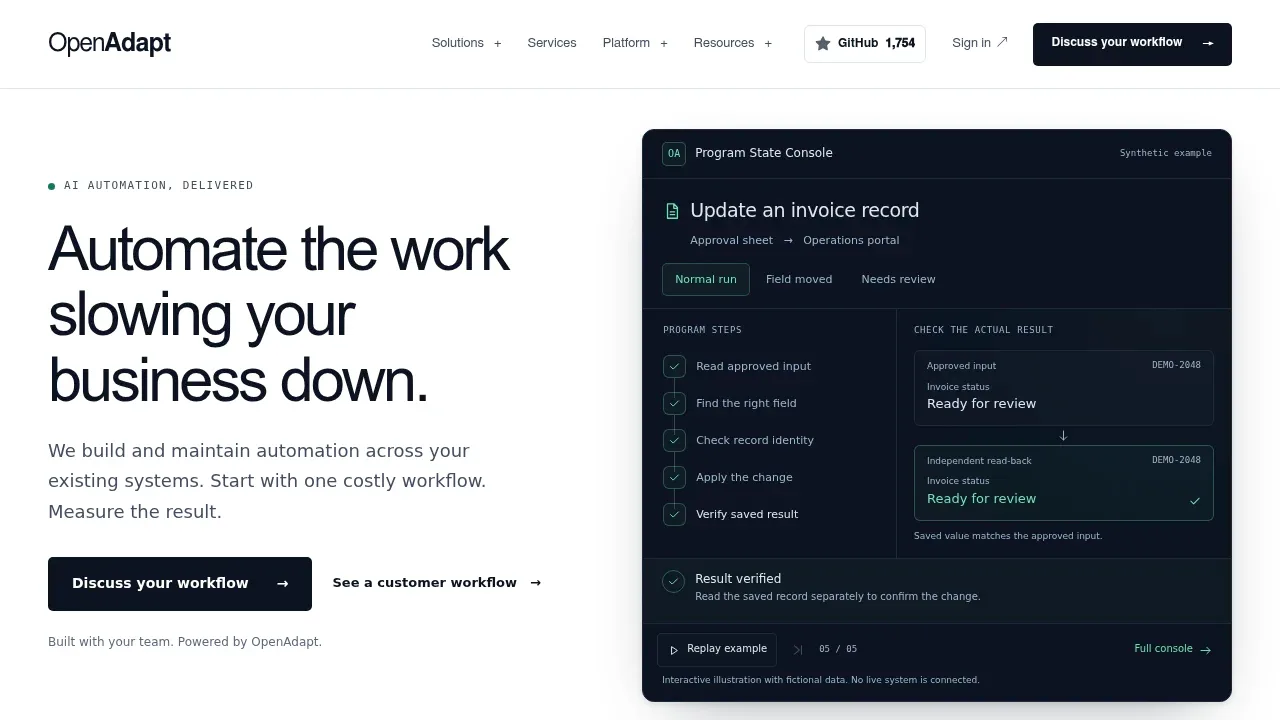
OpenAdapt turns a demonstrated task into a repeatable program for browser, desktop, and remote applications. Its local, MIT-licensed open-source engine is for teams and AI agent builders who need to automate work in interfaces their APIs can't reach. It checks the outcome independently before reporting success and stops when verification fails.
A person demonstrates the task, or supervises a local agent doing it, then approves the resulting program. Repeat runs don't use a generative-model API in the control loop. Verification checks the saved result and any declared unintended effects, rather than treating a successful click as proof that a transaction completed. Runs with uncertain results return a distinct outcome for review.
Supported surfaces include browsers, native applications on Windows, macOS, and Linux, plus RDP and Citrix environments. Each workflow needs validation against its specific application and environment. Remote execution controls the visible client from a customer-controlled runner without installing software inside the remote session.
Local and self-hosted execution keep data on your machine, with raw recordings and live observations staying local by default. The local tutorial needs no account or API key, though its browser download requires internet access. Commercial Cloud coordinates approved metadata for customer-controlled deployments; managed browser workflows can run on OpenAdapt's servers.
The local setup requires Python 3.10 through 3.12.


