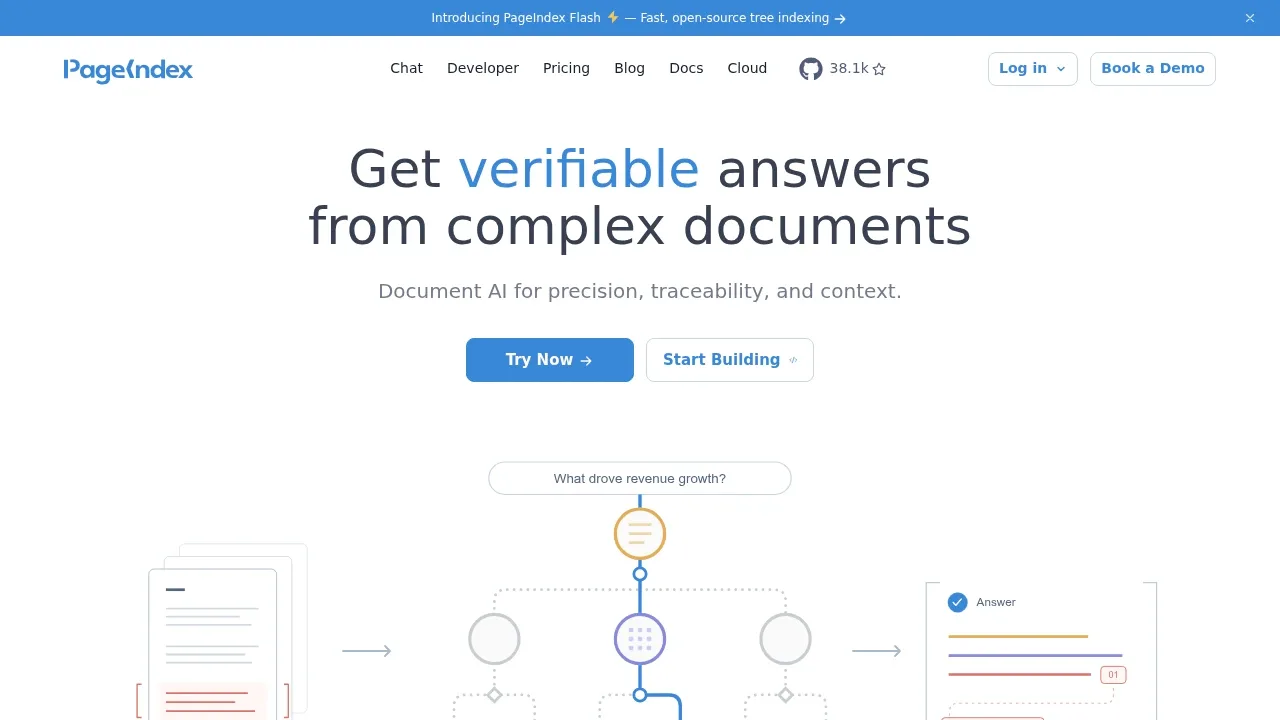
PageIndex is an open-source document RAG engine for developers building question answering over long PDFs, such as financial reports, legal documents and technical manuals. It organizes documents into a hierarchical tree and uses an LLM to find relevant sections, rather than relying on vector similarity search. It doesn't require a vector database or document chunking.
The Python SDK supports local indexing, retrieval and chat with your own LLM key. Document indexing and storage stay on your machine in local mode; model calls use the LLM you connect, so local mode doesn't itself mean offline inference. The MIT-licensed version focuses on text-based PDFs and provides page-level citations. Retrieval can take conversation history and domain knowledge into account, and it reads selected sections instead of sending the entire PDF for every question.
For applications, the SDK supports streaming responses and searches across multiple documents. You can connect its retrieval tools to the OpenAI Agents SDK or Claude Agent SDK. Its explicit document references help readers check answers against the original pages.
PageIndex Cloud runs document indexing and storage on PageIndex's servers. It adds OCR and image understanding for scanned or image-rich documents, block-level citations, and an MCP server. Chat and retrieval remain compatible with your chosen model provider. The cloud offering also has a file-level tree index for searching across a document corpus; dedicated VPC and on-premises deployments are available.
Claim this page with an email at pageindex.ai. PageIndex gets the verified badge, and you can upgrade the listing to be featured on localhosted. Proud to be listed? Put our badge on your site.
Want more people to find PageIndex?Promote it
Something wrong or outdated on this page?
39.9KUpdated 6 days agoMIT
macOS · Windows · Linux · Docker · Web#Knowledge graphs#LLM tracing#Multimodal input
LightRAG combines knowledge graphs with vector search to answer questions across a document collection. It's a self-hosted Python framework for developers building document assistants, particularly where answers depend on relationships between facts in different files, such as legal or financial material.
91.6KUpdated 23 hours agoApache-2.0
macOS · Windows · Linux · Docker#Hybrid search#MCP#Multi-agent workflows
52.4KUpdated 13 hours agoMIT
#Ollama integration#RAG#Reranking
3.7KUpdated 2 days ago
Docker · Web#MCP#Multi-user access#Multimodal input
Morphik Core is a self-hosted multimodal retrieval engine for developers building AI applications around visually rich documents. It searches diagrams, schematics, charts, and datasheets alongside text, so applications can retrieve information that text extraction alone can miss. You can run it on your own server, including through Docker, or use Morphik's hosted service.
4.8KUpdated 1 month agoMIT
Docker#Agent Skills#Multilingual
Chonkie is an MIT-licensed, open-source library for developers preparing documents for retrieval-augmented generation (RAG). It combines text cleaning, chunking, embeddings and vector database ingestion, so you don't have to assemble each stage from separate libraries. It runs locally or in the cloud, with Python and JavaScript support and a self-hosted REST API that can run in Docker.
18.3KUpdated 1 day agoMIT
macOS · Windows · Linux · Docker · Web#Human approval#Hybrid search#llama.cpp backend
RAGFlow is an Apache 2.0 licensed RAG engine for teams building AI agents that need to answer questions from their own documents. It can run on a self-hosted server through Docker on Windows, macOS or Linux. A separate hosted cloud service is available.
LlamaIndex is an MIT-licensed Python framework for developers building AI agents and apps that answer questions using their own data. It connects documents and other sources to language models, then helps an app find the relevant material when a user asks something. Its open source framework can work with models served through Ollama.
DocsGPT is an MIT-licensed, open-source platform for teams that want AI search, assistants and agents over their own documents. It can run on your servers with local models, including fully air-gapped deployments where documents and questions stay inside your network. Answers include the source title and page number so readers can check the evidence.