
PicoClaw
Self-hosted AI assistant for small Linux devices, desktops and Android. Connects to local models through Ollama or vLLM, plus hosted providers.
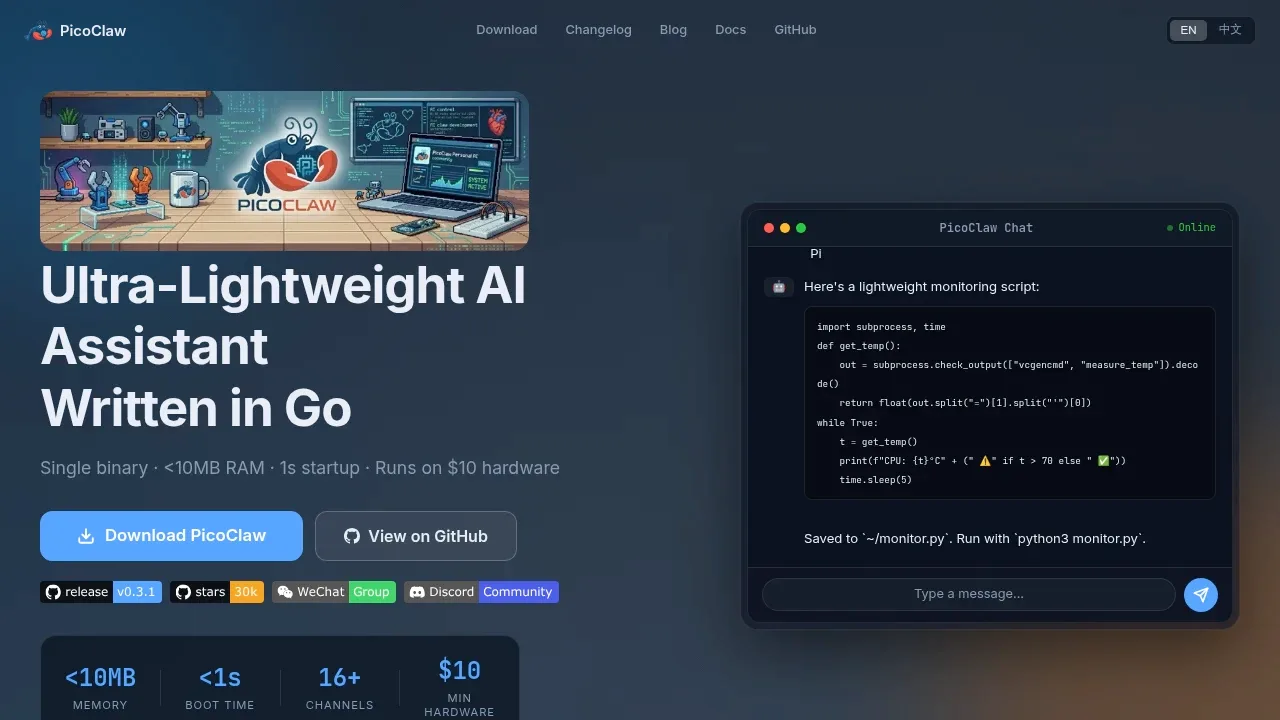
PicoClaw is a self-hosted personal AI assistant that can use local models through Ollama or vLLM. It's aimed at people who want an agent on their own hardware, including small Linux boards and Android phones. Hosted providers are optional, but choosing OpenAI, Anthropic, Google Gemini or DeepSeek sends model requests to those services and requires internet access and API keys.
Its Go implementation keeps the assistant's memory footprint small enough for devices such as Raspberry Pi and LicheeRV-Nano. The application supports ARM, RISC-V, MIPS and x86 hardware, with desktop support for Windows, macOS and Linux and a Docker deployment option. That small application footprint doesn't describe the resources needed to run a local model.
You can chat through its browser interface or connect Telegram, Discord, WhatsApp, Slack, Matrix and other messaging services. These channels have their own accounts and network dependencies, even when the model runs locally. Images and files can accompany requests to models that accept multimodal input.
Built-in tools cover file operations, code execution, web search and scheduled reminders or recurring tasks. MCP connects external tools and data sources, and reusable Skills extend the agent's task guidance. Model-routing rules can send simpler requests to lighter models. Web search includes support for self-hosted SearXNG.
PicoClaw is an independent Sipeed project with an MIT-licensed open-source core. The project cautions that unresolved security issues may remain and advises against production deployment.
 Logotyper


