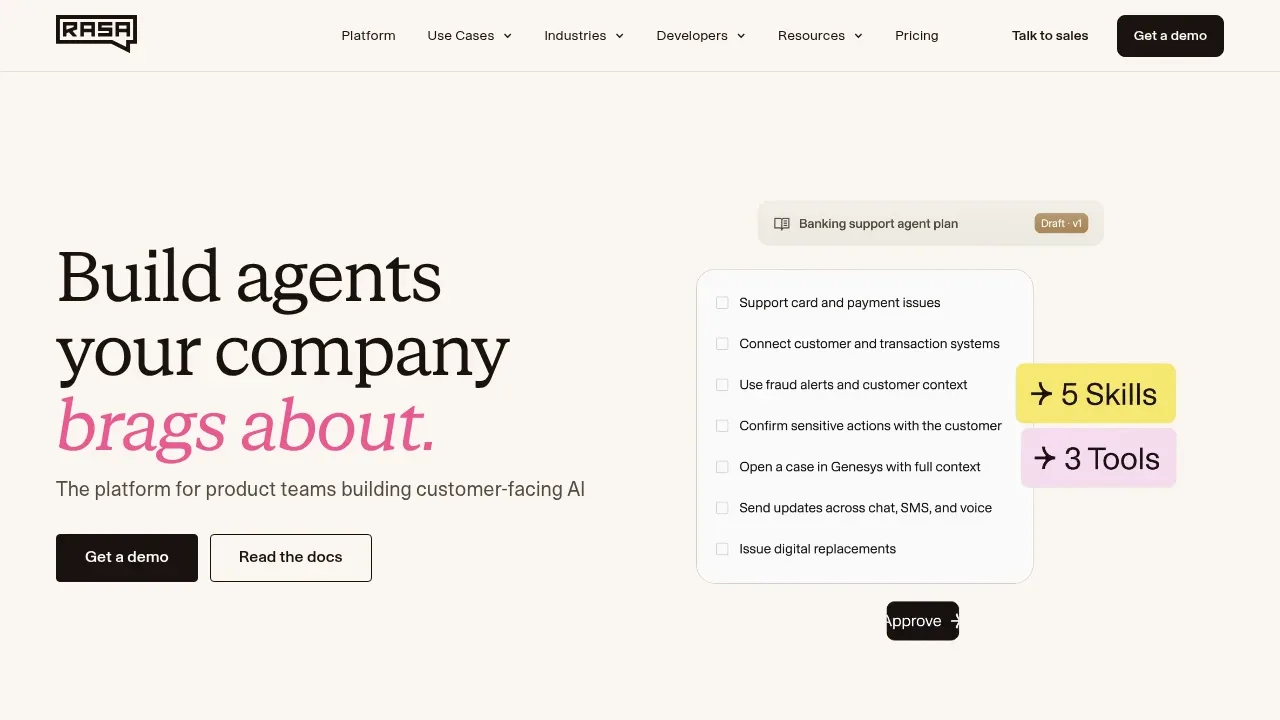
Rasa is an AI agent platform for product teams building customer-facing text and voice assistants. Teams can deploy agents on their own infrastructure and choose their models and data arrangements. Its CALM engine combines language model understanding with business flows whose code enforces rules, so an assistant can handle conversational wording while following defined processes.
The platform covers development, evaluation, and monitoring. Teams can test agents against simulated voice and text conversations, compare versions, and run end-to-end checks before deployment. Conversation analysis tags and groups findings for review, while decision traces and audit trails help teams investigate agent behavior. One agent can serve a hotline, Slack, web chat, WhatsApp, and email.
Studio gives product teams a visual workspace for building and reviewing agents, with changes stored as code in a shared repository. Developers can work in that same codebase through their IDE, CLI, and SDKs. Rasa MCP Tools connect coding agents to the repository for automated builds, tests, and reviews. The modular platform can work alongside existing agents or provide the base for a team's agent development.
Hello Rasa is a browser playground for prototyping CALM agents, with a copilot for code and flow debugging and export to the Rasa Platform. The separate classic Rasa Open Source framework is Python software under the Apache 2.0 license and is in maintenance mode. It provides language understanding and dialogue management for contextual text and voice assistants.
Claim this page with an email at rasa.com. Rasa gets the verified badge, and you can upgrade the listing to be featured on localhosted. Proud to be listed? Put our badge on your site.
Want more people to find Rasa?Promote it
Something wrong or outdated on this page?
42.4KUpdated 1 day agoApache-2.0
Docker · Web#Guardrails#Human approval#LLM tracing
Agno is a Python framework and runtime for developers building customer-facing or internal AI agents. You can run its agent platform locally with Docker, on your own servers or in your cloud. The open-source framework uses the Apache 2.0 license, and the platform keeps sessions, memory, knowledge and traces in your database.
28.4KUpdated 21 hours ago
Web#Human approval#LLM tracing#MCP
Mastra is a TypeScript framework for developers building AI agents and applications on their own servers or inside existing web apps. Its server runs locally or as a standalone deployment; Mastra Cloud provides a hosted alternative. Model routing connects to providers such as OpenAI, Anthropic, and Gemini, so running the framework locally doesn't keep those model requests on your machine.
9.4KUpdated 1 day agoApache-2.0
macOS · Windows · Linux · iOS · Android · Web#Batch processing#LLM tracing#Structured output
BAML is a programming language for developers building AI agents, with typed model calls and local tracing built into the language. It runs standalone on macOS, Linux and Windows, or alongside an existing application. The language is open source under Apache 2.0, and works offline.
4.7KUpdated 2 days agoMIT
Docker · Web#Git integration#LLM tracing#MCP
Latitude is a self-hosted AI agent monitoring platform for teams that need to find production failures and check that fixes work. It connects recurring problems to the sessions that caused them, then can dispatch Claude Code or Cursor with enough context to make a fix and open a pull request.
11.7KUpdated 23 hours ago
Docker · Web#LLM tracing#MCP#Ollama integration
Arize Phoenix is a self-hosted platform for developers who need to understand why an AI agent failed and test changes before shipping them. It runs on a laptop, in Docker, or on Kubernetes. Self-hosting keeps traces on your infrastructure; Phoenix Cloud provides a hosted alternative. Phoenix uses the Elastic License 2.0 (ELv2), a source-available license.
47.9KUpdated 1 day agoGPL-2.0
Linux · Web#LLM tracing#Multi-user access#Structured output
Discourse AI is the official AI plugin bundled with Discourse. Forum administrators can enable its features independently, including an AI bot, semantic search, topic and chat summaries, spam detection and writing assistance. It runs inside a Discourse community, which you can host on your own server.