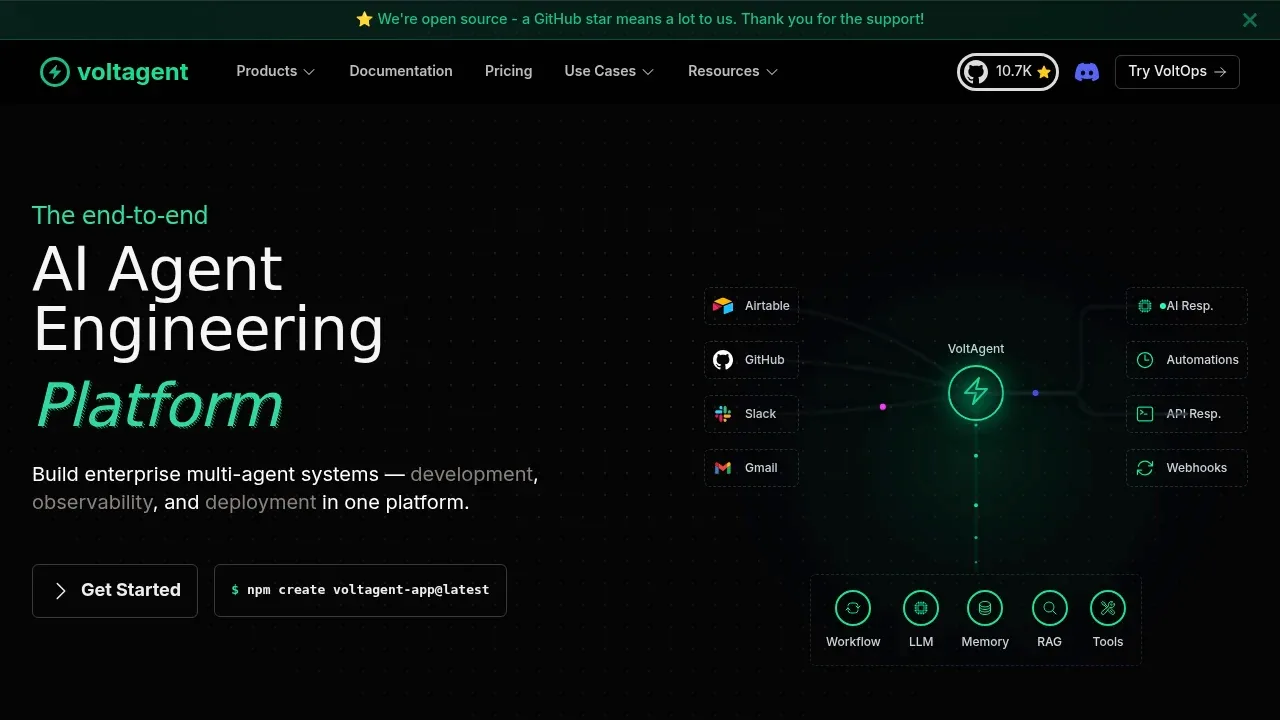
VoltAgent is an MIT-licensed TypeScript AI agent framework for developers building assistants and automated workflows. It pairs code-based agent development with VoltOps, a console for inspecting execution and managing agents. The console can run on your own server or as a cloud service; managed deployment uses hosted infrastructure.
The framework supports agents with memory, access to tools, and retrieval-augmented generation (RAG) for working with knowledge sources. Specialized agents can work under a supervisor that assigns tasks and coordinates their work. Multi-step workflows support human approval, with the ability to pause and resume execution.
Model support includes OpenAI, Anthropic, and Google. Developers can change providers without rewriting the agent logic. MCP connections let agents use external tools, while voice support and guardrails cover spoken interactions and content boundaries. Self-hosting the console is separate from model hosting: these named providers process model requests through their services.
VoltOps exposes execution traces, logs, and performance metrics so developers can investigate what happened during an agent run. It also lets them inspect memory and conversation history, test prompts, and run evaluations of agent behavior and accuracy.
For event-driven automation, workflows can respond to webhooks, schedules, and custom triggers. Slack actions support channel replies, and Airtable actions let agents react to records and write updates back.
Claim this page with an email at voltagent.dev. VoltAgent gets the verified badge, and you can upgrade the listing to be featured on localhosted. Proud to be listed? Put our badge on your site.
Want more people to find VoltAgent?Promote it
Something wrong or outdated on this page?
28.5KUpdated 8 hours ago
Web#Human approval#LLM tracing#MCP
Mastra is a TypeScript framework for developers building AI agents and applications on their own servers or inside existing web apps. Its server runs locally or as a standalone deployment; Mastra Cloud provides a hosted alternative. Model routing connects to providers such as OpenAI, Anthropic, and Gemini, so running the framework locally doesn't keep those model requests on your machine.
42.5KUpdated 12 hours agoApache-2.0
Docker · Web#Guardrails#Human approval#LLM tracing
157.7KUpdated 6 hours ago
Docker · Web#Code execution#MCP#OpenAI-compatible API
6.5KUpdated 18 hours agoApache-2.0
Web#LLM tracing#Multimodal input#Ollama integration
483Updated 2 months agoMIT
macOS · Web#Guardrails#LLM tracing#Multi-agent workflows
556Updated 3 weeks agoApache-2.0
Web · VS Code#Human approval#LLM tracing#MCP
Agno is a Python framework and runtime for developers building customer-facing or internal AI agents. You can run its agent platform locally with Docker, on your own servers or in your cloud. The open-source framework uses the Apache 2.0 license, and the platform keeps sessions, memory, knowledge and traces in your database.
Dify is a source-available platform for teams building AI agents and apps on a visual canvas. Its Community Edition runs on your own server with Docker. Dify also offers a hosted cloud service, while Enterprise deployments can run in a VPC or on a self-hosted server. The Community Edition uses a custom Apache 2.0 derivative license.
Genkit is Google's open-source framework for developers building AI applications and agents with local or cloud models. Its shared API connects to Ollama as well as hosted providers such as Gemini, OpenAI and Anthropic. You can host the application logic yourself. The framework uses the Apache 2.0 license.
HarnessX is a self-hosted Python framework for developers and researchers building AI agents for coding, research, or assistant tasks. It separates model selection from agent behavior, so you can change memory, tools, or safety checks without rewriting the agent. It's open source under MIT.
MASFactory is an open-source Python framework for developers building workflows in which multiple AI agents work together. Its Vibe Graphing feature drafts a collaboration graph from a plain-language description, then lets people refine and approve the design through dialogue before it becomes an executable workflow. The license is Apache 2.0.