
Sim
An open-source AI agent workspace for building and managing workflows, with Docker or Kubernetes self-hosting and centralized access and spend controls.
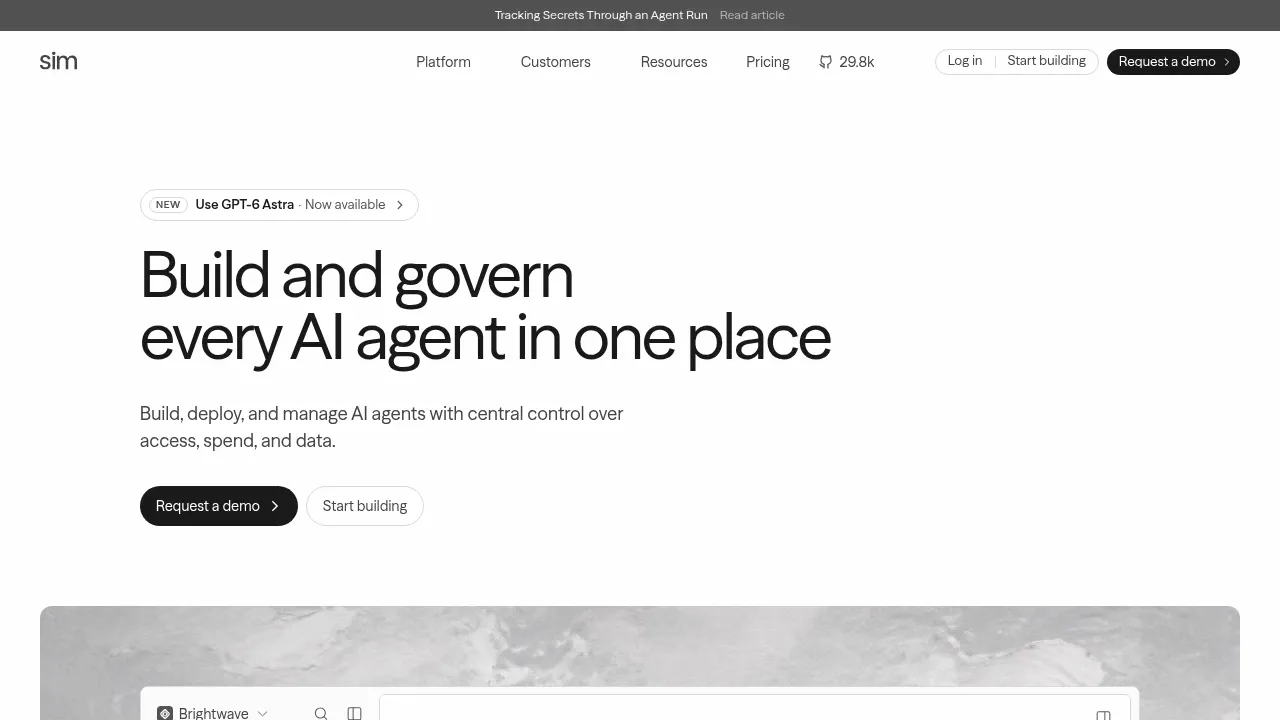
Sim is an AI agent workspace for teams that need to build automations and control how people use them across an organization. You can self-host it on your own server or cloud with Docker or Kubernetes. Its open-source code uses the Apache 2.0 license.
Teams can build agents through conversation, a visual workflow canvas, or code. Workflows connect models with services such as Slack, HubSpot and Salesforce for tasks like lead enrichment and support ticket routing. Model choices include GPT-6 Astra and Claude Sonnet. A CLI also lets developers build, run and manage agents from a terminal or Claude Code.
Shared tables hold structured data that agents can read and update between runs. Files and agent outputs live in a shared store, while knowledge bases sync material from Notion, Google Drive, Confluence and other connected sources. Run logs show each workflow block's inputs, outputs and failures, alongside cost and performance data.
The governance controls suit organizations managing agents across multiple teams. Permission groups restrict access to models, integrations and tools; spend controls track costs and set usage limits. Sim also supports SSO and SCIM, audit records, and workspace-specific retention for run data.
Self-hosting doesn't make every component local: chat uses a Sim-managed service and requires a Chat API key obtained through sign-in. You can access the workspace in a browser or through its macOS desktop app, which supports Apple Silicon and Intel Macs and can connect to a self-hosted deployment.


