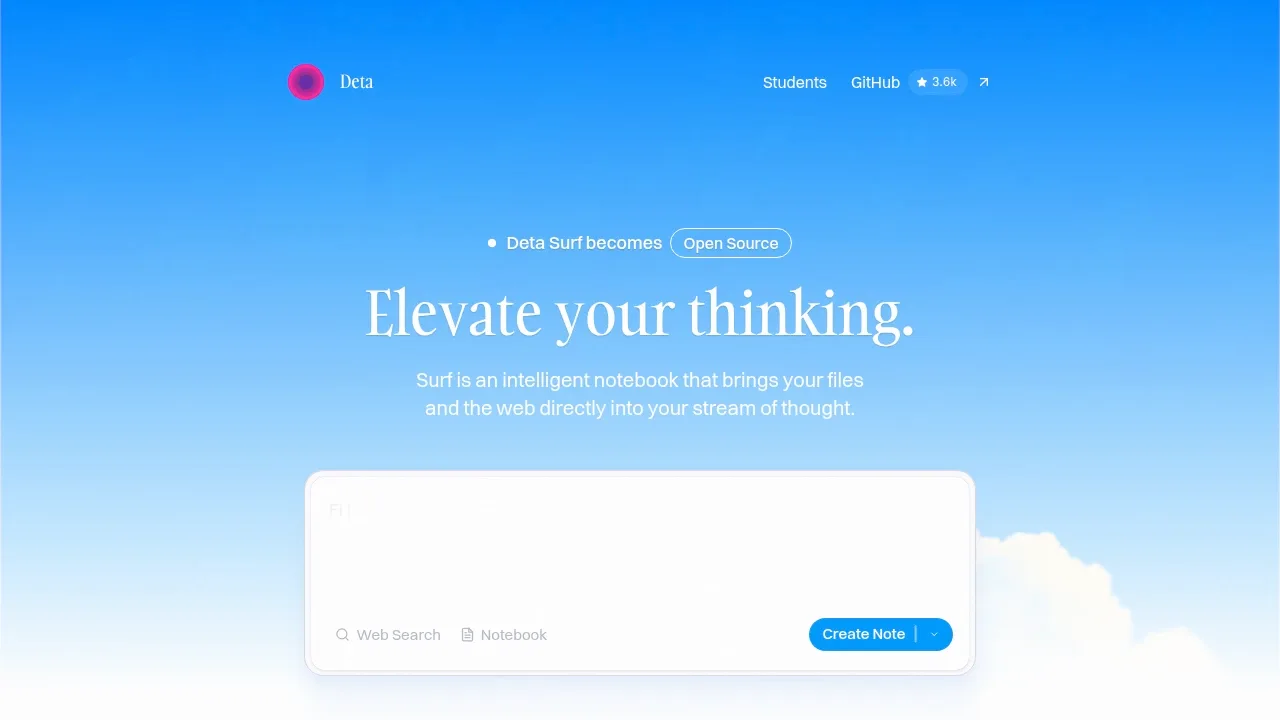
Surf combines an AI notebook with web browsing for people researching across websites, videos and documents. It runs on macOS, Windows and Linux and keeps your library on your device in open formats. You can collect source material, ask questions about it and write notes in the same workspace.
Its AI can draw on websites, YouTube videos, PDFs and images, including material you've saved in your library. Notes can include web search results and citations that point to a specific webpage section, video timestamp or PDF page. That gives you a way to check an answer against the material it came from without hunting through the whole source.
Notebooks hold files, links, images and your own writing. Tabs and split view let you read sources beside your notes, while the editor supports tables, code blocks and to-do lists. You can open and use much of your saved library offline; web searches and cloud models need an internet connection.
You choose the AI backend. Surf supports local LLMs as well as cloud models using your own API key, so local data storage doesn't mean every AI request stays on your machine. The project is open source under Apache 2.0, and you can import, export and manage your stored data.
For research that benefits from interaction, Surflets generate small apps and graphs without requiring you to write code. These applets can help you explore concepts or data within the notebook.
Claim this page with an email at deta.surf. Surf gets the verified badge, and you can upgrade the listing to be featured on localhosted. Proud to be listed? Put our badge on your site.
Want more people to find Surf?Promote it
Something wrong or outdated on this page?
247Updated 2 days agoAGPL-3.0
macOS · Windows · Linux · Docker#Hybrid search#MCP#Multimodal input
Marginalia is a local-first AI research agent for people whose research papers, notes and working documents are scattered across different formats. It checks relevant passages in the original files before writing answers with citations. Your library stays in readable folders by default.
77KUpdated 3 months agoAGPL-3.0
macOS · Windows · Linux · iOS · Android · Web#MCP#Multi-user access#RAG
292Updated 1 week ago
macOS · Windows · Docker · Web#Human approval#Knowledge graphs#MCP
Revornix is a self-hosted AI workspace for people who collect research, articles and meeting recordings and want to search or ask questions across them. It turns saved material into Markdown, connects it in a personal knowledge graph, and produces summaries, illustrated reports or two-voice podcasts.
361Updated 3 weeks agoAGPL-3.0
#Ollama integration#RAG#Semantic search
7.8KUpdated 13 hours agoAGPL-3.0
#LM Studio integration#Multi-agent workflows#Ollama integration
4KUpdated 13 hours agoAGPL-3.0
Docker · Web#Multi-user access#Multilingual#Prompt caching
AppFlowy is a self-hosted Notion alternative for teams that want project management, shared documents, and AI in an environment they control. Its self-hosted enterprise offering can run on premises, in your own cloud, or in an air-gapped environment. Self-hosted LLMs and embedding models let you keep AI processing and workspace data inside your infrastructure, with no vendor access to your instance.
Joplin Jarvis is an AI assistant for people who keep their writing, research, or personal knowledge in Joplin on desktop and mobile. It connects conversations to your existing notes and supports local LLMs through Ollama alongside cloud services such as GPT, Claude, Gemini, and Hugging Face.
Obsidian Copilot brings AI agents into your vault to find notes by meaning, edit drafts and organize research. It's for writers, researchers and other Obsidian users who want AI to work directly with their existing notes. Agents create Markdown files, wikilinks and canvases that remain in your vault.
Speakr is a self-hosted transcription and note-taking app for meetings, interviews and lectures. Its browser interface can record microphone and system or browser-tab audio, or accept existing files. The app runs on your server and supports Docker deployment.