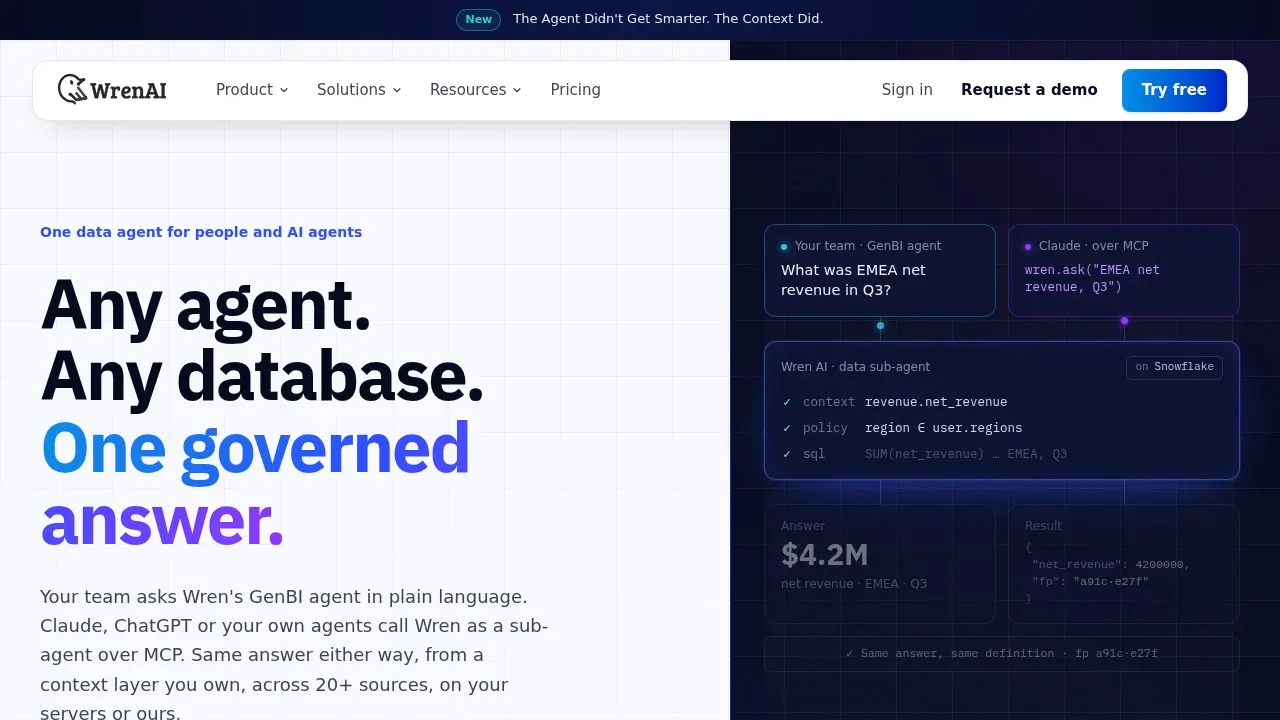
Wren AI is a self-hosted data agent for teams and agent builders who need answers based on agreed business definitions. It turns plain-language questions into SQL and interactive dashboards, using the same definitions when someone asks directly or through Claude, ChatGPT or Gemini over MCP.
Its context layer holds approved metrics, relationships between tables, units and business knowledge that database schemas alone don't capture. Teams keep that context in Git as reviewable YAML and Markdown. This gives agents a shared definition of terms such as revenue rather than leaving each agent to interpret them independently.
Wren queries data where it already lives, without requiring ETL or a database migration. Connections include PostgreSQL, Snowflake, BigQuery, ClickHouse, Databricks and DuckDB. Dashboards support drill-down, roll-up and filters, while product teams can embed analytics under their own brand through an iframe, API or MCP.
The commercial platform includes row- and column-level access controls, role-based permissions and audit logs. Its agent can reason in an isolated sandbox, with replayable traces for inspecting its work. Developers can also connect it to LangChain and LangGraph.
You can run Wren on your own servers, in a VPC or fully air-gapped on-premises; Wren AI Cloud is the hosted offering. The context engine can run without a vendor account, and the engine uses Apache DataFusion.
Claim this page with an email at getwren.ai. Wren AI gets the verified badge, and you can upgrade the listing to be featured on localhosted. Proud to be listed? Put our badge on your site.
Want more people to find Wren AI?Promote it
Something wrong or outdated on this page?
2.4KUpdated 3 days agoAGPL-3.0
macOS · Windows · Web#Code execution#MCP#Multimodal input
PenEcho is an open-source workspace that puts handwritten notes, diagrams and AI-generated widgets on an infinite canvas. It runs on your computer as a macOS or Windows app, or through Node.js with a browser interface. It's for people who want to work through technical ideas visually and give AI feedback by drawing directly on the result.
3.4KUpdated 1 month agoMIT
macOS · Windows · Linux · Docker#Code execution#MCP#Tool calling
24.8KUpdated 1 day ago
Docker · Web#Code execution#Human approval#MCP
42.4KUpdated 1 day agoApache-2.0
Docker · Web#Guardrails#Human approval#LLM tracing
8.5KUpdated 23 hours agoApache-2.0
Web#LLM tracing#MCP#Multimodal input
31.2KUpdated 21 hours agoApache-2.0
Docker · Web#Knowledge graphs#MCP#Multi-user access
Postgres MCP Pro is a self-hosted MCP server that gives AI assistants access to PostgreSQL alongside tools for diagnosing slow queries and testing index recommendations. It's for developers and database maintainers who want their assistant to work with the database's actual schema, query statistics and execution plans. It runs through Docker or Python and is open source under the MIT license.
Activepieces brings AI agents and workflow automation into one workspace for teams that need to connect their apps and internal data. It runs on your own servers with Docker or Kubernetes, or as a managed cloud service. An isolated deployment can keep platform data on its own infrastructure; connected apps and model providers may still require external access. Its core and app integration pieces are MIT-licensed.
Agno is a Python framework and runtime for developers building customer-facing or internal AI agents. You can run its agent platform locally with Docker, on your own servers or in your cloud. The open-source framework uses the Apache 2.0 license, and the platform keeps sessions, memory, knowledge and traces in your database.
Bifrost is a self-hosted AI gateway for developers and teams whose applications use multiple model providers. It puts Ollama, custom model deployments, and cloud services behind one OpenAI-compatible API, so applications can switch models without maintaining a separate integration for each provider.
Cognee gives AI agents persistent memory across sessions, connecting documents, code, and conversations in a searchable knowledge graph. It's for developers who want agents to retain project context and teams whose knowledge sits across tickets, discussions, and repositories. The Python package is open source under Apache 2.0.