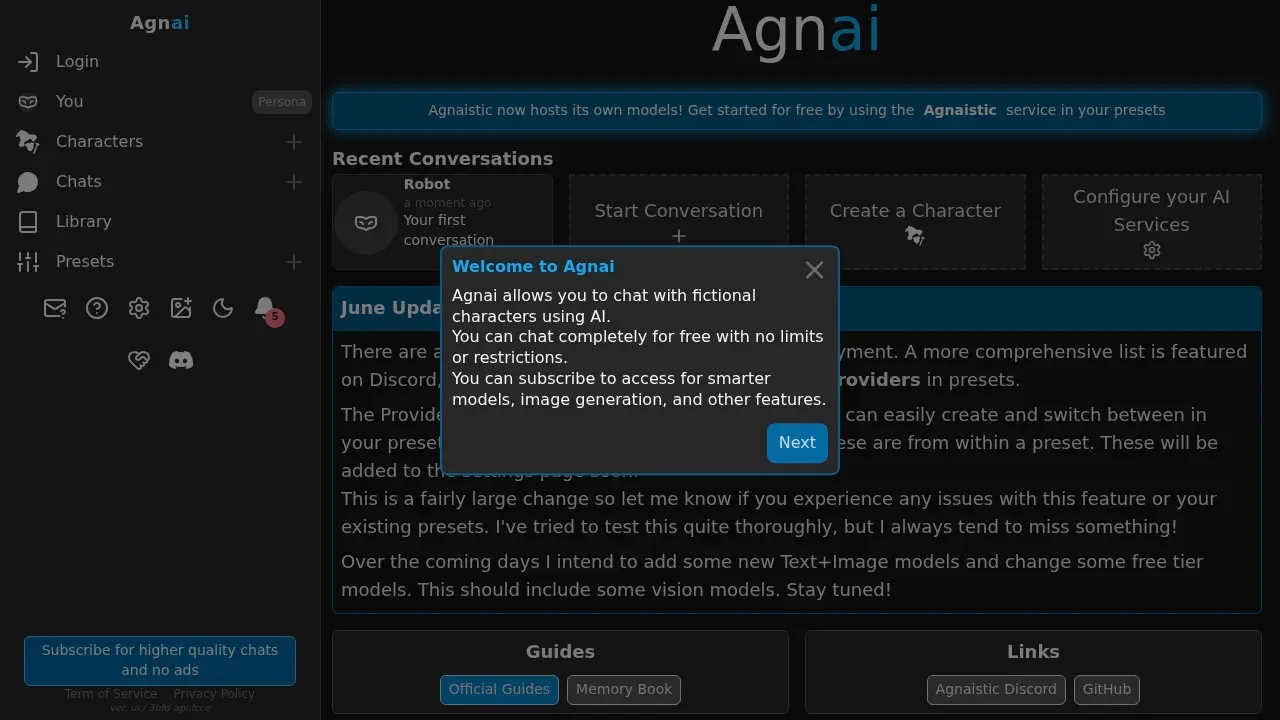
Agnai is a self-hosted AI roleplay chat app for people who want to create fictional characters and talk with them alone or in a group. A conversation can include multiple people and multiple bots. It builds on early work from Galatea-UI by PygmalionAI and uses the AGPL-3.0 open-source license.
You can run the app on your own computer or server, including through Docker, and use it in a browser. It also runs on macOS, Linux and Windows through Node.js. Agnai.chat provides a hosted version with its own models. Self-hosting runs the chat app on your hardware; choosing an external AI service sends generation requests to that service.
Its choice of backends includes Kobold, AI Horde, OpenAI, Claude, OpenRouter and Mancer. Reusable provider connections and generation presets let you keep different service settings for different conversations. The Claude connection supports images and reasoning options.
Character tools support several persona formats, including W++, SBF and plain text, alongside AI-assisted character creation. Memory and lore books supply background information for roleplay, while optional long-term memory and PDF or Wikipedia embeddings add material the chat can draw on. Image generation uses third-party services.
Guest access doesn't require an account. In guest mode, the browser stores your data locally, so it doesn't carry across browsers or devices. A self-hosted instance can also support user authentication, individual settings and presets, with MongoDB for persistent storage.
Claim this page with an email at agnai.chat. Agnai gets the verified badge, and you can upgrade the listing to be featured on localhosted. Proud to be listed? Put our badge on your site.
Want more people to find Agnai?Promote it
Something wrong or outdated on this page?
11.9KUpdated 4 days agoAGPL-3.0
macOS · Windows · Linux · Android · Docker · Web#GGUF#Hugging Face integration#llama.cpp backend
KoboldCpp pairs local model inference with a browser interface built for chat, creative writing and roleplay. A fork of llama.cpp, it bundles KoboldAI Lite with tools for keeping character details and story context alongside your conversations. It's open source under AGPL-3.0.
voxta.aiAI Characters and Roleplay
Windows · Linux · Android · Web#Code execution#MCP#Multimodal input
1.6KUpdated 1 year agoMIT
Windows · Docker · Web#llama.cpp backend#LM Studio integration#Multimodal input
14KUpdated 5 months ago
macOS · Windows · Linux · Web#GGUF#LM Studio integration#MCP
Open-LLM-VTuber is a local AI companion for people who want a character they can talk to, with a Live2D avatar that responds through speech and expressions. It runs on Windows, macOS and Linux through web and desktop clients. With local models for speech and language processing, it works fully offline and keeps conversations on your device. Cloud APIs are optional alternatives that send the corresponding processing to external services.
1.7KUpdated 2 days agoGPL-3.0
macOS · Windows · Linux · Android · Docker · Web#Multilingual#Persistent memory
49.8KUpdated 23 hours agoMIT
macOS · Windows · Web#Ollama integration
Voxta is an AI companion for people who want a character they can talk to, give work to or use in interactive stories. You choose its personality, voice and optional avatar. The proprietary local-server edition has a browser interface, and AI processing can run entirely on your hardware, through Voxta Cloud or across a mix of local and cloud services.
Amica is a locally runnable interface for talking with customizable 3D AI characters. It's for people who want an animated, voiced character as the face of their AI assistant, with a choice of local LLM backends or cloud services. The project builds on Pixiv's ChatVRM.
RisuAI is an open-source AI roleplay client for people who want to create characters, build fictional worlds and chat with several characters together. It runs on Windows, macOS, Linux, Android and in a browser. You can also host the web app yourself with Docker.
AIRI is a self-hosted AI companion for people who want a virtual character they can talk to and play games with. Inspired by Neuro-sama, it combines real-time voice conversation with game integrations for Minecraft and Factorio. The project is in early development; Factorio support is a work in progress with a proof of concept. It's open source under the MIT license.