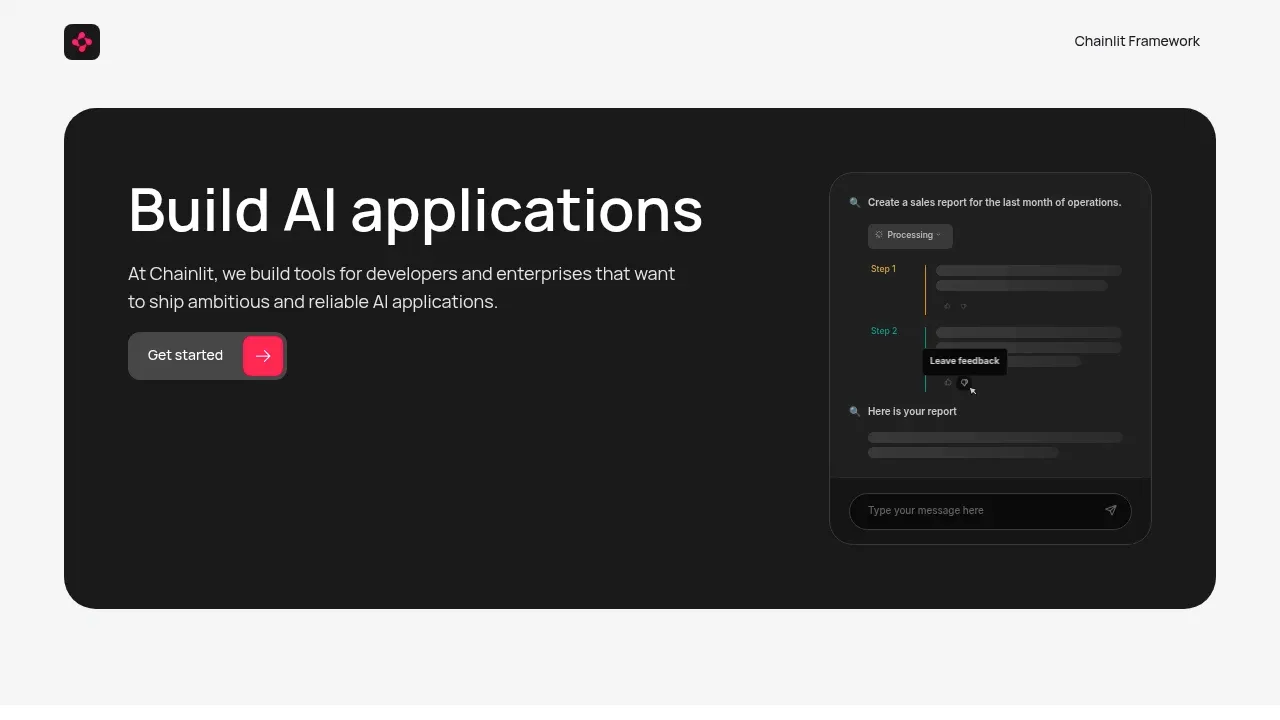
Chainlit is an open-source Python framework for developers building conversational AI apps with their own application logic. You can run the app on your own server and give users a browser chat interface. It's a framework for creating an app, rather than a ready-made chatbot with a fixed model.
Its main appeal is the choice of where that conversation lives. An app can stand alone on the web or appear as an embedded copilot inside another product. Chainlit also supports custom React frontends, FastAPI deployments and bots for Slack, Discord and Teams.
Developers can customize the frontend and create their own chat components. Authentication supports simple sign-in methods and OAuth providers such as GitHub, Google, Azure and Okta, so access control can sit alongside the conversation interface.
Chainlit integrates with LangGraph and LlamaIndex, as well as model providers and tools including OpenAI, Mistral and HuggingFace. That makes it relevant to teams choosing a chat interface around an existing AI stack. Self-hosting the interface doesn't make a connected cloud model local: where model requests go depends on the backend the application uses.
The framework uses the Apache 2.0 license and is community-maintained. Community maintainers handle code review, releases and security.
Claim this page with an email at chainlit.io. Chainlit gets the verified badge, and you can upgrade the listing to be featured on localhosted. Proud to be listed? Put our badge on your site.
Want more people to find Chainlit?Promote it
Something wrong or outdated on this page?
41.2KUpdated 1 day agoAGPL-3.0
macOS · Docker · Web#Code execution#Hybrid search#LM Studio integration
AstrBot brings AI assistants into messaging apps such as Telegram, Discord, Slack, QQ and WeCom. It's an open source platform under AGPL-3.0 for people building personal companions, customer support bots or team automation. You can run it on your own computer or server, including through Docker, or use its desktop app for browser-style chat.
886Updated 2 weeks agoMIT
macOS · Windows · Linux · Docker · Web#Agent Skills#Code execution#Guardrails
390.8KUpdated 18 hours ago
macOS · Windows · Linux · iOS · Android · Docker#Multi-user access#Persistent memory#Tool calling
4.8KUpdated 1 day ago
Docker · Web#Git integration#Human approval#LLM tracing
Agenta is an MIT-licensed, open source workspace for teams that want AI agents to handle tasks in chat and continue recurring work in the background. You can self-host it with Docker Compose or Helm to keep agents and workspace data on your infrastructure, or use Agenta Cloud as a hosted service.
47.9KUpdated 1 day agoGPL-2.0
Linux · Web#LLM tracing#Multi-user access#Structured output
12KUpdated 12 months agoApache-2.0
macOS · Windows · Linux · Docker · Web#Code execution#llama.cpp backend#Multi-user access
PocketPaw is a self-hosted AI agent for people who want a personal assistant that can work with files, write code and use a browser on their own computer or server. It runs on macOS, Windows and Linux, with a web dashboard and access through messaging apps. It is open source under the MIT license.
OpenClaw is a self-hosted AI assistant that connects your own computer to the messaging services you already use. It's for people who want a personal assistant on their laptop, or teams that want to run a shared assistant on their own hardware. The project is open source under the MIT license.
Discourse AI is the official AI plugin bundled with Discourse. Forum administrators can enable its features independently, including an AI bot, semantic search, topic and chat summaries, spam detection and writing assistance. It runs inside a Discourse community, which you can host on your own server.
h2oGPT is a self-hosted ChatGPT alternative for people who want to chat with local models and ask questions about their own documents. The project is archived and no longer maintained. It's open source under Apache 2.0, with support for Linux, macOS, Windows and Docker.