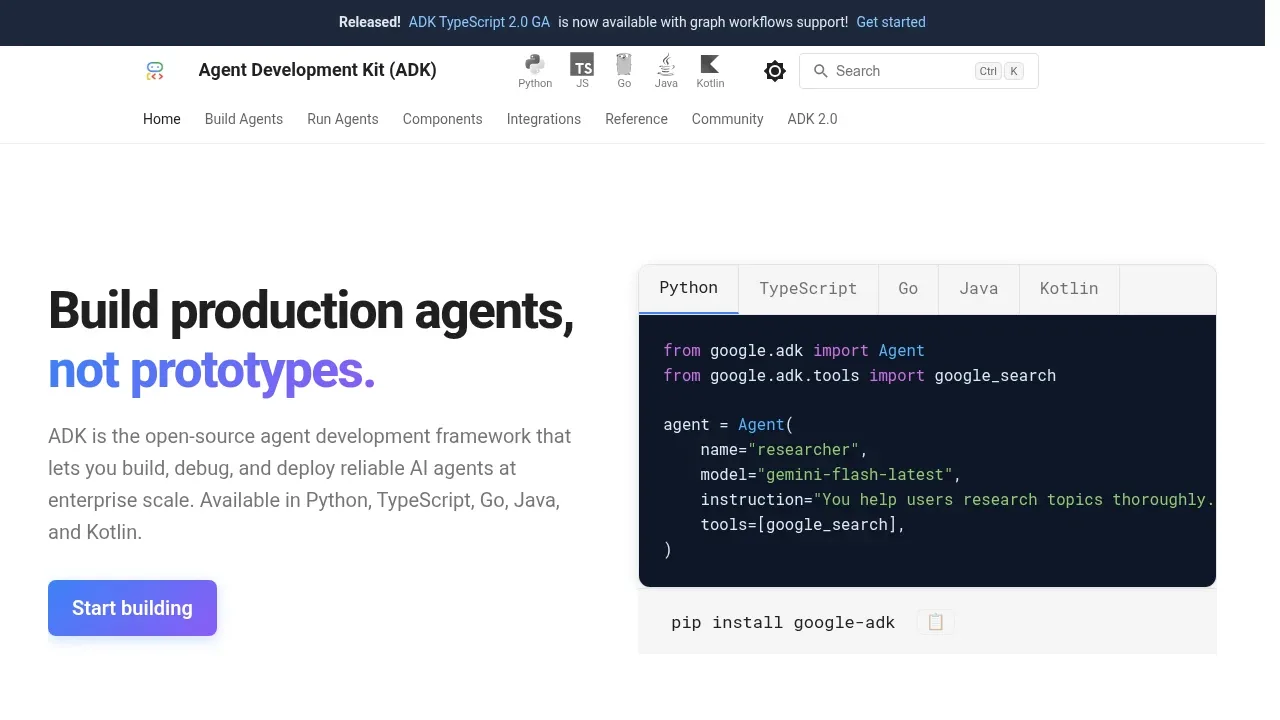
Google ADK is an open-source AI agent framework for developers building applications that carry out multi-step tasks. You can run agents locally in Docker or on your own infrastructure, and connect them to locally running models through adapters. The framework is optimized for Gemini but supports other models and providers. Its Python repository uses the Apache 2.0 license.
ADK combines model reasoning with explicit workflow logic. Graph workflows let developers define execution paths, run tasks in parallel, repeat steps, retry failures, and pause for human input. Multiple specialized agents can delegate work to one another, with support for both ongoing exchanges and single-turn tasks with controlled output. Tool confirmation can require approval before an agent acts.
Agents can use custom functions, MCP tools, and tools described by OpenAPI specifications. A built-in development UI supports testing, debugging, and evaluation, so developers can assess agent behavior before deployment. The framework is available in Python, TypeScript, Go, Java, and Kotlin.
Context management handles sessions, memory, tool results, and artifacts together. It filters irrelevant events, summarizes older conversation turns, loads artifacts as needed, and tracks token usage. Developers can customize that behavior for more complex tasks.
Self-hosting and model hosting are separate choices: agents running on your infrastructure can still call hosted models. ADK also supports deployment to Google Cloud through Agent Runtime, Cloud Run, or GKE.
Claim this page and we'll verify you by hand. Google ADK gets the verified badge, and you can upgrade the listing to be featured on localhosted. Proud to be listed? Put our badge on your site.
Want more people to find Google ADK?Promote it
Something wrong or outdated on this page?
42.4KUpdated 1 day agoApache-2.0
Docker · Web#Guardrails#Human approval#LLM tracing
Agno is a Python framework and runtime for developers building customer-facing or internal AI agents. You can run its agent platform locally with Docker, on your own servers or in your cloud. The open-source framework uses the Apache 2.0 license, and the platform keeps sessions, memory, knowledge and traces in your database.
29.8KUpdated 23 hours agoMIT
macOS · Windows · Linux#Code execution#Guardrails#Human approval
20.3KUpdated 1 hour agoMIT
#Human approval#LLM tracing#MCP
24.8KUpdated 1 day ago
Docker · Web#Code execution#Human approval#MCP
41.2KUpdated 1 day agoAGPL-3.0
macOS · Docker · Web#Code execution#Hybrid search#LM Studio integration
34.4KUpdated 2 months agoApache-2.0
macOS · Windows · Linux · Docker · Web#Batch processing#Human approval#MCP
OpenAI Agents SDK is an open-source Python framework for developers building AI apps that need to use tools, delegate tasks, or work across multiple steps. Its runtime manages agent turns and conversation state while letting developers express workflows in ordinary Python. It uses the MIT license.
Pydantic AI is a Python SDK for developers building AI agents into their own applications. Its main draw is Pydantic validation across agent tools and results, so an agent can return structured data that application code can check and use. The SDK is MIT licensed.
Activepieces brings AI agents and workflow automation into one workspace for teams that need to connect their apps and internal data. It runs on your own servers with Docker or Kubernetes, or as a managed cloud service. An isolated deployment can keep platform data on its own infrastructure; connected apps and model providers may still require external access. Its core and app integration pieces are MIT-licensed.
AstrBot brings AI assistants into messaging apps such as Telegram, Discord, Slack, QQ and WeCom. It's an open source platform under AGPL-3.0 for people building personal companions, customer support bots or team automation. You can run it on your own computer or server, including through Docker, or use its desktop app for browser-style chat.
ChatDev is a self-hosted platform for building teams of AI agents through a visual workflow editor. It's for people who want agents to collaborate on research, data analysis or software projects without writing the orchestration code themselves. You define each agent's role and how information passes between them.