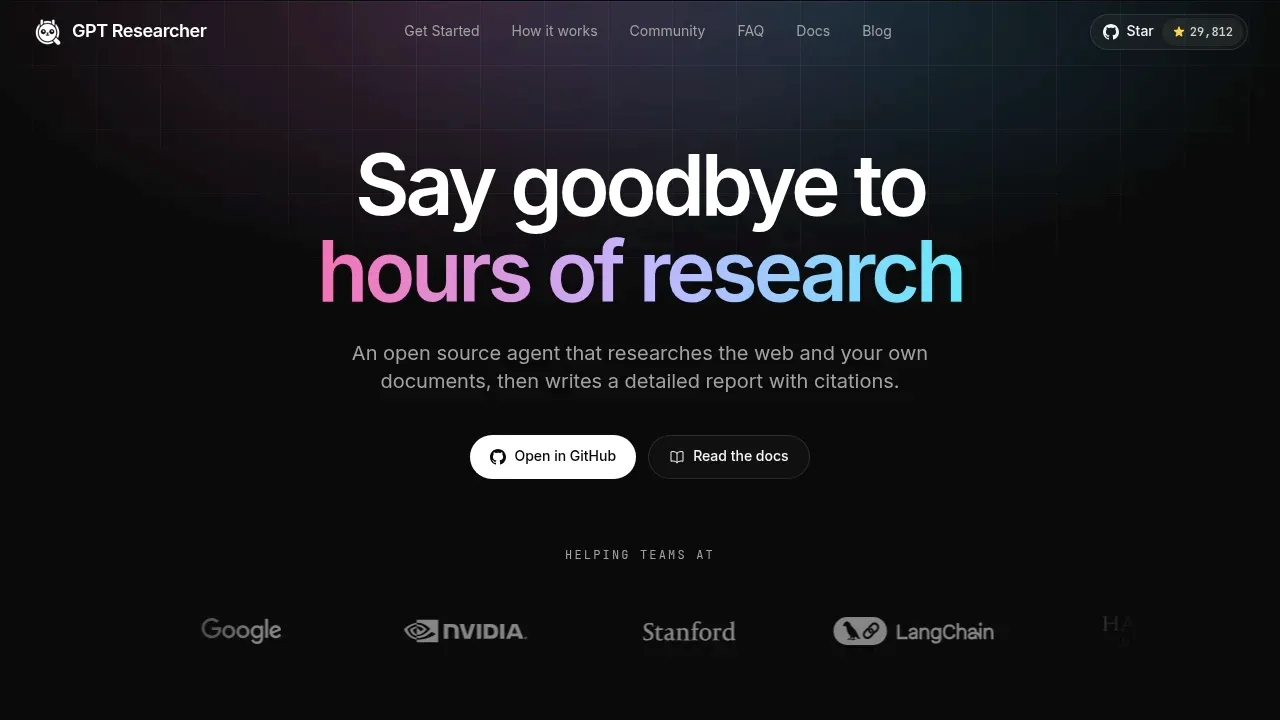
GPT Researcher is a self-hosted AI research agent for people who need detailed, cited reports drawn from the web, their own documents, or both. You choose the language model and search provider, and can run the software on your own server or through Docker. It's open source under Apache 2.0.
The agent breaks a question into smaller research tasks, investigates them in parallel, and follows findings into further subtopics. It filters source passages before writing, then includes inline citations so readers can check the evidence. Reports can exceed the length of a typical chat response and export to PDF, Word, Markdown, JSON or CSV.
Model choices include local models through Ollama and cloud providers such as OpenAI, Anthropic, Google, Mistral and DeepSeek. Web research needs internet access; cloud LLM and search APIs send requests to external providers. Choosing local files as the research source doesn't by itself keep processing local, since the agent can still use a cloud model.
For document research, it reads PDF, plain text, spreadsheets, Markdown, PowerPoint and Word files. Search connections include Tavily, Google, Bing, DuckDuckGo and SearXNG, with arXiv and PubMed available for academic material. MCP connections extend research to repositories, databases and custom APIs. The companion gptr-mcp server brings research and report-writing capabilities into Claude Desktop, Cursor and n8n.
Claim this page with an email at gptr.dev. GPT Researcher gets the verified badge, and you can upgrade the listing to be featured on localhosted. Proud to be listed? Put our badge on your site.
Want more people to find GPT Researcher?Promote it
Something wrong or outdated on this page?
9.1KUpdated 21 hours agoMIT
macOS · Windows · Linux · Docker · Web#llama.cpp backend#MCP#Multi-user access
Local Deep Research is a self-hosted AI research assistant for people who need cited answers drawn from academic papers, the web and their own documents. It can produce a quick summary or pursue a complex question through repeated searches, then assemble a structured report. It's open source under MIT.
32.3KUpdated 24 hours ago
Docker · Web · Browser Extension#MCP#Multi-user access#Ollama integration
29.4KUpdated 4 days agoAGPL-3.0
iOS · Android · Docker · Web · Browser Extension#MCP#Multi-user access#Ollama integration
perfectmemory.aiAI Notes and Knowledge Bases
macOS · Windows#LM Studio integration#MCP#Ollama integration
30.1KUpdated 3 weeks agoMIT
macOS#GGUF#Hugging Face integration#Hybrid search
42.4KUpdated 1 day agoApache-2.0
Docker · Web#Guardrails#Human approval#LLM tracing
Onyx is an AI search and chat platform for teams whose information is spread across workplace apps. It indexes company knowledge so employees can ask questions across sources and get answers grounded in relevant documents. Teams can deploy it in their own cloud or on bare metal, including an air-gapped environment.
Karakeep is a bookmark manager for people who collect links, notes, images and PDFs in one place. You can run the open source app on your own server with Docker under the AGPL-3.0 license, or use the managed Karakeep Cloud service. It has a web app, iOS and Android apps, and extensions for Chrome, Firefox and Safari.
Perfect Memory AI keeps a searchable record of what you've seen on your screen and heard in meetings on Mac and Windows. It's for people who need to find a page, presentation or conversation again without remembering which app held it. Recordings stay on your device, and search returns material you've actually seen or heard.
QMD is a local search engine for people with Markdown notes, meeting transcripts, or documentation they want to search themselves or make available to an AI agent. It accepts exact keywords and natural-language queries, with indexing and model inference running on your own machine. It's open source under MIT.
Agno is a Python framework and runtime for developers building customer-facing or internal AI agents. You can run its agent platform locally with Docker, on your own servers or in your cloud. The open-source framework uses the Apache 2.0 license, and the platform keeps sessions, memory, knowledge and traces in your database.