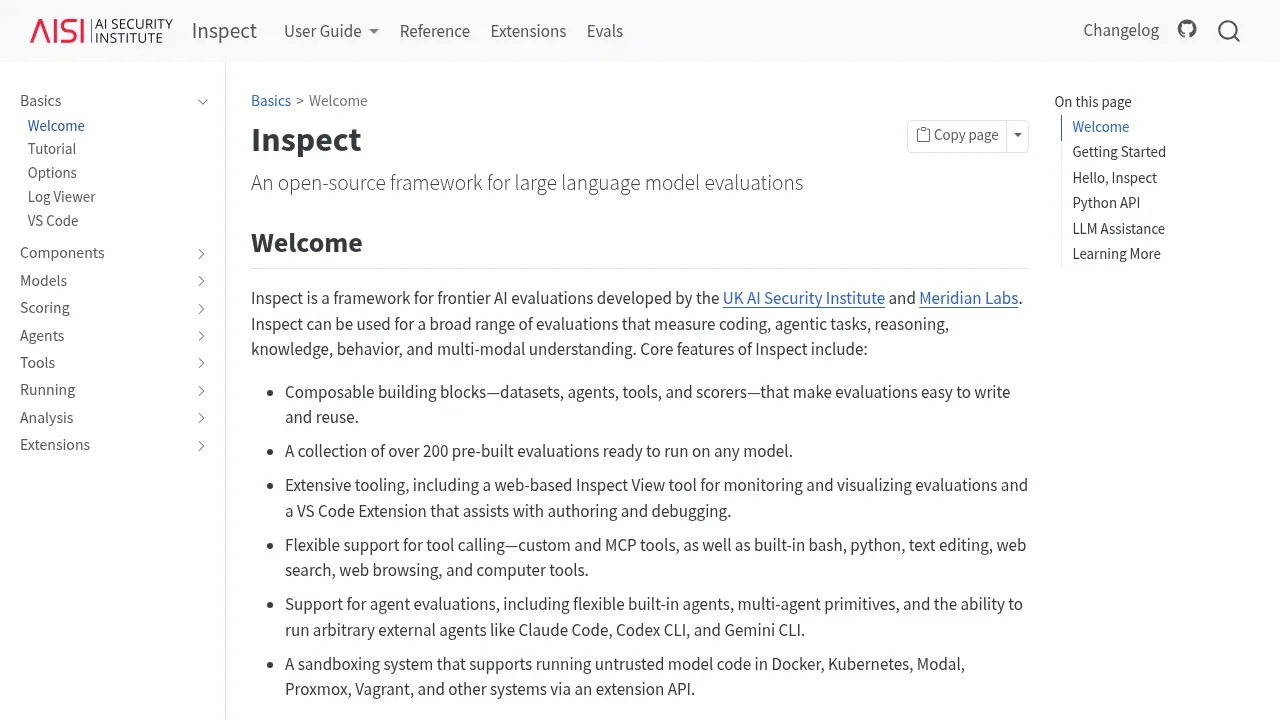
Inspect AI is a Python framework for researchers and developers testing language models and AI agents. Developed by the UK AI Security Institute and Meridian Labs, it evaluates coding, reasoning, knowledge, behavior and multimodal understanding, including tasks where agents must take actions to succeed.
It supports local inference through Hugging Face, vLLM and SGLang, alongside cloud model APIs from OpenAI, Anthropic and Google. Local backends run inference on your hardware; cloud providers receive the model requests. The framework is open source under the MIT license.
Evaluations can reuse datasets, agents, tools and scoring methods, so teams can adapt existing tests or build their own. A library of ready-made benchmarks includes SimpleQA. Scoring can use text comparisons, model-based grading or custom criteria, while multi-turn dialogue and tool use let tests go beyond single answers.
Agent testing is a particular focus. Inspect supports built-in agents, multi-agent tasks and external agents such as Claude Code, Codex CLI and Gemini CLI. Agents can use custom or MCP tools, plus built-in capabilities for bash, Python, text editing, web browsing and computer interaction. Its sandbox system isolates untrusted model code through Docker, Kubernetes and other supported environments.
Inspect View provides a browser interface for monitoring evaluations and examining individual transcripts. A VS Code extension supports evaluation authoring and debugging, and Python packages can extend the framework with new scoring methods, model APIs and sandboxes.
Claim this page with an email at inspect.aisi.org.uk. Inspect AI gets the verified badge, and you can upgrade the listing to be featured on localhosted. Proud to be listed? Put our badge on your site.
Want more people to find Inspect AI?Promote it
Something wrong or outdated on this page?
42.4KUpdated 1 day agoApache-2.0
Docker · Web#Guardrails#Human approval#LLM tracing
Agno is a Python framework and runtime for developers building customer-facing or internal AI agents. You can run its agent platform locally with Docker, on your own servers or in your cloud. The open-source framework uses the Apache 2.0 license, and the platform keeps sessions, memory, knowledge and traces in your database.
61.2KUpdated 6 months agoCC-BY-4.0
Web#Code execution#MCP#Multi-agent workflows
3.1KUpdated 2 days agoApache-2.0
macOS · Windows · Linux · Web#Code execution#MCP#Multi-agent workflows
28.4KUpdated 21 hours ago
Web#Human approval#LLM tracing#MCP
21.3KUpdated 9 months agoApache-2.0
Web#Guardrails#LLM tracing#MCP
9.4KUpdated 1 day agoApache-2.0
macOS · Windows · Linux · iOS · Android · Web#Batch processing#LLM tracing#Structured output
AutoGen is a framework for developers building AI agents that work together or alongside people. Its agent runtime can run locally or across distributed systems, while model integrations such as OpenAI and Azure OpenAI send requests to external services. It's community-managed and in maintenance mode, with no further features or enhancements planned.
BotSharp is a self-hosted framework for .NET developers building AI agents into business applications. Written in C#, it runs on Windows, Linux and macOS and is open source software under Apache 2.0. Its plugin design lets teams choose their model provider, storage and interface while keeping agent coordination in the same framework.
Mastra is a TypeScript framework for developers building AI agents and applications on their own servers or inside existing web apps. Its server runs locally or as a standalone deployment; Mastra Cloud provides a hosted alternative. Model routing connects to providers such as OpenAI, Anthropic, and Gemini, so running the framework locally doesn't keep those model requests on your machine.
Rasa is an AI agent platform for product teams building customer-facing text and voice assistants. Teams can deploy agents on their own infrastructure and choose their models and data arrangements. Its CALM engine combines language model understanding with business flows whose code enforces rules, so an assistant can handle conversational wording while following defined processes.
BAML is a programming language for developers building AI agents, with typed model calls and local tracing built into the language. It runs standalone on macOS, Linux and Windows, or alongside an existing application. The language is open source under Apache 2.0, and works offline.