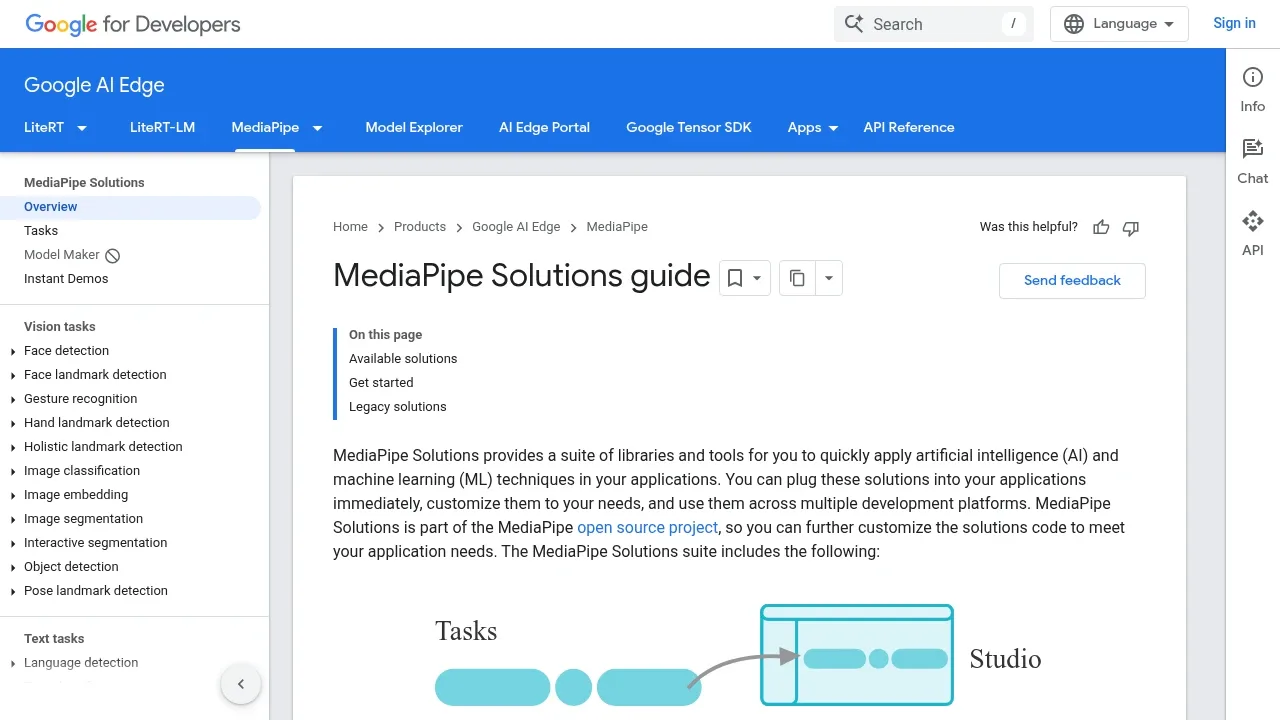
MediaPipe is an open-source toolkit for developers adding on-device AI to applications on Android, iOS, the web, desktop and edge devices. It pairs pretrained models with APIs for specific tasks, so developers can use existing solutions or customize them for their applications. The project uses the Apache 2.0 license.
Its vision tools cover face, hand and pose landmarks, gesture recognition, object detection and image segmentation. Image classification and embeddings support applications that need to categorize or compare images. Audio classification sits alongside text tools for language detection, classification, embeddings, proofreading and summarization. An LLM Inference API is also available. Platform support varies by solution.
MediaPipe Tasks provides the application-facing libraries, with Python support alongside mobile and web APIs. Model Maker lets developers adapt supported models using their own data. MediaPipe Studio runs in a browser and provides tools to visualize results, evaluate solutions and benchmark performance. For developers building custom processing pipelines, MediaPipe Framework provides a lower-level foundation for on-device machine learning.
MediaPipe Tasks processes input such as images, video and text on the device and doesn't send that input to Google servers. The APIs do send performance and usage metrics to Google, a distinction that matters for applications handling data that must stay local.
Some legacy solutions are unsupported and provided as-is. Use the current task documentation to check platform availability and model-customization support.
Claim this page with an email at ai.google.dev. MediaPipe gets the verified badge, and you can upgrade the listing to be featured on localhosted. Proud to be listed? Put our badge on your site.
Want more people to find MediaPipe?Promote it
Something wrong or outdated on this page?
5.1KUpdated 20 hours ago
macOS · Windows · Linux · iOS · Android · Web#MLX#Multimodal input#OpenAI-compatible API
ExecuTorch is PyTorch's runtime for developers building AI into mobile apps, desktop software and embedded devices. It runs models on the user's hardware, with support for Android, iOS, Linux, macOS and Windows, as well as microcontrollers. Developers can reuse a PyTorch model across targets, though hardware-specific deployments need their own exported model files.
3.5KUpdated 19 hours agoApache-2.0
macOS · Windows · Linux · iOS · Android · Web#Agent Skills#Hugging Face integration#Multimodal input
23.9KUpdated 6 days ago
macOS · Windows · Linux · iOS · Android · Web#ONNX#Quantization
ncnn is a C++ framework for developers building on-device AI into mobile, desktop and embedded applications. Its focus is running neural networks with a small memory footprint and no third-party runtime dependencies. Models run on the target device's CPU or a supported Vulkan GPU.
6.1KUpdated 5 days ago
macOS · iOS · Android#Hugging Face integration#Multimodal input#Quantization
Cactus is an on-device AI engine for developers building automation into mobile apps, wearables and embedded devices. Its Needle model handles tool calling locally, so a device can turn a request into an action without an internet connection. The focus is small devices, including smart home hardware, robots and microcontrollers.
16.2KUpdated 1 day agoApache-2.0
Windows · iOS · Android#Image-to-image#Multimodal input#ONNX
10.9KUpdated 23 hours agoApache-2.0
macOS · Windows · Linux#Hugging Face integration#Multimodal input#ONNX
LiteRT is Google's open-source framework for developers building AI into apps that run on users' own devices. It succeeds TensorFlow Lite and covers model conversion, optimization and local inference. It's licensed under Apache 2.0.
MNN is a lightweight C++ framework for developers who want AI models to run on phones, PCs and embedded devices. It handles inference and training on the device, with a focus on small application footprints and hardware acceleration. The project is open source under Apache 2.0, and Alibaba uses it in apps including Taobao, Youku and DingTalk.
OpenVINO is an Apache 2.0 licensed toolkit for developers who want to run AI models locally or serve them on their own infrastructure. It converts and optimizes models for inference, with support for x86 and ARM CPUs, Intel integrated and discrete GPUs, and Intel NPUs. Its runtime works on Linux, Windows and macOS.