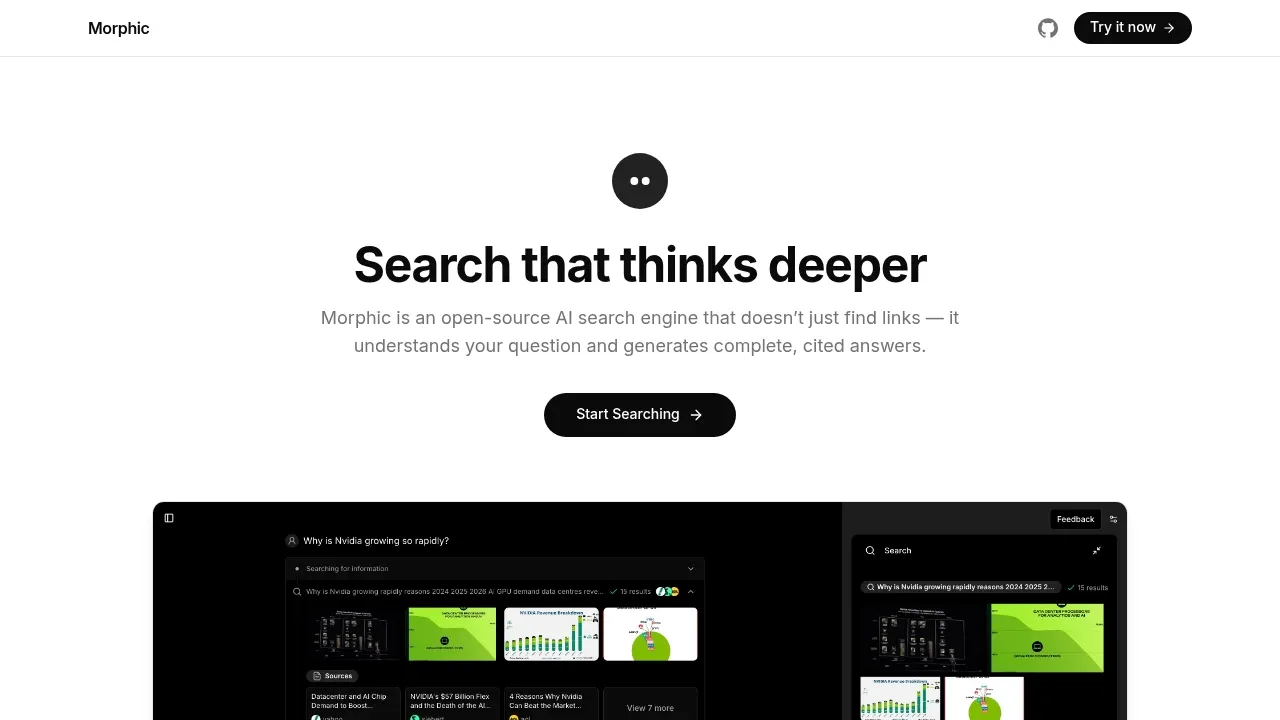
Morphic is a self-hosted AI search engine for people who want answers backed by web sources and control over the search interface they use. It combines web searches and URL reading with AI-generated responses, so you can examine the sources behind an answer. It's open source under Apache 2.0, and you can run your own instance with Docker or use the hosted website.
Quick mode handles fast lookups. Adaptive mode performs deeper, multi-step research. Answers can include source-credited images, grids and headings alongside text, with the interface rendering these elements as the response arrives. That makes its answer format a useful distinction for readers who want visual results alongside citations.
Morphic supports Ollama for local models, plus OpenAI, Anthropic, Google, Vercel AI Gateway and OpenAI-compatible providers. The interface includes a model selector. Self-hosting the application doesn't make every request local: cloud model providers process requests externally, and web research needs network access. Search backends include Tavily, SearXNG, Brave and Exa.
For ongoing research, Morphic supports file uploads, stores chat history in PostgreSQL and lets you share results through unique URLs. It supports accounts through Supabase Auth, while guest mode allows anonymous use.
Claim this page with an email at morphic.sh. Morphic gets the verified badge, and you can upgrade the listing to be featured on localhosted. Proud to be listed? Put our badge on your site.
Want more people to find Morphic?Promote it
Something wrong or outdated on this page?
18.3KUpdated 24 hours agoMIT
macOS · Windows · Linux · Docker · Web#Human approval#Hybrid search#llama.cpp backend
DocsGPT is an MIT-licensed, open-source platform for teams that want AI search, assistants and agents over their own documents. It can run on your servers with local models, including fully air-gapped deployments where documents and questions stay inside your network. Answers include the source title and page number so readers can check the evidence.
29.8KUpdated 4 days agoApache-2.0
Docker · Web#MCP#Multi-agent workflows#Ollama integration
9.1KUpdated 21 hours agoMIT
macOS · Windows · Linux · Docker · Web#llama.cpp backend#MCP#Multi-user access
32.3KUpdated 24 hours ago
Docker · Web · Browser Extension#MCP#Multi-user access#Ollama integration
36.9KUpdated 4 weeks agoMIT
Docker · Web#Multimodal input#Ollama integration#OpenAI-compatible API
3.5KUpdated 2 years agoApache-2.0
Docker · Web#Ollama integration#Web search
Farfalle is a self-hosted AI search engine for people who want a Perplexity-style search app with a choice of local or cloud models. It combines web search with model-generated answers and includes an agent that plans and carries out searches. The code is open source under Apache 2.0.
GPT Researcher is a self-hosted AI research agent for people who need detailed, cited reports drawn from the web, their own documents, or both. You choose the language model and search provider, and can run the software on your own server or through Docker. It's open source under Apache 2.0.
Local Deep Research is a self-hosted AI research assistant for people who need cited answers drawn from academic papers, the web and their own documents. It can produce a quick summary or pursue a complex question through repeated searches, then assemble a structured report. It's open source under MIT.
Onyx is an AI search and chat platform for teams whose information is spread across workplace apps. It indexes company knowledge so employees can ask questions across sources and get answers grounded in relevant documents. Teams can deploy it in their own cloud or on bare metal, including an air-gapped environment.
Vane (formerly Perplexica) is a self-hosted AI search engine for people who want answers drawn from web results, with citations they can check. It runs on your own hardware through Docker or as a server application, with a browser interface and locally stored search history. The project is free and open source under the MIT license.