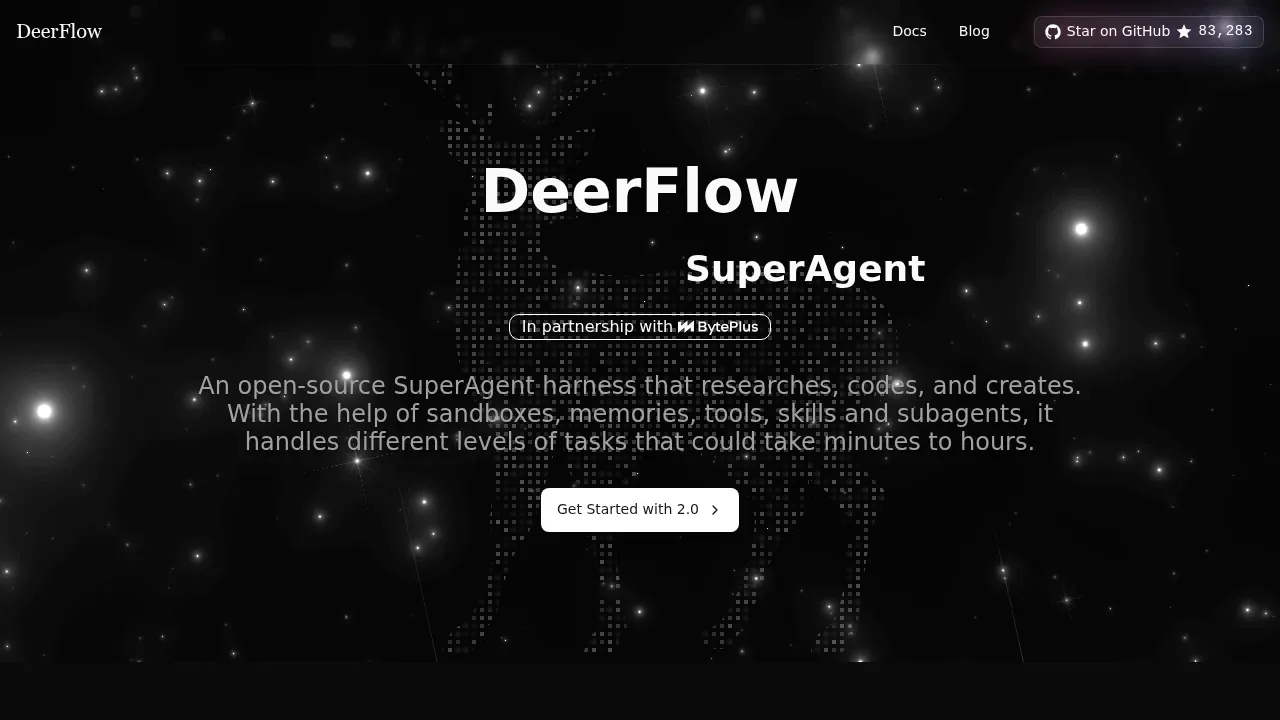
DeerFlow is an MIT-licensed AI agent framework for people who want to build and run agents on their own infrastructure. It combines subagents, memory and a Docker-based workspace to handle research, coding and content creation tasks that can take minutes or hours.
Its agents can execute commands, work with files and carry out longer jobs inside a sandbox. The recommended All-in-One Sandbox brings a browser, shell, file tools, MCP and VSCode Server into one container. This gives agents a working environment for producing outputs such as webpages, reports and data visualizations.
Skills define the work. Built-in skills cover research, slide creation, image and video generation, alongside other document and web tasks. You can add your own workflows, replace existing skills or combine them. DeerFlow loads skills only when a task needs them, which reduces the amount of context they consume. Custom skills can also move between DeerFlow instances as exportable archives.
For work involving private documents, DeerFlow can connect to RAGFlow and retrieve evidence from permitted datasets. Answers can include clickable citations with source excerpts, document names and page numbers when available. Those evidence snapshots stay with the conversation and remain inspectable after reloading it.
DeerFlow uses LangChain and supports MCP tools and Lark/Feishu integration. Its Python framework is open source under the MIT license.
Claim this page with an email at deerflow.tech. DeerFlow gets the verified badge, and you can upgrade the listing to be featured on localhosted. Proud to be listed? Put our badge on your site.
Want more people to find DeerFlow?Promote it
Something wrong or outdated on this page?
3.4KUpdated 2 months agoApache-2.0
Docker · Web#Agent Skills#Browser automation#Code execution
II Agent is a self-hosted AI agent for developers and teams who want an assistant that can research a topic, write software and carry out tasks through a browser or shell. It's a Python framework with a web interface, released under Apache 2.0, so you can inspect, fork and extend the code.
34.4KUpdated 2 months agoApache-2.0
macOS · Windows · Linux · Docker · Web#Batch processing#Human approval#MCP
1.6KUpdated 8 months ago
macOS · Windows · Linux · Docker#Code execution#Ollama integration#Persistent memory
Lemon AI is a local AI agent for people who want research, coding and data analysis tools running on their own hardware. It combines web browsing and task execution with an editor for refining generated HTML pages, reports and charts without regenerating the whole page.
18.2KUpdated 5 months agoApache-2.0
macOS · Windows · Linux · Docker · Web#Guardrails#Human approval#Knowledge graphs
4.4KUpdated 1 week agoApache-2.0
Web#Agent Skills#Human approval#MCP
MS Agent is an open-source Python framework for developers building AI agents that carry out complex tasks over multiple sessions. Its browser workspace works with local projects, while terminal interfaces and a Python SDK share the same agent logic. It uses the Apache 2.0 license and supports OpenAI-compatible APIs, Anthropic and ModelScope.
1.4KUpdated 3 weeks agoMIT
Linux · Docker · Web#Agent Skills#Batch processing#Code execution
ChatDev is a self-hosted platform for building teams of AI agents through a visual workflow editor. It's for people who want agents to collaborate on research, data analysis or software projects without writing the orchestration code themselves. You define each agent's role and how information passes between them.
OpenFang runs scheduled AI agents on your own machine, with built-in task packages called Hands that report results to a dashboard. It's for people who want recurring research, monitoring or business tasks to continue without prompting an agent each time. The open source platform runs on macOS, Windows and Linux under the Apache 2.0 license.
AgentFlow is an MIT-licensed Python framework for developers who want several coding agents to share a workflow. It connects Codex, Claude, Kimi, and Pi tasks in dependency graphs, so planning can feed implementation and parallel reviews can feed a combined result. Agents can run in local Docker containers or on remote machines through SSH, EC2, and ECS.