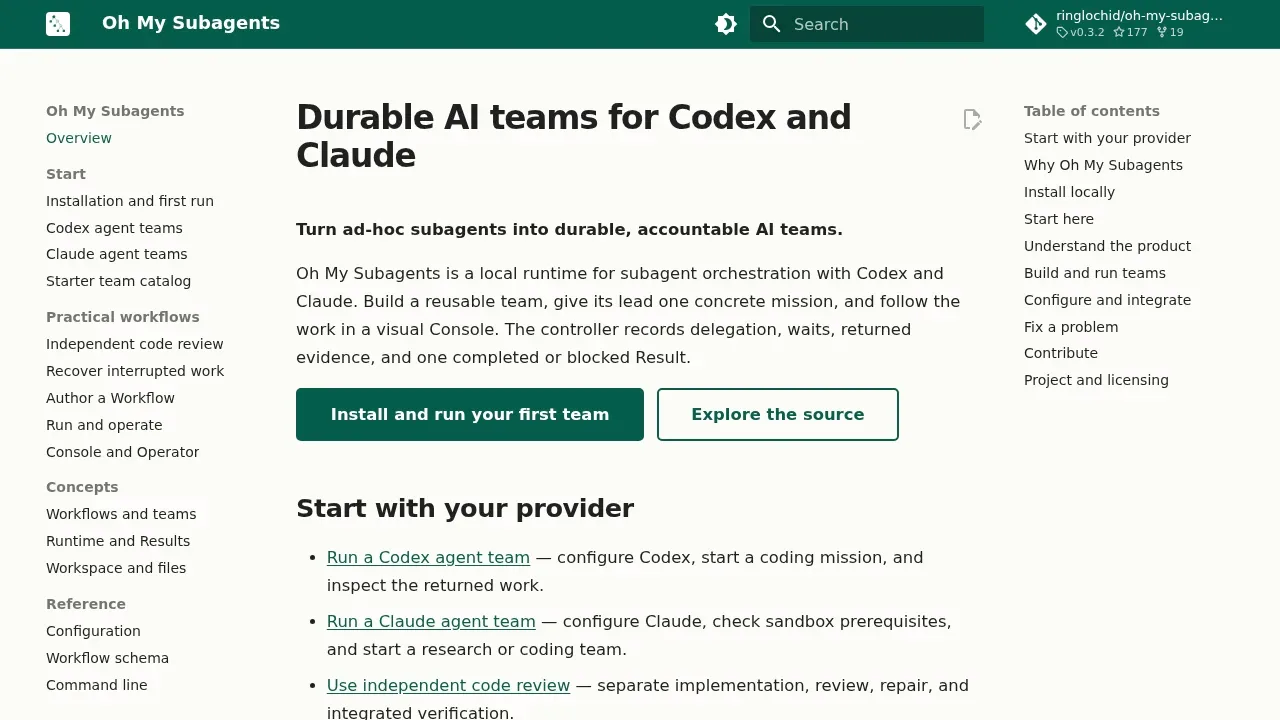
Oh My Subagents coordinates Codex and Claude agent teams through a runtime on your own machine. It's for developers and researchers who need delegated work to survive interruptions and want a clear record of who did what. It supports Linux, macOS 13+ and Windows 11 x64; Codex and Claude providers require authentication.
Teams define reusable responsibilities rather than a fixed sequence of steps. Managers can run independent work in parallel, handle dependent work in order, or send review findings back for repair. The same team can adapt its approach to different tasks, including coding, research and independent code review.
The runtime saves assignments, waiting states and returned evidence. After a provider interruption, browser closure or controller restart, work can resume from saved state without discarding accepted history. The team lead reviews the returned work and produces a single result that states whether the task is complete or blocked, with references to supporting files.
A local browser Console lets you edit teams visually and inspect active work, requests for human input and results. A separate conversational Operator can manage the same teams and runs. Notes, code and reports remain in your workspace; SQLite stores runtime state by default, with PostgreSQL also supported.
The Python core is open source under MIT. The visual Console includes n8n-derived material under the Sustainable Use License.
Claim this page with an email at ringlochid.me. Oh My Subagents gets the verified badge, and you can upgrade the listing to be featured on localhosted. Proud to be listed? Put our badge on your site.
Want more people to find Oh My Subagents?Promote it
Something wrong or outdated on this page?
1.1KUpdated 16 hours agoMIT
iOS · Android · Docker · Web#Code execution#Distributed execution#Git integration
Optio is a self-hosted AI agent orchestration platform for teams running coding and automation work on their own Kubernetes clusters or paired machines. Its pull request workflow follows a ticket through coding, CI, review, and merge, resuming the agent when checks fail, conflicts arise, or a reviewer asks for changes. When checks pass and approval arrives, it squash-merges the PR and closes the issue.
2.3KUpdated 2 days agoApache-2.0
macOS · Windows · Linux · Docker · Web#Agent Skills#Guardrails#Human approval
14.8KUpdated 1 day agoMIT
macOS · Windows · Linux · Web#Agent Skills#Code execution#Git integration
34.4KUpdated 2 months agoApache-2.0
macOS · Windows · Linux · Docker · Web#Batch processing#Human approval#MCP
51Updated 2 months agoMIT
macOS · Windows · Linux · Web#Agent Skills#Code execution#Git integration
137Updated 15 hours ago
macOS · Windows · Linux · Docker · Web#Agent Skills#Human approval#Knowledge graphs
Agency Orchestrator turns a task description into a team of specialist AI roles that divide the work and combine their results. It's for solo builders, developers and content creators who want repeatable workflows for product planning, research or code review. The open-source software uses the Apache 2.0 license and runs locally through a browser interface, a desktop app for macOS, Windows and Linux, or Docker on a server or NAS.
cc-haha is a desktop workspace for Claude Code and AI agents, aimed at developers who want coding tasks, change review and work across apps in one place. It runs on macOS, Windows and Linux, with Intel, AMD and ARM builds. The app is open source under the MIT license.
ChatDev is a self-hosted platform for building teams of AI agents through a visual workflow editor. It's for people who want agents to collaborate on research, data analysis or software projects without writing the orchestration code themselves. You define each agent's role and how information passes between them.
Claudeck gives developers a browser interface for Claude Code that runs on their own macOS, Linux or Windows machine. It brings coding conversations, autonomous agents and repository tools into one workspace. The local server connects to Claude Code through Anthropic's SDK; Claudeck itself is open source under the MIT license.
Project Orchestrator is a self-hosted coordination tool for developers working with multiple AI coding agents. It keeps code knowledge, development plans, and architectural decisions in a shared store so agents can reuse context across tasks and projects. It runs on macOS, Windows, and Linux, with desktop apps and Docker deployment available.