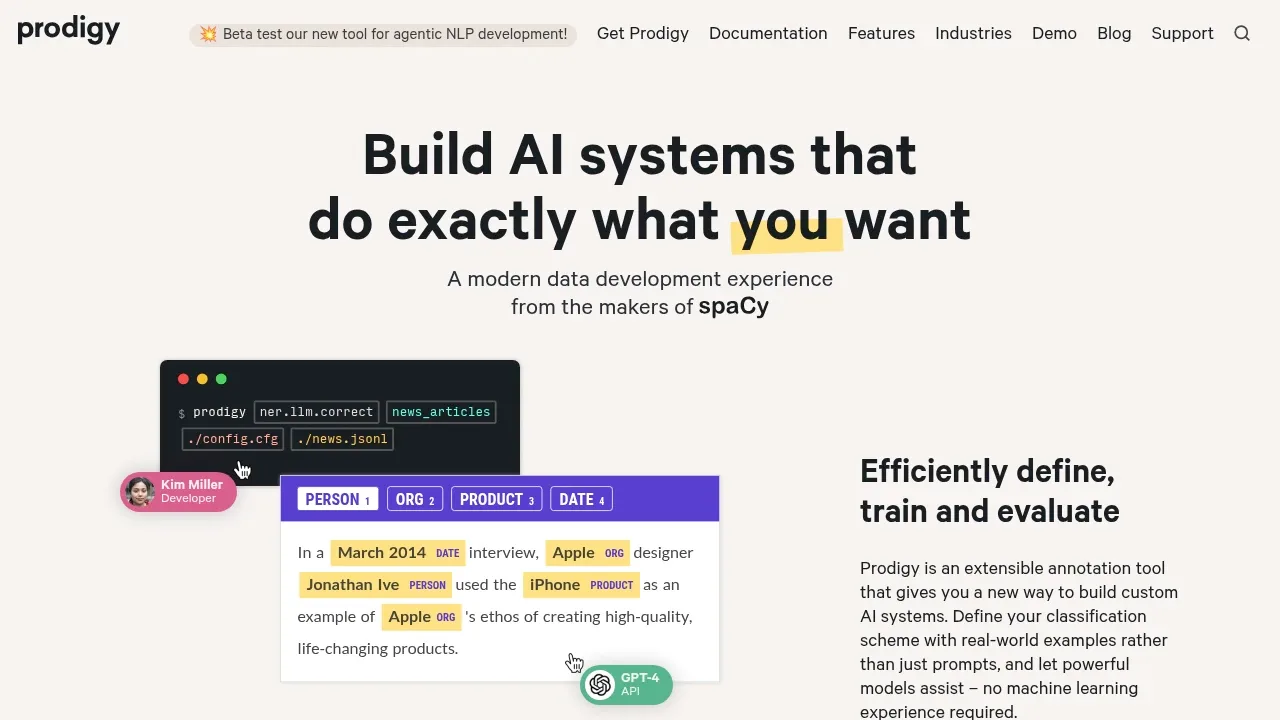
Prodigy is a proprietary annotation tool that runs on your own machines, including air-gapped systems without an internet connection. It's for developers and research teams building training and evaluation datasets for custom AI models. The Python library includes a web application where annotators can label data without programming knowledge.
Its tasks cover named entity recognition, text classification, object detection and image segmentation, as well as model evaluation. Teams can define labels through real examples, review model suggestions and train models from the resulting annotations. Built-in workflows provide a starting point for common tasks; custom Python workflows let developers adapt the data feeds, processing and annotation interface to their own projects.
Prodigy integrates closely with spaCy and has plugins for using and training Hugging Face models. Teams can also use the annotations to train models with PyTorch or TensorFlow. LLM API integrations support model-assisted labeling, including workflows where people correct generated annotations. Those external API calls use a cloud service; the annotation application itself runs locally and doesn't phone home.
The tool can run on premises or on a cloud provider you choose. Local workflows keep data and models under your control, and you own the models you produce. Developers can combine interface components or build custom interfaces with HTML, CSS and JavaScript.
Claim this page with an email at prodi.gy. Prodigy gets the verified badge, and you can upgrade the listing to be featured on localhosted. Proud to be listed? Put our badge on your site.
Want more people to find Prodigy?Promote it
Something wrong or outdated on this page?
89Updated 22 hours agoGPL-3.0
macOS · Windows · Linux · Docker · Web#Batch processing#Hugging Face integration#ONNX
PixlStash is an open-source image manager for photographers, AI creators and people curating image datasets. It combines library search with tools for reviewing tags, ranking images and sending selected work through ComfyUI. You can use a desktop app or a self-hosted server with a browser interface.
16.8KUpdated 1 day agoMIT
Docker · Web#Hugging Face integration#Multi-user access#ONNX
19.9KUpdated 2 years agoApache-2.0
Web#Hugging Face integration
5.1KUpdated 1 year agoApache-2.0
Web#Multi-user access#Semantic search
Argilla is an open-source data annotation and feedback tool for AI engineers and domain experts who build training and evaluation datasets. You can run your own Argilla server or deploy it on Hugging Face Spaces. It's licensed under Apache 2.0.
10.8KUpdated 8 months agoMIT
Windows · Docker · Web#Multi-user access#Multilingual
28.4KUpdated 1 day agoApache-2.0
macOS · Windows · Docker · Web#Human approval#Multi-user access#Multimodal input
CVAT is a browser-based data annotation platform for teams building computer vision datasets. Its open-source Community edition runs on your own infrastructure with Docker and uses the MIT license. CVAT Online is hosted by CVAT, while the Enterprise offering runs in an organization's own cloud or internal environment.
Segment Anything 2 (SAM 2) is Meta's open-source model for selecting objects in images and tracking them through video. It's for developers and researchers who need object masks for visual applications or dataset annotation. The model and its web demo can run on your own GPU machine; Meta also provides a hosted demo.
Doccano is a self-hosted text annotation tool for machine learning practitioners who need labeled training or evaluation data. It runs on your own machine or server, with a browser interface and Docker support. The software is open source under the MIT license.
Label Studio is a self-hosted platform for teams preparing training data or evaluating AI outputs through human review. It handles text, images, audio, video and time series in the same application, including tasks that combine several data types. The open source edition uses the Apache 2.0 license and runs locally or on your own server, with Docker deployment and browser access. A separate hosted cloud edition runs on the provider's infrastructure.