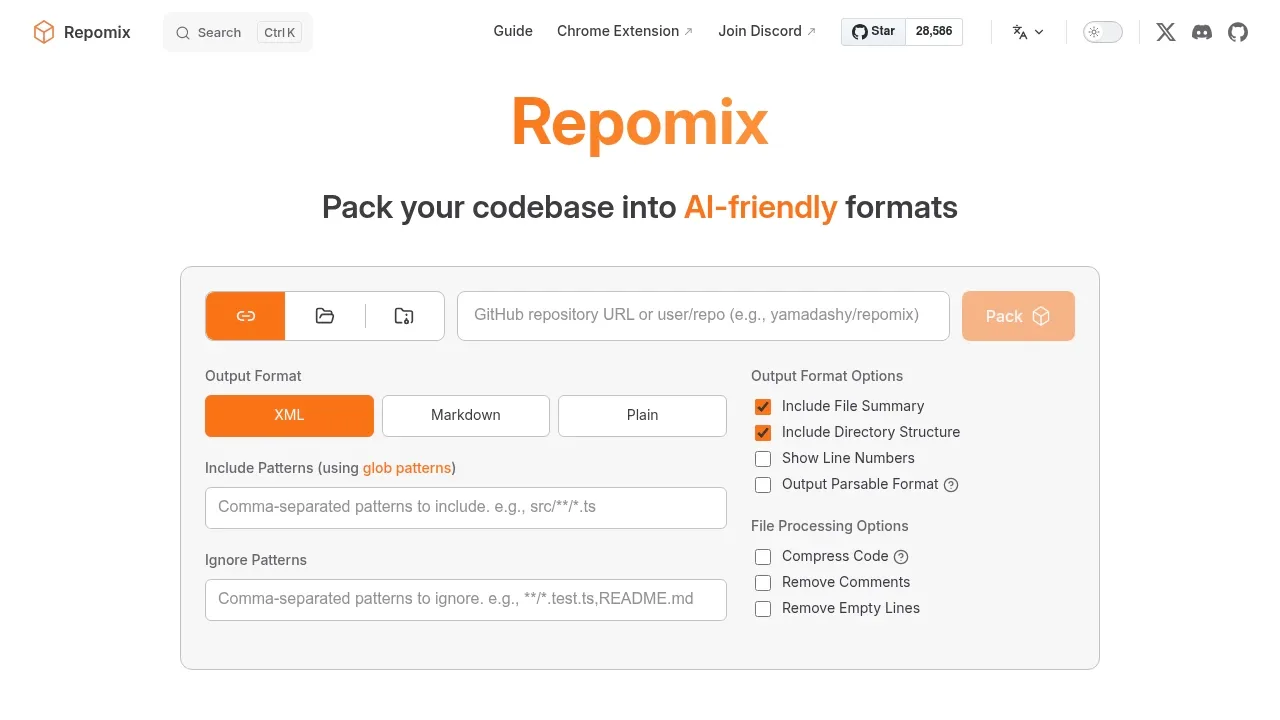
Repomix turns a code repository into a single file that an AI assistant can read. It’s for developers who need to give Claude, ChatGPT, Gemini, or another model enough project context for code review or analysis. You can use its command line on your own machine, pack a repository through its website, or run it as an MCP server, including through Docker. It is open source under the MIT license.
The output can be XML, Markdown, JSON, or plain text. You can choose which files to include, and Repomix respects .gitignore, .ignore, and .repomixignore when leaving files out. It reports token counts for individual files and the repository, which helps when the result needs to fit a model’s context window. For larger projects, Tree-sitter compression keeps code signatures and structure while removing implementation details to reduce the amount of text sent to the model.
Repomix also scans for files matching known credential formats and excludes them from its output. As an MCP server, it lets assistants pack local or remote repositories and search the resulting file. Its optional sandbox mode confines the server’s file tools to one workspace directory and limits them to read-only access. A browser extension provides access to Repomix from GitHub repositories.
Claim this page with an email at repomix.com. Repomix gets the verified badge, and you can upgrade the listing to be featured on localhosted. Proud to be listed? Put our badge on your site.
Want more people to find Repomix?Promote it
Something wrong or outdated on this page?
29.9KUpdated 1 day ago
Docker · JetBrains#Code execution#MCP#Persistent memory
Serena is a locally run MCP toolkit that gives AI coding agents access to code structure: functions, classes and the references between them. It's for developers who want their agent to find and change specific parts of a codebase without reading whole files or relying on text matching. It requires an LLM client and works with Claude Code, Codex, OpenCode, Cursor and OpenWebUI.
470Updated 1 month agoMIT
macOS#MCP#Tool calling
62.5KUpdated 1 day agoMIT
#MCP#RAG#Tool calling
293KUpdated 5 days agoMIT
Windows#Agent Skills#Code execution#Git integration
269.7KUpdated 20 hours agoMIT
Windows#Guardrails#MCP#Multi-agent workflows
272.1KUpdated 1 day agoMIT
#Agent Skills#Git integration#Multi-agent workflows
ast-grep MCP is a locally run server that lets AI coding assistants search code by its syntax structure. It connects ast-grep to Cursor, Claude Desktop and other clients that support the Model Context Protocol (MCP). It's for developers who need an assistant to find specific code constructs when matching words alone is too broad.
Context7 brings current library documentation and code examples into an AI coding assistant's context. It's for developers who want answers grounded in the libraries and versions they're actually using, rather than an assistant's older training data. It works with Claude Code, Codex, Cursor, Devin Desktop and Antigravity.
Superpowers adds a structured development process to AI coding assistants. It's for developers who want their agent to agree on a design before writing code, follow an implementation plan, and check its work against that plan. The open-source framework uses the MIT license and works inside coding tools including Claude Code, Codex, Cursor, Gemini CLI and OpenCode.
ECC is a free, MIT-licensed open source toolkit that adds repeatable engineering workflows to coding assistants. It runs alongside your chosen agent and works with self-hosted models or cloud providers through that agent's supported endpoints. It's for developers who want planning, testing and review to follow a consistent process across coding sessions.
Skills (mattpocock) is an MIT-licensed collection of engineering workflows for developers using Claude Code, Codex and other AI coding agents. Its small, separate skills work with any model and can be combined or adapted to your project, so you can choose specific practices without adopting an entire development process.