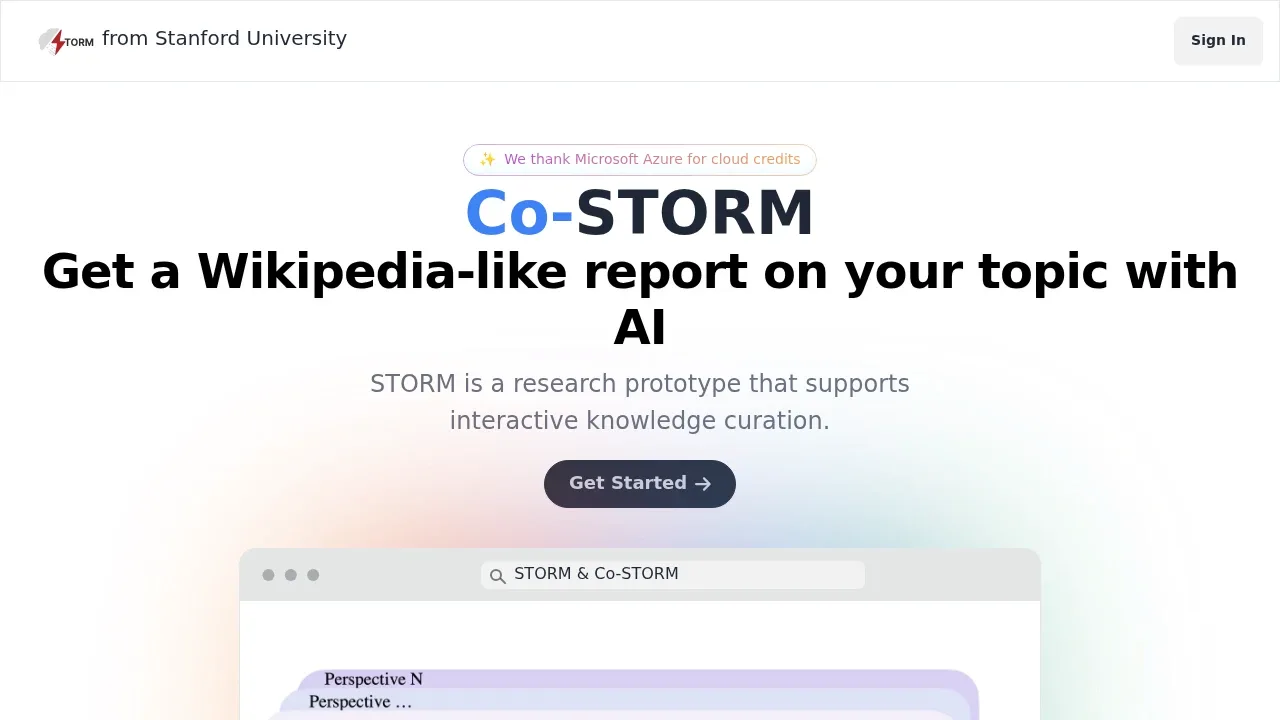
STORM is an MIT-licensed, open-source research tool from Stanford OVAL that turns a topic into a Wikipedia-style report with citations. You can run its Python software on your own machine or host it on a server; Stanford also offers a hosted research preview. It's aimed at people gathering background material and writers preparing an article draft.
The research process explores different perspectives on a topic, collects references, and builds an outline before writing the report. That makes its question generation a useful distinction: it draws on related articles to find angles to investigate, rather than relying on a single prompt for a finished answer. Reports still need fact-checking and editing before publication.
Co-STORM adds an interactive discussion with AI experts and a moderator. You can follow their exchange or contribute to steer the research, while a changing mind map organizes the information into related concepts.
For self-hosted use, STORM supports language and embedding models through LiteLLM, including workflows using OpenAI models. It can research through services such as Bing, Brave, Tavily, and SearXNG, or ground its writing in documents you provide through VectorRM. Its research, outlining, writing, and polishing components are customizable.
Self-hosting runs the research software under your control, but internet search and cloud model services still involve external providers. The hosted preview requires sign-in and collects inputs and feedback for research, with possible redistribution under CC-BY or a similar license.
Claim this page with an email at storm.genie.stanford.edu. STORM gets the verified badge, and you can upgrade the listing to be featured on localhosted. Proud to be listed? Put our badge on your site.
Want more people to find STORM?Promote it
Something wrong or outdated on this page?
77KUpdated 3 months agoAGPL-3.0
macOS · Windows · Linux · iOS · Android · Web#MCP#Multi-user access#RAG
AppFlowy is a self-hosted Notion alternative for teams that want project management, shared documents, and AI in an environment they control. Its self-hosted enterprise offering can run on premises, in your own cloud, or in an air-gapped environment. Self-hosted LLMs and embedding models let you keep AI processing and workspace data inside your infrastructure, with no vendor access to your instance.
360Updated 3 weeks agoAGPL-3.0
#Ollama integration#RAG#Semantic search
7.8KUpdated 1 day agoAGPL-3.0
#LM Studio integration#Multi-agent workflows#Ollama integration
29.8KUpdated 4 days agoApache-2.0
Docker · Web#MCP#Multi-agent workflows#Ollama integration
9.1KUpdated 21 hours agoMIT
macOS · Windows · Linux · Docker · Web#llama.cpp backend#MCP#Multi-user access
6.9KUpdated 1 year agoApache-2.0
Web#Multi-agent workflows#Multilingual#RAG
Joplin Jarvis is an AI assistant for people who keep their writing, research, or personal knowledge in Joplin on desktop and mobile. It connects conversations to your existing notes and supports local LLMs through Ollama alongside cloud services such as GPT, Claude, Gemini, and Hugging Face.
Obsidian Copilot brings AI agents into your vault to find notes by meaning, edit drafts and organize research. It's for writers, researchers and other Obsidian users who want AI to work directly with their existing notes. Agents create Markdown files, wikilinks and canvases that remain in your vault.
GPT Researcher is a self-hosted AI research agent for people who need detailed, cited reports drawn from the web, their own documents, or both. You choose the language model and search provider, and can run the software on your own server or through Docker. It's open source under Apache 2.0.
Local Deep Research is a self-hosted AI research assistant for people who need cited answers drawn from academic papers, the web and their own documents. It can produce a quick summary or pursue a complex question through repeated searches, then assemble a structured report. It's open source under MIT.
MindSearch is a self-hosted AI search framework for people who want to build their own Perplexity-style answer engine. Multiple LLM agents search and read web pages to produce answers with a visible research process. It's open source under Apache 2.0.