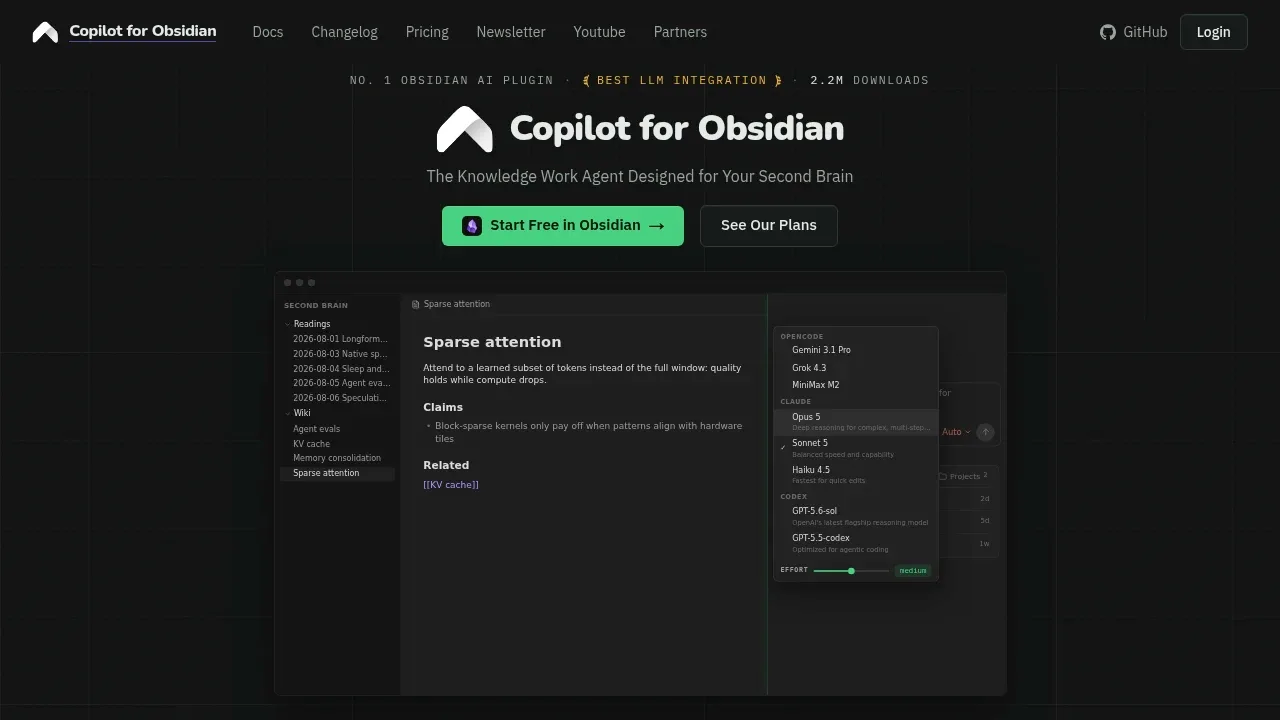
Obsidian Copilot brings AI agents into your vault to find notes by meaning, edit drafts and organize research. It's for writers, researchers and other Obsidian users who want AI to work directly with their existing notes. Agents create Markdown files, wikilinks and canvases that remain in your vault.
The plugin is open source under AGPL-3.0. It supports opencode, Claude Code and Codex, with shared skills across agents. You can use an existing Claude or ChatGPT account, your own provider keys, or local models through Ollama and LM Studio. It also connects to OpenAI, Anthropic, Google and OpenAI-compatible endpoints. Optional licensed collaboration combines several installed agents into one read-only research or review request.
Miyo, its local indexing engine, searches notes alongside external PDFs and EPUBs. It also surfaces related notes beside your current writing. Projects keep instructions, reusable context and chat history together for ongoing work; saved commands handle repeatable prompts. Quick Ask lets you discuss or revise selected text inside a note.
Agent mode runs on desktop because its backends use local processes. Mobile users can use Quick Chat, custom commands and Quick Ask. Notes and Miyo indexes stay on your device, while prompts and included context go to the model or service you choose. A local endpoint processes those requests locally. Cloud providers process them remotely.
An optional hosted offering requires an account and internet access. Its models and cloud tools send the required input to Brevilabs for processing.
Claim this page with an email at obsidiancopilot.com. Obsidian Copilot gets the verified badge, and you can upgrade the listing to be featured on localhosted. Proud to be listed? Put our badge on your site.
Want more people to find Obsidian Copilot?Promote it
Something wrong or outdated on this page?
360Updated 3 weeks agoAGPL-3.0
#Ollama integration#RAG#Semantic search
Joplin Jarvis is an AI assistant for people who keep their writing, research, or personal knowledge in Joplin on desktop and mobile. It connects conversations to your existing notes and supports local LLMs through Ollama alongside cloud services such as GPT, Claude, Gemini, and Hugging Face.
77KUpdated 3 months agoAGPL-3.0
macOS · Windows · Linux · iOS · Android · Web#MCP#Multi-user access#RAG
14Updated 19 hours agoMIT
Windows · Linux · Docker · Web#Human approval#LM Studio integration#Multilingual
46Updated 5 days agoAGPL-3.0
macOS · Windows · Linux · Browser Extension#Code execution#GGUF#llama.cpp backend
boltai.comChat With Your Documents
macOS#Code execution#Human approval#LM Studio integration
18.3KUpdated 24 hours agoMIT
macOS · Windows · Linux · Docker · Web#Human approval#Hybrid search#llama.cpp backend
AppFlowy is a self-hosted Notion alternative for teams that want project management, shared documents, and AI in an environment they control. Its self-hosted enterprise offering can run on premises, in your own cloud, or in an air-gapped environment. Self-hosted LLMs and embedding models let you keep AI processing and workspace data inside your infrastructure, with no vendor access to your instance.
ScribeDog is a Markdown editor for writers and note-takers who want AI assistance while keeping their documents on their own hardware. It displays formatted text, tables and images instead of Markdown syntax, but saves ordinary .md files that work with Git and other editors. It has a native desktop app and a self-hosted Server Edition available through Docker.
Vyact is an open source desktop workspace for people who want to use a local LLM with their documents, email and code. It runs on Apple Silicon Macs, Windows and Linux x64 under the AGPL-3.0 license. Intel Macs aren't supported.
BoltAI is a native Mac app for people who want local LLMs and cloud AI services in the same workspace. It runs on Intel and Apple Silicon Macs and suits coding, writing, research and document analysis. The interface uses SwiftUI and AppKit.
DocsGPT is an MIT-licensed, open-source platform for teams that want AI search, assistants and agents over their own documents. It can run on your servers with local models, including fully air-gapped deployments where documents and questions stay inside your network. Answers include the source title and page number so readers can check the evidence.