
Transcritório
A local AI transcription app turns Brazilian Portuguese interviews into text offline, with speaker separation and audio-linked editing under the MIT license.
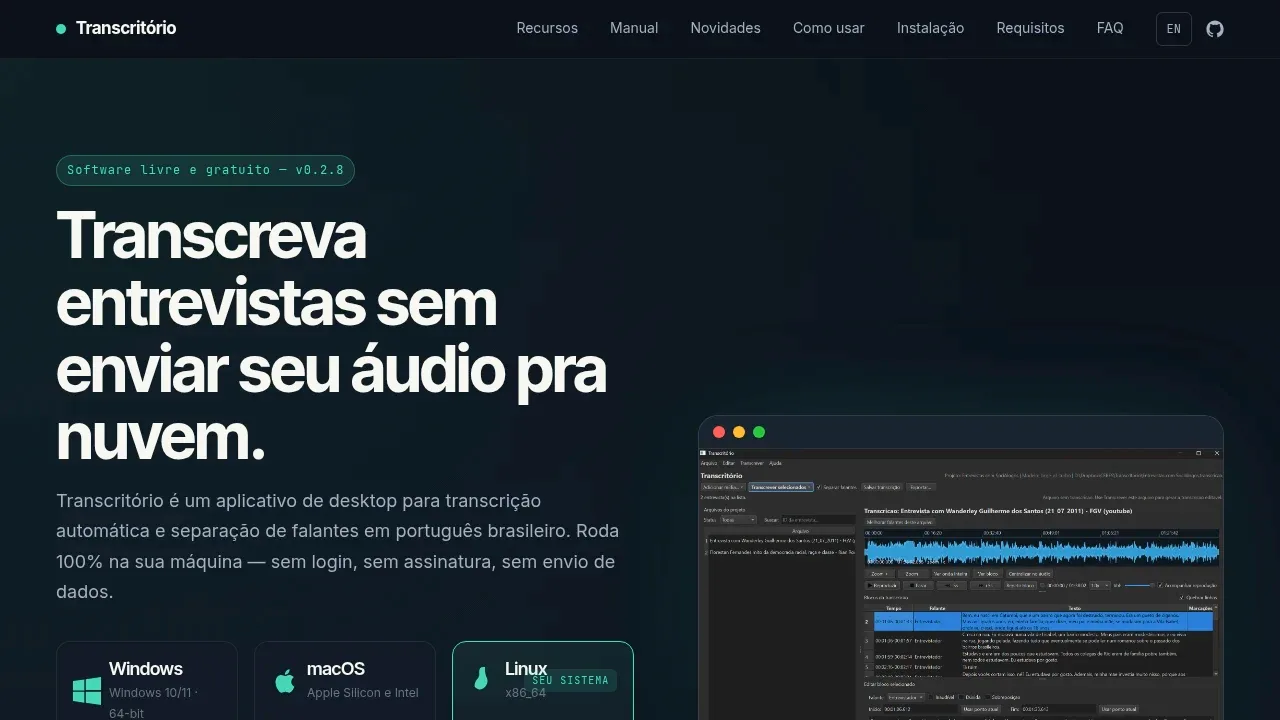
Transcritório is a desktop app for researchers transcribing interviews and focus groups, with a focus on Brazilian Portuguese. It keeps audio, transcripts and metadata on your computer.
- Transcription models: The default Parakeet pt-BR "TAGARELA" model transcribes Brazilian Portuguese on CPU alone, while Whisper handles recordings in other languages.
- Speaker separation: pyannote.audio distinguishes speakers automatically, and acoustic checks flag uncertain speaker changes for review; you can rename participants throughout a transcript.
- Audio-linked editing: Timestamped text and a waveform help you check interruptions, correct words, adjust segment boundaries and split or join speech turns.
- Local analysis: Semantic search finds passages without exact keyword matches, and a glossary groups spelling variants of names; Qwen produces thematic summaries and answers with cited excerpts, but these writing features require an NVIDIA GPU.
- Projects and exports: Track transcription and review status across recordings and export to DOCX, Markdown, SRT, VTT, CSV, TSV or NVivo formats for further analysis.
The app is free and open source under MIT. It works offline after the initial software and model downloads. Windows 10/11 is the primary supported platform; Intel and Apple Silicon macOS and x86_64 Linux are also supported, though macOS and Linux haven't had field testing. Apple Silicon can accelerate Whisper through Metal.
Basic transcription needs at least two CPU cores and 4 GB RAM. Speaker separation needs four cores and 8 GB RAM, with optional NVIDIA acceleration. Search and name extraction can run on CPU; Qwen's summaries and written answers require an NVIDIA GPU with at least 6 GB VRAM and 16 GB system RAM. Human review is recommended for names, technical terms and noisy recordings.


