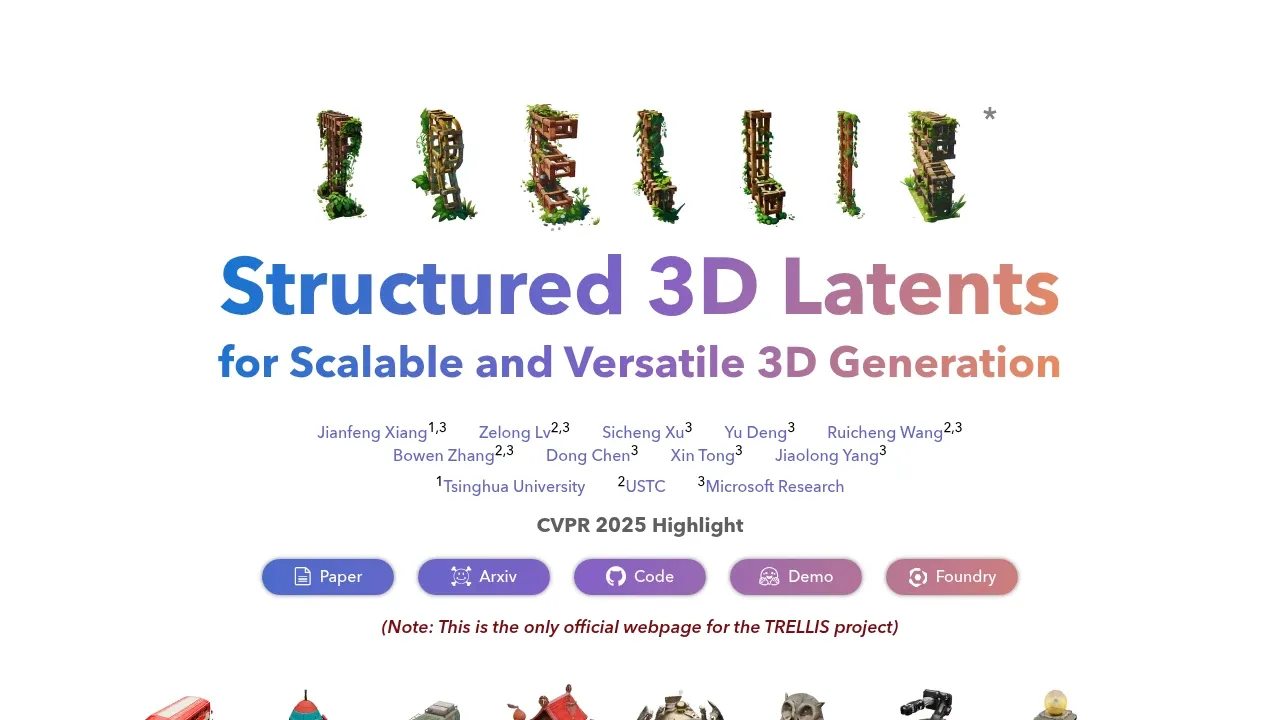
TRELLIS is a local AI model for generating 3D assets from images or text prompts, aimed at 3D artists and researchers exploring asset creation. It can produce meshes, radiance fields and 3D Gaussians from the same underlying representation, so you can choose an output suited to your rendering or editing work.
Its Structured Latent (SLAT) representation captures both geometry and appearance. That shared representation supports several output formats rather than tying generation to a single kind of 3D asset. The project also shows GLB exports with appearance baked onto meshes.
Editing goes beyond whole-object regeneration. You can create variants of an existing asset or change a targeted region using text or image prompts, such as replacing a robot's legs or adding weapons. The model works best with artistic assets; its ability to generate photorealistic real-world objects is limited. The project recommends image prompts for better results.
The Python code runs on your own hardware and has been tested on Linux. It requires an NVIDIA GPU with at least 16GB of VRAM. Pretrained models are available through Hugging Face and can load from local files, while a Gradio demo provides a browser interface to the locally running model.
The repository is open source under the MIT license. The project website separately restricts its page materials to academic and research use. Researchers can also use the training and fine-tuning code and a curated dataset drawn from Objaverse(XL), ABO, 3D-FUTURE, HSSD and Toys4k.
Claim this page and we'll verify you by hand. TRELLIS gets the verified badge, and you can upgrade the listing to be featured on localhosted. Proud to be listed? Put our badge on your site.
Want more people to find TRELLIS?Promote it
Something wrong or outdated on this page?
7KUpdated 4 months agoMIT
#Batch processing
TripoSR reconstructs a 3D object from a single image on your own hardware. Developed by Tripo AI and Stability AI, it's an open-source model for researchers, developers, and artists who want image-based 3D generation they can use in their own projects. The MIT license covers both the source code and pretrained models.
135.6KUpdated 47 minutes agoGPL-3.0
macOS · Windows · Linux · Web#ControlNet#Inpainting#LoRA
15KUpdated 11 months ago
macOS · Windows · Linux · Web#Hugging Face integration
Hunyuan3D generates textured 3D assets from reference images or text and can run on your own computer. It's for 3D artists, hobbyists and developers who want AI-generated meshes they can use in other software. It supports macOS, Windows and Linux; Hunyuan3D Studio is a separate hosted option.
34.4KUpdated 2 months agoApache-2.0
macOS · Windows · Linux · Docker · Web#Batch processing#Human approval#MCP
11.2KUpdated 5 months agoApache-2.0
macOS · iOS · Web#Hugging Face integration#MLX#Quantization
1.8KUpdated 2 years ago
macOS · Windows · Linux#Batch processing#Hugging Face integration
Stable Fast 3D turns a single object image into a textured 3D mesh on your own hardware. It's aimed at game and VR developers, designers and people creating product models for e-commerce. Built on TripoSR, it uses a retrained model designed to produce meshes and textures suitable for use in games and other 3D projects.
ComfyUI is a local visual AI workspace for artists and technical teams who want to control how images, video, audio, 3D models and text are made. Its node canvas shows each model and processing step, so users can build and adjust workflows without writing code. It runs on your hardware.
ChatDev is a self-hosted platform for building teams of AI agents through a visual workflow editor. It's for people who want agents to collaborate on research, data analysis or software projects without writing the orchestration code themselves. You define each agent's role and how information passes between them.
Moshi is a voice AI model and dialogue framework that can listen while it speaks. It processes speech directly, retaining information such as emotion and non-verbal cues that a text transcription can miss. It's aimed at researchers and developers building spoken AI applications, with local inference and self-hosted server options.