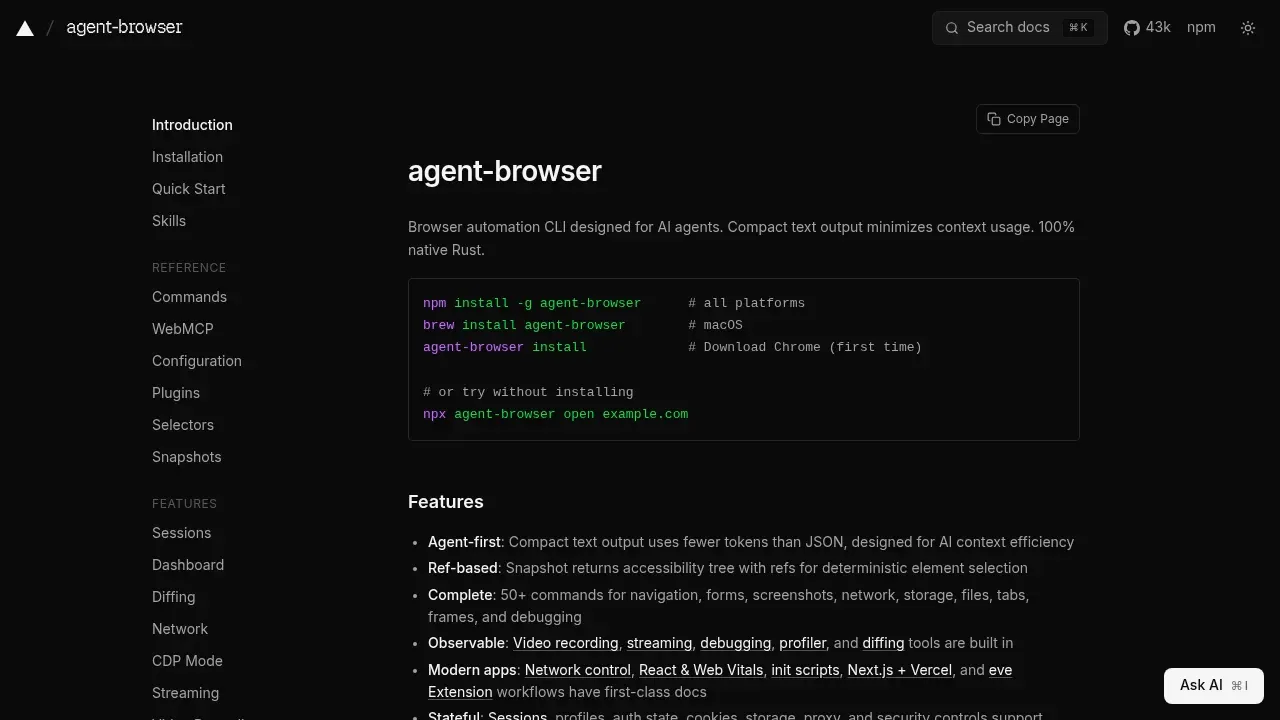
agent-browser gives AI agents a compact text view of a browser page, with references that identify the exact elements they can interact with. It's for developers who want coding assistants or other agents to use websites without filling their context with a full page's HTML. The open source tool runs locally on macOS, Linux and Windows under the Apache 2.0 license.
Agents can follow links, fill forms, manage tabs and interact with local PDFs or HTML files. Screenshots, video recording and streaming let you inspect what the browser does, while network controls, profiling and page comparisons support testing and debugging. Sessions and saved authentication state help agents continue work across browser interactions.
It works with Claude Code, Cursor, GitHub Copilot, OpenAI Codex, Google Gemini and opencode, as well as any agent that can execute shell commands. Its Rust runtime controls Chrome directly without requiring Node.js or Playwright for the daemon. Chrome is the default browser; it also supports Lightpanda and Mobile Safari in the iOS Simulator, which requires macOS and Xcode. Browser provider plugins can connect it to cloud browsers instead of a local browser.
Optional security controls include an encrypted local credential vault that keeps passwords out of the LLM's context, domain restrictions and policies that gate destructive actions. Page output can carry boundary markers to help agents distinguish website content from tool output. Plugins can add credential providers, browser providers and domain-specific commands.
Claim this page with an email at agent-browser.dev. agent-browser gets the verified badge, and you can upgrade the listing to be featured on localhosted. Proud to be listed? Put our badge on your site.
Want more people to find agent-browser?Promote it
Something wrong or outdated on this page?
886Updated 2 weeks agoMIT
macOS · Windows · Linux · Docker · Web#Agent Skills#Code execution#Guardrails
PocketPaw is a self-hosted AI agent for people who want a personal assistant that can work with files, write code and use a browser on their own computer or server. It runs on macOS, Windows and Linux, with a web dashboard and access through messaging apps. It is open source under the MIT license.
12.4KUpdated 4 weeks agoApache-2.0
macOS · Windows · Linux#Code execution#Multimodal input#Tool calling
27.3KUpdated 20 hours agoMIT
macOS · Windows · Linux#Code execution#MCP#Tool calling
17.5KUpdated 1 day agoMIT
macOS · Windows · Linux · Web#Persistent memory#Tool calling
Leon is a self-hosted personal AI assistant for Linux, macOS and Windows. The project focuses on the 2.0 Developer Preview on its develop branch. Its MIT-licensed runtime combines tools, context and memory with a local web interface.
68.5KUpdated 3 days agoApache-2.0
macOS · Windows · Linux#Agent Client Protocol#Code execution#Human approval
1.8KUpdated 2 weeks agoMIT
macOS · Windows · Linux#Human approval#Tool calling
Agent S is an open-source AI agent framework that controls ordinary desktop and web applications through the screen, mouse and keyboard. It runs on macOS, Windows and Linux and is aimed at developers, computer-use researchers and people building automation for their own desktops. You describe the task in natural language; the agent clicks, types and scrolls without requiring an API integration or a separate script for each application.
Cua gives AI agents access to computers they can inspect and operate, with tools for desktop automation, local virtual machines, and hosted fleets. It's for developers building agents that work across native apps and browsers, or evaluating how well those agents complete computer tasks. You bring the agent and model.
Open Interpreter is a terminal coding assistant built around open-weight models, with model-specific behavior for Kimi, Qwen and DeepSeek. It's a fork of OpenAI's Codex for developers who want to choose their model provider while keeping a familiar agent interface. The project uses the Apache 2.0 license.
OpenAdapt turns a demonstrated task into a repeatable program for browser, desktop, and remote applications. Its local, MIT-licensed open-source engine is for teams and AI agent builders who need to automate work in interfaces their APIs can't reach. It checks the outcome independently before reporting success and stops when verification fails.