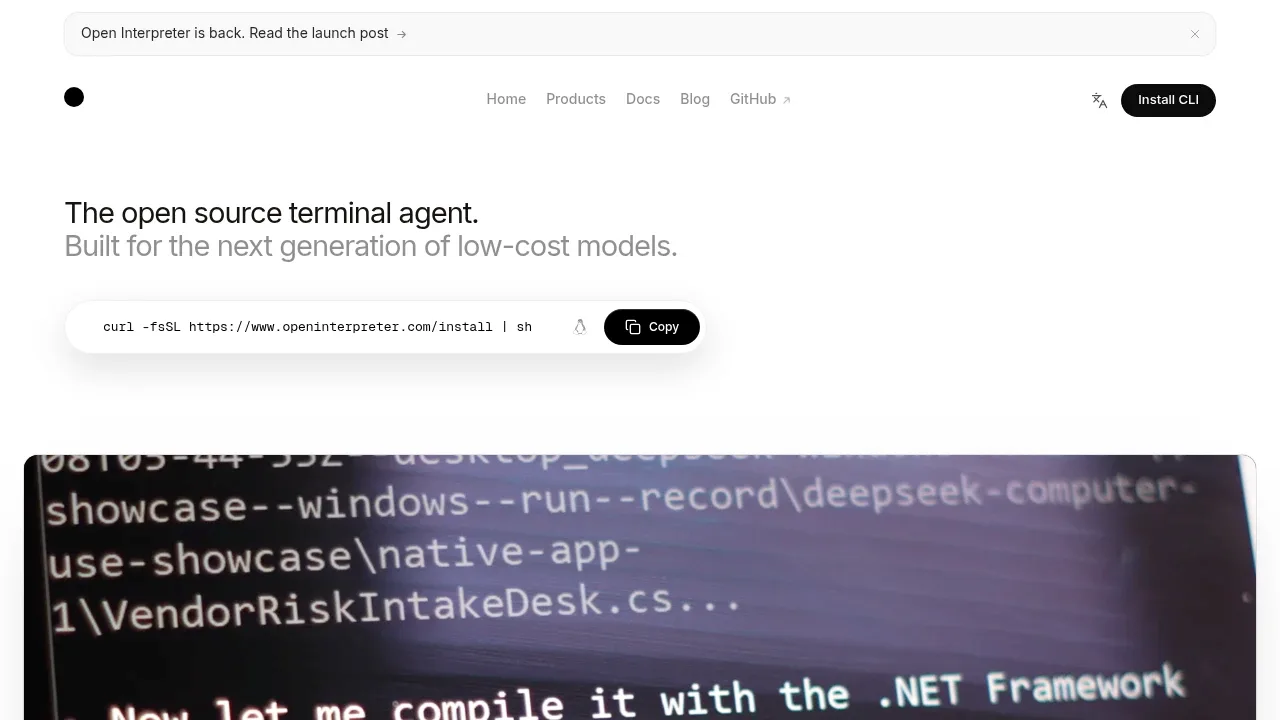
Open Interpreter is a terminal coding assistant built around open-weight models, with model-specific behavior for Kimi, Qwen and DeepSeek. It's a fork of OpenAI's Codex for developers who want to choose their model provider while keeping a familiar agent interface. The project uses the Apache 2.0 license.
The agent reads project files, edits code and runs commands on macOS, Linux and Windows. Its OS-level sandbox controls file access and network use, with approval requests when an action needs broader permissions. A built-in QA skill can test web interfaces in a real browser through agent-browser and native apps through trycua.
Local models connect through Ollama or LM Studio and stay on your machine. Cloud options include OpenAI, Amazon Bedrock, Anthropic and OpenRouter, alongside providers for Kimi, Qwen and DeepSeek. With your own API key, requests go directly to the provider. Requests using its hosted model service pass through Open Interpreter's servers and are logged for up to 30 days.
Existing AGENTS.md instructions, shared skills and MCP servers carry over. ACP support lets the agent work in compatible editors, and Codex SDK compatibility lets developers retain existing integrations. Separate coding sessions can resume or fork earlier work.
Claim this page with an email at openinterpreter.com. Open Interpreter gets the verified badge, and you can upgrade the listing to be featured on localhosted. Proud to be listed? Put our badge on your site.
Want more people to find Open Interpreter?Promote it
Something wrong or outdated on this page?
4.4KUpdated 19 hours agoMIT
macOS · Windows · Linux · Web · JetBrains#Agent Client Protocol#Code execution#Git integration
gptme is a self-hosted AI agent that works directly in your terminal, with access to your files and installed tools. It's for developers who want a coding assistant in their own environment, and people who want an agent for data analysis or other knowledge work. The software is free under the MIT license and doesn't require a gptme account.
49.3KUpdated 4 months agoApache-2.0
macOS · Windows · Linux#Code execution#Git integration#Multimodal input
42Updated 12 hours ago
macOS · Windows · Linux · Docker#Agent Skills#Code execution#Distributed execution
127.2KUpdated 24 hours agoApache-2.0
macOS · Windows · Linux#Code execution#Git integration#Human approval
28.4KUpdated 1 day ago
macOS · Windows · Linux · Android#llama.cpp backend#LM Studio integration#MCP
Crush is a terminal AI coding assistant for developers who want to work with their code and tools through a model they choose. The app runs on your machine, while model requests go to your selected local backend or cloud provider. It supports macOS, Linux, Windows (PowerShell and WSL), Android, FreeBSD, OpenBSD and NetBSD.
27.3KUpdated 20 hours agoMIT
macOS · Windows · Linux#Code execution#MCP#Tool calling
Aider is an Apache 2.0 open-source coding assistant for developers who work in a terminal and keep their projects in Git. It can help start a project or make changes to an existing codebase. You can use local LLMs or connect to cloud models from providers including Anthropic, DeepSeek and OpenAI.
Code Buddy is an AI coding assistant for developers who want a terminal agent running on their own machine, with a choice of local or cloud models. It reads repositories, edits code and runs commands on Linux, macOS and Windows. Ollama keeps model inference local without an API key or account; cloud providers send model requests off the machine. Routing includes automatic provider failover.
Codex CLI is an open source coding assistant that runs on your computer and works with local repositories. It's for developers who want to explore code, make changes, and use their existing development tools from the terminal. It runs on macOS, Windows, and Linux under the Apache 2.0 license.
Cua gives AI agents access to computers they can inspect and operate, with tools for desktop automation, local virtual machines, and hosted fleets. It's for developers building agents that work across native apps and browsers, or evaluating how well those agents complete computer tasks. You bring the agent and model.