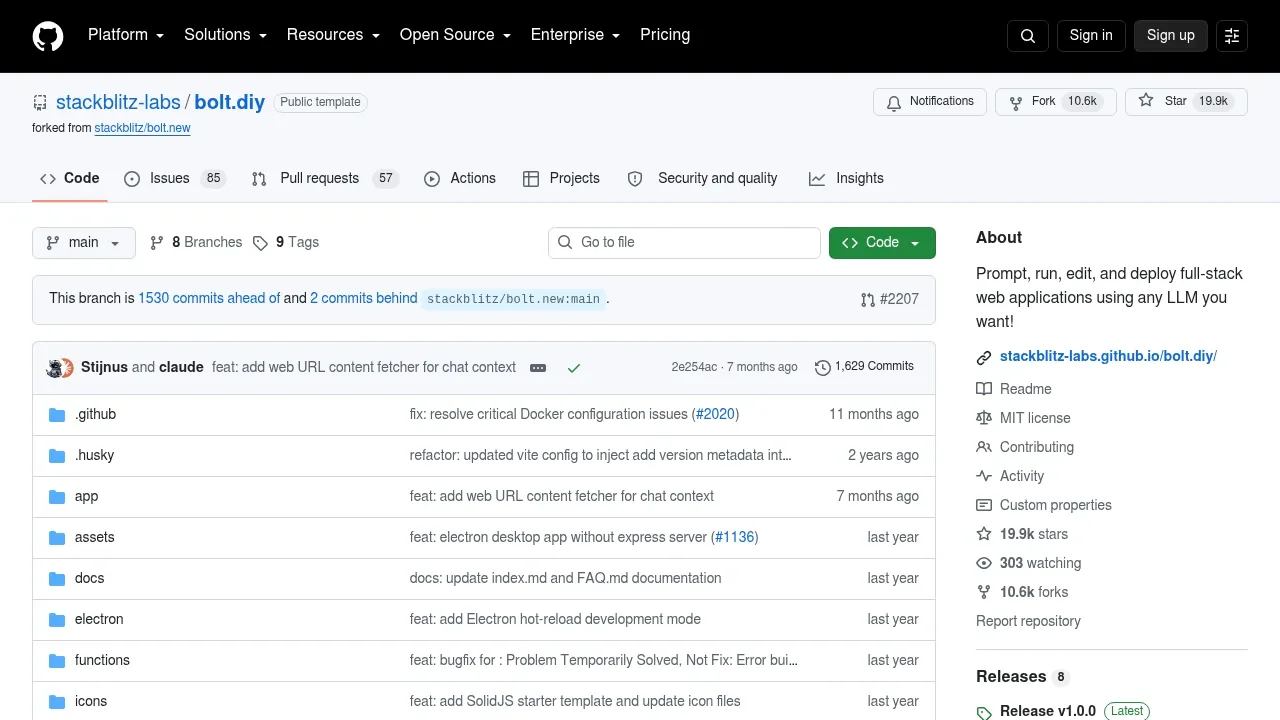
Bolt.diy is a self-hosted AI coding assistant for people building full-stack Node.js web apps who want to choose their own model provider. It's a fork of Bolt.new, with a browser workspace and an Electron desktop app for macOS, Windows, and Linux. You can also run it through Docker.
You choose the model. Ollama and LM Studio let it use models running locally, while OpenAI-compatible endpoints support other backends. Cloud choices include Anthropic, OpenAI, Gemini, and OpenRouter. The app can run on your machine, but choosing a cloud provider sends model requests to that service and requires its API credentials.
The workspace combines AI code generation with editing, an integrated terminal, and codebase search. Image attachments and voice prompts give you alternatives to text input. A diff view shows the AI's edits, file locking protects selected files during generation, and version restoration lets you return to earlier code. Git import, ZIP downloads, and host-folder syncing let you work with projects outside the app.
Supabase integration covers database management and queries, and MCP connects the assistant to additional tools. It also supports Expo projects for React Native apps and deployment to Netlify, Vercel, or GitHub Pages. The source is open source under MIT, but its WebContainer API requires a commercial license for production use in a for-profit setting; prototypes and proofs of concept don't require that license.
Claim this page with an email at bolt.diy. Bolt.diy gets the verified badge, and you can upgrade the listing to be featured on localhosted. Proud to be listed? Put our badge on your site.
Want more people to find Bolt.diy?Promote it
Something wrong or outdated on this page?
26.8KUpdated 2 months agoApache-2.0
Web#Code execution#Git integration#Multimodal input
Onlook is a visual code editor for designers who want to work directly on a website rather than hand off a separate mockup. It uses the actual app code as the design source, so visual edits change the product itself. The Apache 2.0 project can run locally or be self-hosted; Onlook also offers a hosted cloud product.
91.1KUpdated 20 hours ago
macOS · Windows · Linux#Agent Client Protocol#llama.cpp backend#LM Studio integration
22.6KUpdated 3 months agoApache-2.0
macOS · Docker · Web#Ollama integration#OpenAI-compatible API
21.6KUpdated 2 days ago
macOS · Windows#LM Studio integration#MCP#Ollama integration
70.7KUpdated 8 months agoMIT
Windows · Docker#Code execution#Multi-agent workflows#Ollama integration
55.1KUpdated 2 years agoMIT
Windows · Docker#Code execution#Multimodal input
Zed is a native code editor for developers who want AI coding assistance and collaboration in the same desktop app. It runs on macOS, Linux, and Windows, with a minimal interface and a focus on responsive editing. Its AI agents can work in parallel on tasks that involve editing files, exploring code, and running tools.
OpenUI is a self-hosted AI UI builder for developers prototyping web interfaces with models they choose. It turns plain-language descriptions into rendered interfaces, with a live preview and follow-up requests for changes. You can run the app locally through Docker or Python and use it in your browser.
Dyad turns a written idea into a working web app on your desktop. It's for people who want to build without starting from code, as well as developers who want to keep control of the result. The app requires no sign-up and runs on macOS and Windows. Your project files stay on your machine.
MetaGPT organizes AI agents into a software development team, with roles for product management, architecture, project management and engineering. It's a self-hosted Python framework for developers who want to generate software projects from plain-language requirements or build their own collaborative agents.
gpt-engineer is a locally run coding assistant for developers who want to experiment with AI code generation and build their own agents. It can create software from plain-language descriptions or make requested changes to an existing codebase. The project is archived and no longer maintained. Its Python code is open source under the MIT license.