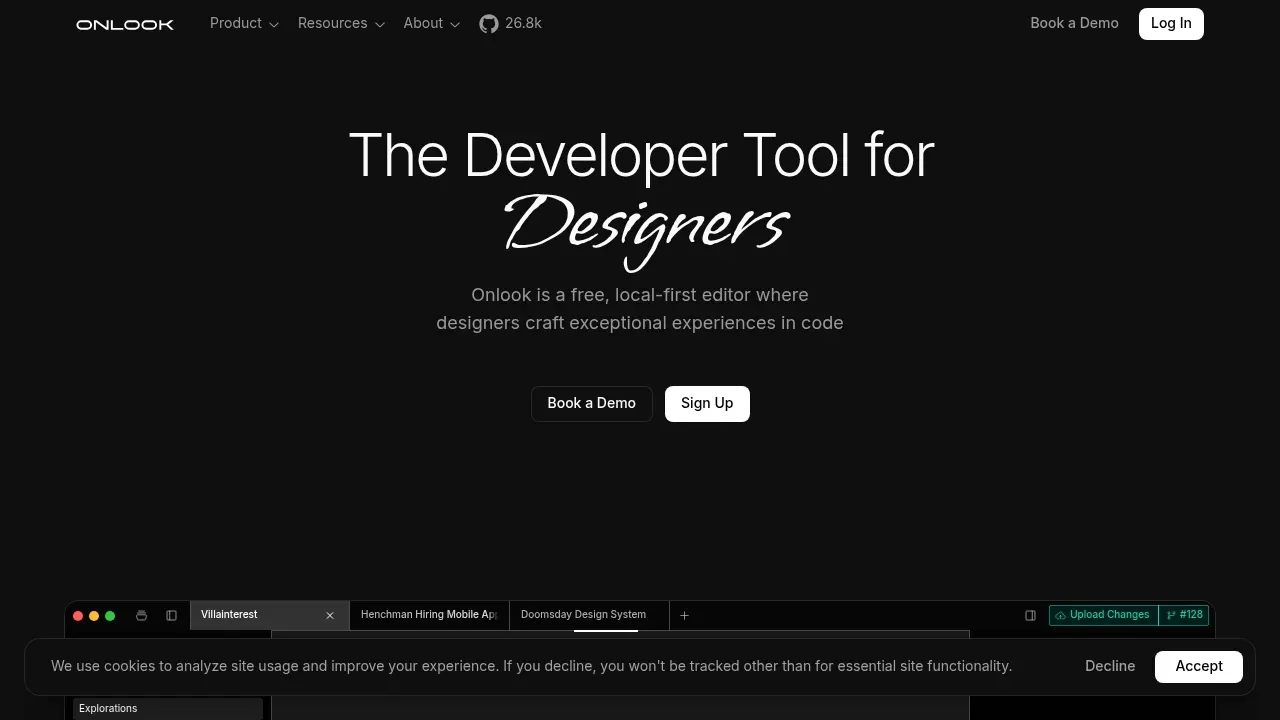
Onlook is a visual code editor for designers who want to work directly on a website rather than hand off a separate mockup. It uses the actual app code as the design source, so visual edits change the product itself. The Apache 2.0 project can run locally or be self-hosted; Onlook also offers a hosted cloud product.
The editor combines an infinite canvas, a live app preview and AI chat. You can rearrange and resize elements visually, adjust styling, and ask the AI to create pages or edit existing code. It supports importing React codebases, with the open-source editor focused on Next.js and Tailwind CSS. You can also start a website from text, an image or a template.
For teams with an existing design system, Onlook can manage brand fonts, colors and styles. Layers and page views help you select elements and work across a site, while image management keeps project assets in the editor. Branching lets you try design alternatives, and revision history and checkpoints let you restore earlier work.
Local hosting doesn't make the AI fully offline: the listed AI services include OpenRouter, Morph Fast Apply and Relace. The AI has access to project code to understand and edit it. You own the code you create and can export it to your machine, publish it to GitHub or host the site with a custom domain.
Claim this page with an email at onlook.com. Onlook gets the verified badge, and you can upgrade the listing to be featured on localhosted. Proud to be listed? Put our badge on your site.
Want more people to find Onlook?Promote it
Something wrong or outdated on this page?
19.9KUpdated 8 months agoMIT
macOS · Windows · Linux · Docker · Web#Code execution#Git integration#LM Studio integration
Bolt.diy is a self-hosted AI coding assistant for people building full-stack Node.js web apps who want to choose their own model provider. It's a fork of Bolt.new, with a browser workspace and an Electron desktop app for macOS, Windows, and Linux. You can also run it through Docker.
544Updated 14 hours agoMIT
macOS · iOS · Web#Code execution#Distributed execution#Hugging Face integration
Pooled runs a single open model across browser tabs on laptops, desktops and phones, combining their memory when the model won't fit on one device. It's for people who want local AI chat or a coding assistant using hardware they already have. It's open source under the MIT license and requires no account or per-device installation.
7.1KUpdated 2 weeks agoMIT
Web#Code execution
LlamaCoder generates small apps from a single prompt and previews them in your browser. It's an open-source alternative to Claude Artifacts for people who want to turn an idea into an app, with a MIT license that lets them run and modify the code themselves.
73.1KUpdated 1 day ago
iOS · Android · Docker · Web#Multi-user access
AFFiNE is a local-first knowledge workspace for individuals and teams who want documents and visual planning in the same place. It combines a block editor, an edgeless whiteboard and databases, making it an alternative to Notion and Miro for team wikis, project plans and connected notes.
22.6KUpdated 3 months agoApache-2.0
macOS · Docker · Web#Ollama integration#OpenAI-compatible API
OpenUI is a self-hosted AI UI builder for developers prototyping web interfaces with models they choose. It turns plain-language descriptions into rendered interfaces, with a live preview and follow-up requests for changes. You can run the app locally through Docker or Python and use it in your browser.
55.1KUpdated 2 years agoMIT
Windows · Docker#Code execution#Multimodal input
gpt-engineer is a locally run coding assistant for developers who want to experiment with AI code generation and build their own agents. It can create software from plain-language descriptions or make requested changes to an existing codebase. The project is archived and no longer maintained. Its Python code is open source under the MIT license.