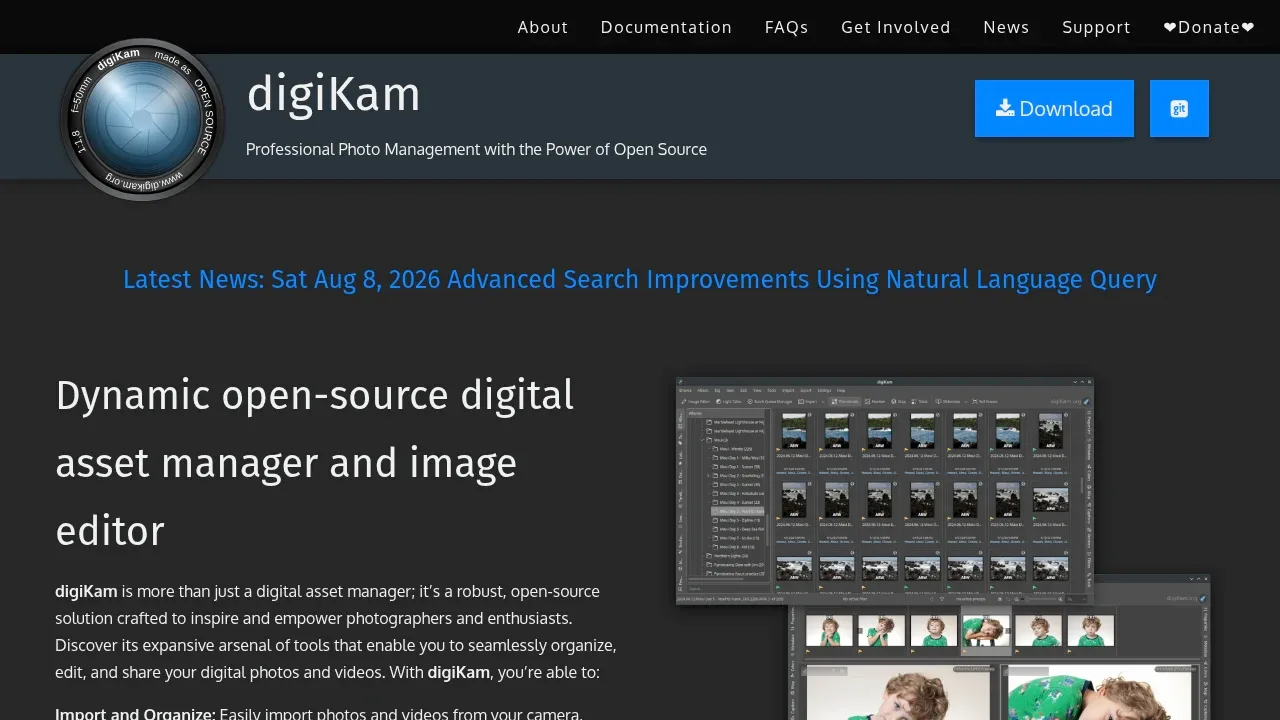
digiKam is a local photo manager and image editor for photographers who need to organize large collections of photos, RAW files and videos. It runs on Linux, Windows and macOS and is open-source software under GPL-2.0. Its archived GitHub mirror points contributors to the maintained KDE repository.
Albums, tags, ratings and labels help you sort collections, while face detection and recognition let you group photos by person. AI features enrich image metadata with tags and ratings. Searches can use date, location, camera properties and EXIF, IPTC or XMP metadata. The announced local-LLM natural language search is described in the official project update as a development feature for the 9.2.0 release. You can combine criteria or find photos on an interactive map.
The editor covers color correction, cropping, sharpening and retouching, plus curves, panorama stitching and automatic lens correction through Lensfun. LibRaw handles RAW decoding. Batch processing applies edits and adjustments across multiple images, and you can access external editing tools from your collection.
Collections can live on your computer, removable drives or network storage; the database can reside locally or on a remote server. That gives you a choice of where to keep your library. Export tools send selected images to social networks and cloud services, and digiKam can also create slideshows and web galleries. Auto-tagging uses local neural-network object recognition; network exports and any separately configured AI services have their own data paths.
Claim this page with an email at digikam.org. digiKam gets the verified badge, and you can upgrade the listing to be featured on localhosted. Proud to be listed? Put our badge on your site.
Want more people to find digiKam?Promote it
Something wrong or outdated on this page?
picapport.deAI Photo Libraries
macOS · Windows · Linux · Docker · Web#Batch processing#Multi-user access#Role-based access
PicApport is a self-hosted photo server for families and businesses that want a searchable media archive on their own hardware. Its AI tagging add-on recognizes image content without sending photos to a cloud service and saves the resulting tags in image metadata. The server runs on Windows, Linux or macOS, with a Docker image available, and you access the gallery through a browser.
89Updated 22 hours agoGPL-3.0
macOS · Windows · Linux · Docker · Web#Batch processing#Hugging Face integration#ONNX
PixlStash is an open-source image manager for photographers, AI creators and people curating image datasets. It combines library search with tools for reviewing tags, ranking images and sending selected work through ComfyUI. You can use a desktop app or a self-hosted server with a browser interface.
29.2KUpdated 1 day agoAGPL-3.0
macOS · Windows · Linux · iOS · Android · Web#Multi-user access#Role-based access#Semantic search
1.2KUpdated 3 months agoMIT
macOS · Windows · Linux · Docker · Web#Semantic search
HomeGallery is a self-hosted web gallery for people who want to browse their personal photos and videos while keeping their existing files and folders. It brings multiple media directories into one gallery, with a mobile-friendly browser interface and PWA support. It's open source under MIT.
40.3KUpdated 20 hours ago
macOS · Windows · Linux · Docker · Web
PhotoPrism is a self-hosted photo and video library for people who want to organize personal media on their own hardware or server. Its AI recognizes faces and labels pictures by content and location, so finding a photo doesn't depend entirely on folders or tags you've added yourself. You browse and share the library through a web app.
7.3KUpdated 1 week agoApache-2.0
macOS · Windows · Linux · Docker · Web#ControlNet#Image-to-image#Inpainting
Ente Photos is a Google Photos alternative for people who want encrypted photo backups and AI search without giving a storage provider access to their library. You can use its hosted service or self-host the server. Face detection, grouping and natural-language search run on your device; the hosted service stores your encrypted backups.
SD.Next is a self-hosted web interface for artists, researchers and people who want to generate and edit images or videos on their own hardware. It builds on Automatic1111 WebUI's original codebase and supports Stable Diffusion alongside other diffusion models. It's open source under Apache 2.0.