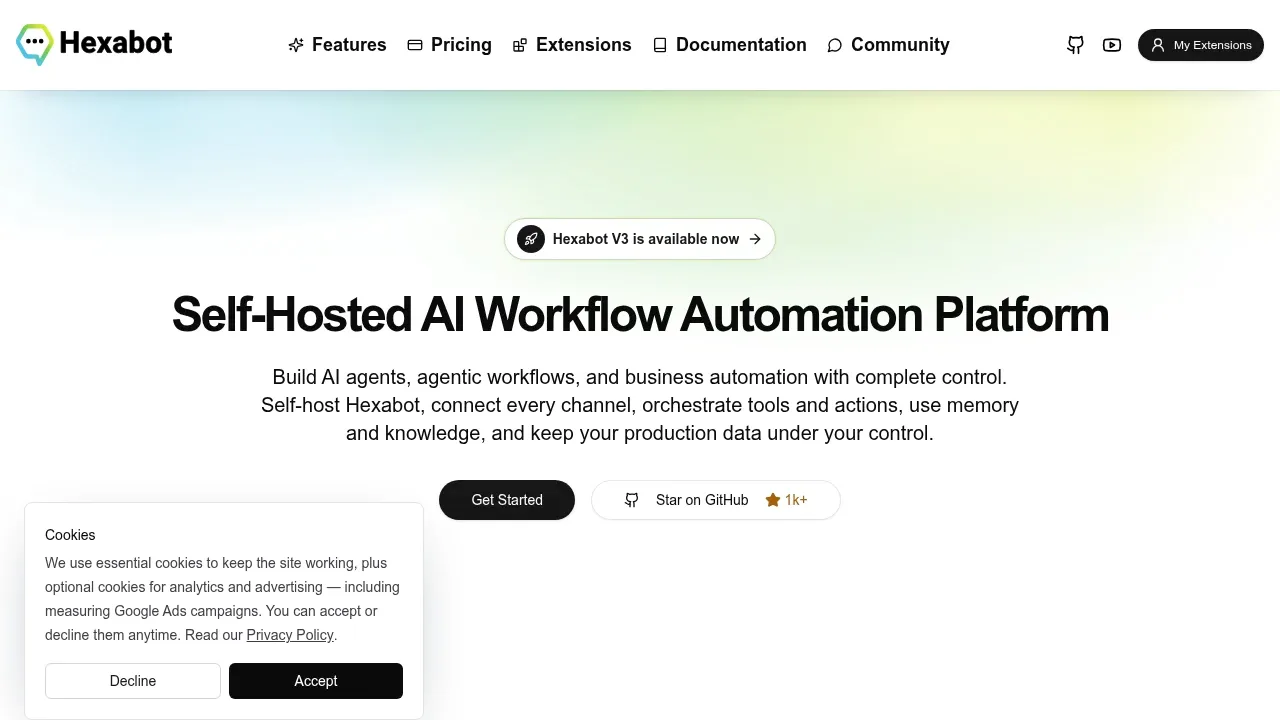
Hexabot is a self-hosted AI workflow automation platform for teams building customer service assistants and business automations. It connects conversations to actions across websites, messaging platforms, social channels and custom entry points. You can run it on-premise or in your own cloud, with workflows, memory and customer data in infrastructure you control.
Workflows can start from chat, forms, schedules or events, then call language models, APIs, tools and back-office systems. A visual graph editor and portable YAML definitions give teams two ways to describe the same flows. Reusable actions and schema-validated contracts help developers connect external systems and keep workflow inputs and outputs consistent.
Memory and retrieval-augmented generation give agents context, while MCP integration points connect them to tools. Conditions and loops support more involved workflows. When a conversation needs human judgment, support staff can take over through inbox workflows and live handoff. Multilingual assistants can serve customers across channels from a shared runtime.
Developers can extend Hexabot with custom actions, channels and helpers. The local data layer uses SQLite by default, with Postgres support for production deployments; Docker is optional for Docker-based services.
Hexabot is source-available under the Fair Core License 1.0 with an ALv2 Future License. The full codebase is available to inspect and extend.
Claim this page with an email at hexabot.ai. Hexabot gets the verified badge, and you can upgrade the listing to be featured on localhosted. Proud to be listed? Put our badge on your site.
Want more people to find Hexabot?Promote it
Something wrong or outdated on this page?
55.5KUpdated 2 months ago
Docker · Web#Human approval#LLM tracing#Multi-agent workflows
Flowise is a visual builder for AI agents and chatbots that can run locally or on your own server, including through Docker. It's for developers and teams building LLM applications with connected workflow blocks. The project is archived and no longer maintained.
22.9KUpdated 3 days agoGPL-3.0
Docker · Web#MCP#Multimodal input#RAG
24.8KUpdated 1 day ago
Docker · Web#Code execution#Human approval#MCP
12KUpdated 1 week agoApache-2.0
Docker · Web#Batch processing#Human approval#Multi-agent workflows
34.4KUpdated 2 months agoApache-2.0
macOS · Windows · Linux · Docker · Web#Batch processing#Human approval#MCP
157.6KUpdated 3 hours ago
Docker · Web#Code execution#MCP#OpenAI-compatible API
MaxKB is a self-hosted AI agent platform for organizations building customer support bots, internal knowledge assistants and business automation. It combines answers grounded in company documents with workflows that can call functions and MCP tools. You can run it on your own server through Docker and use it through a browser.
Activepieces brings AI agents and workflow automation into one workspace for teams that need to connect their apps and internal data. It runs on your own servers with Docker or Kubernetes, or as a managed cloud service. An isolated deployment can keep platform data on its own infrastructure; connected apps and model providers may still require external access. Its core and app integration pieces are MIT-licensed.
Bisheng is an open source, self-hosted platform for teams building AI applications around business documents and processes. Its visual workflow editor combines automated tasks with human feedback, including intervention during multi-turn conversations. It's suited to document review, support ticket assistance and report generation that need more control than a single chatbot exchange.
ChatDev is a self-hosted platform for building teams of AI agents through a visual workflow editor. It's for people who want agents to collaborate on research, data analysis or software projects without writing the orchestration code themselves. You define each agent's role and how information passes between them.
Dify is a source-available platform for teams building AI agents and apps on a visual canvas. Its Community Edition runs on your own server with Docker. Dify also offers a hosted cloud service, while Enterprise deployments can run in a VPC or on a self-hosted server. The Community Edition uses a custom Apache 2.0 derivative license.