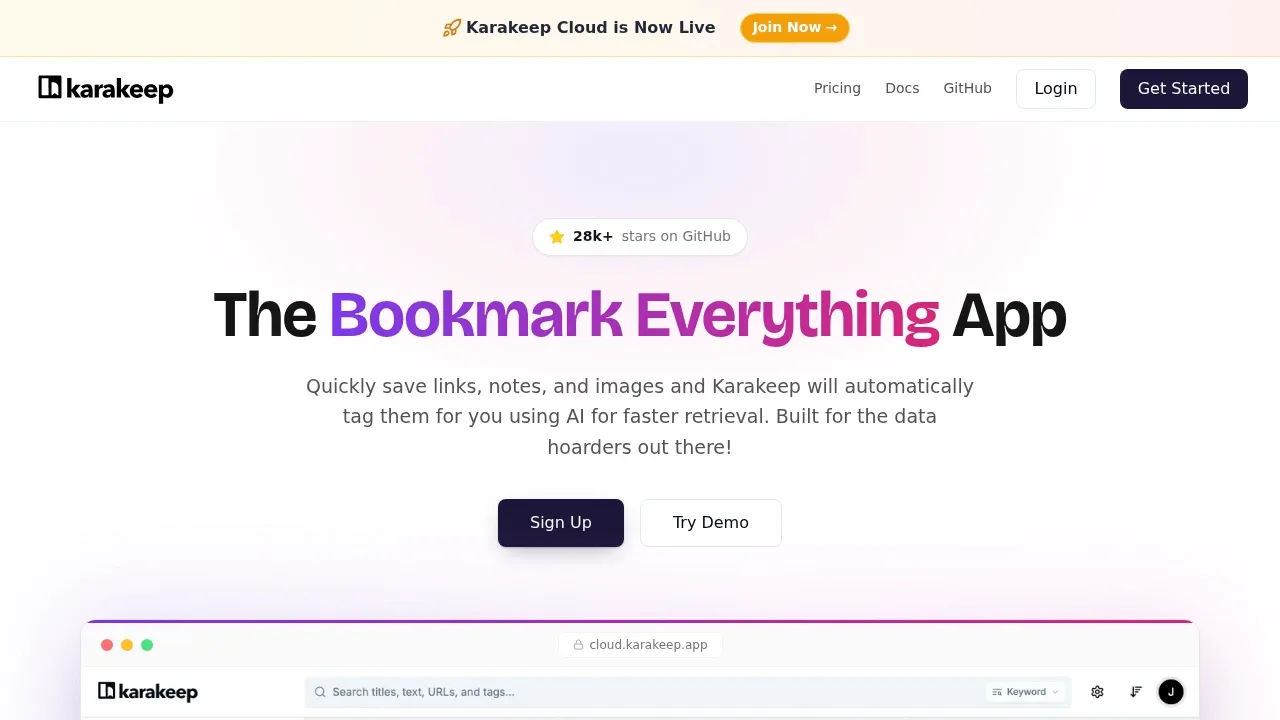
Karakeep is a bookmark manager for people who collect links, notes, images and PDFs in one place. You can run the open source app on your own server with Docker under the AGPL-3.0 license, or use the managed Karakeep Cloud service. It has a web app, iOS and Android apps, and extensions for Chrome, Firefox and Safari.
Saved links get titles, descriptions and images, so a collection remains recognizable later. Full-page archives preserve pages if the original links disappear. You can search saved content by keyword or meaning, and OCR makes text in images and screenshots searchable. Mobile reading works offline.
AI can tag and summarize what you save. Karakeep supports local models through Ollama for those features. Lists and custom rules help organize a growing collection, while RSS subscriptions can save new posts automatically. The reader view supports highlights, and shared lists let other people contribute or browse as viewers.
For people who want their bookmarks in other workflows, Karakeep has a CLI, an MCP server and an API that returns saved pages as markdown. The API supports keys with separate read and write permissions. It can import bookmarks from Chrome, Pocket, Linkwarden, Omnivore and Tab Session Manager, and sync browser bookmarks through floccus.
Claim this page with an email at karakeep.app. Karakeep gets the verified badge, and you can upgrade the listing to be featured on localhosted. Proud to be listed? Put our badge on your site.
Want more people to find Karakeep?Promote it
Something wrong or outdated on this page?
perfectmemory.aiAI Notes and Knowledge Bases
macOS · Windows#LM Studio integration#MCP#Ollama integration
Perfect Memory AI keeps a searchable record of what you've seen on your screen and heard in meetings on Mac and Windows. It's for people who need to find a page, presentation or conversation again without remembering which app held it. Recordings stay on your device, and search returns material you've actually seen or heard.
77KUpdated 3 months agoAGPL-3.0
macOS · Windows · Linux · iOS · Android · Web#MCP#Multi-user access#RAG
32.3KUpdated 24 hours ago
Docker · Web · Browser Extension#MCP#Multi-user access#Ollama integration
31.2KUpdated 21 hours agoApache-2.0
Docker · Web#Knowledge graphs#MCP#Multi-user access
9.1KUpdated 21 hours agoMIT
macOS · Windows · Linux · Docker · Web#llama.cpp backend#MCP#Multi-user access
29.8KUpdated 4 days agoApache-2.0
Docker · Web#MCP#Multi-agent workflows#Ollama integration
AppFlowy is a self-hosted Notion alternative for teams that want project management, shared documents, and AI in an environment they control. Its self-hosted enterprise offering can run on premises, in your own cloud, or in an air-gapped environment. Self-hosted LLMs and embedding models let you keep AI processing and workspace data inside your infrastructure, with no vendor access to your instance.
Onyx is an AI search and chat platform for teams whose information is spread across workplace apps. It indexes company knowledge so employees can ask questions across sources and get answers grounded in relevant documents. Teams can deploy it in their own cloud or on bare metal, including an air-gapped environment.
Cognee gives AI agents persistent memory across sessions, connecting documents, code, and conversations in a searchable knowledge graph. It's for developers who want agents to retain project context and teams whose knowledge sits across tickets, discussions, and repositories. The Python package is open source under Apache 2.0.
Local Deep Research is a self-hosted AI research assistant for people who need cited answers drawn from academic papers, the web and their own documents. It can produce a quick summary or pursue a complex question through repeated searches, then assemble a structured report. It's open source under MIT.
GPT Researcher is a self-hosted AI research agent for people who need detailed, cited reports drawn from the web, their own documents, or both. You choose the language model and search provider, and can run the software on your own server or through Docker. It's open source under Apache 2.0.