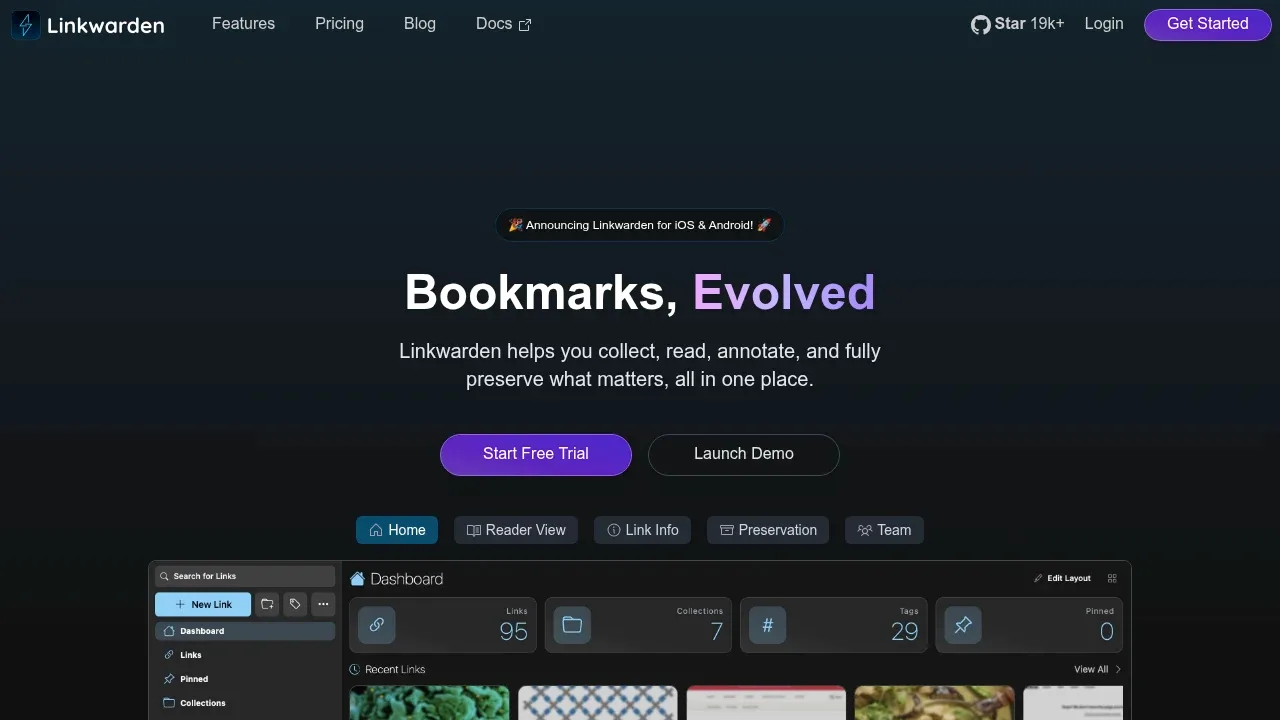
Linkwarden is a self-hosted bookmark manager for people and teams who want to keep the pages behind their saved links. It archives webpages as HTML, screenshots, and PDFs, so you can revisit the content even if the original site removes it. It's useful for research, shared reference collections, and articles you want to read later.
The reader view lets you adjust fonts, highlight passages, and add notes. Collections and sub-collections keep related material together, while full-text search and filters help you find saved content. Optional local AI tagging assigns tags based on a page's content, reducing the work of organizing a growing archive.
You can invite others to contribute to collections, set each member's permissions, or publish collections and their archived pages for public access. RSS subscriptions bring feed entries into collections alongside saved webpages. Linkwarden also accepts image and PDF uploads.
A browser extension captures pages, and Floccus syncs browser bookmarks. Import and export support helps you move an existing collection in or take it elsewhere. Native iOS and Android apps require a Linkwarden account; there's also an installable web app.
The open-source software uses the AGPL-3.0 license and can be self-hosted on your own server, where you keep the bookmark collection and archives. The Linkwarden Cloud service hosts the instance for you. You can optionally send pages to the external Wayback Machine for another archive copy.
Claim this page with an email at linkwarden.app. Linkwarden gets the verified badge, and you can upgrade the listing to be featured on localhosted. Proud to be listed? Put our badge on your site.
Want more people to find Linkwarden?Promote it
Something wrong or outdated on this page?
29.4KUpdated 4 days agoAGPL-3.0
iOS · Android · Docker · Web · Browser Extension#MCP#Multi-user access#Ollama integration
Karakeep is a bookmark manager for people who collect links, notes, images and PDFs in one place. You can run the open source app on your own server with Docker under the AGPL-3.0 license, or use the managed Karakeep Cloud service. It has a web app, iOS and Android apps, and extensions for Chrome, Firefox and Safari.
77KUpdated 3 months agoAGPL-3.0
macOS · Windows · Linux · iOS · Android · Web#MCP#Multi-user access#RAG
73.1KUpdated 1 day ago
iOS · Android · Docker · Web#Multi-user access
AFFiNE is a local-first knowledge workspace for individuals and teams who want documents and visual planning in the same place. It combines a block editor, an edgeless whiteboard and databases, making it an alternative to Notion and Miro for team wikis, project plans and connected notes.
45.1KUpdated 1 day agoAGPL-3.0
Linux · iOS · Android · Web
Logseq is an AGPL-3.0 knowledge base with an outline editor, linked references and block references. It combines note-taking with task management, PDF annotations and flashcards. Search and queries can gather related information into tables.
46.6KUpdated 2 days agoAGPL-3.0
Windows · Linux · iOS · Android · Docker · Web
SiYuan is a local-first, self-hosted knowledge workspace for people who want linked notes, research material and AI writing tools in one place. Its block references let you connect individual passages rather than whole documents, with bidirectional links to follow those connections. It's open source under AGPL-3.0.
31.2KUpdated 21 hours agoApache-2.0
Docker · Web#Knowledge graphs#MCP#Multi-user access
AppFlowy is a self-hosted Notion alternative for teams that want project management, shared documents, and AI in an environment they control. Its self-hosted enterprise offering can run on premises, in your own cloud, or in an air-gapped environment. Self-hosted LLMs and embedding models let you keep AI processing and workspace data inside your infrastructure, with no vendor access to your instance.
Cognee gives AI agents persistent memory across sessions, connecting documents, code, and conversations in a searchable knowledge graph. It's for developers who want agents to retain project context and teams whose knowledge sits across tickets, discussions, and repositories. The Python package is open source under Apache 2.0.